
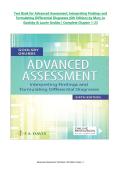
Test Bank for Advanced Assessment: Interpreting Findings and
Formulating Differential Diagnoses (6th Edition) by Mary Jo
Goolsby & Laurie Grubbs | Complete Chapter 1-23
Advanced Assessment Test Bank • 6th Edition Topics • 1
,ADVANCED ASSESSMENT
Interpreting Findings and Formulating Differential Diagnoses
6th Edition — Test Bank
Table of Contents
Chapter 1. Clinical Decision Making: Assessment and Differential Diagnosis
Chapter 2. Diagnostic Studies
Chapter 3. Genomic Assessment: Interpreting Findings and Formulating Differential Diagnoses
Chapter 4. Skin
Chapter 5. Head, Face, and Neck
Chapter 6. The Eye
Chapter 7. Ear, Nose, Mouth, and Throat
Chapter 8. Cardiac and Peripheral Vascular Systems
Chapter 9. Respiratory System
Chapter 10. Breasts
Chapter 11. Abdomen
Chapter 12. Genitourinary System
Chapter 13. Male Reproductive System
Chapter 14. Female Reproductive System
Chapter 15. Musculoskeletal System
Chapter 16. Neurological System
Chapter 17. Nonspecific Complaints
Chapter 18. Psychiatric Mental Health
Chapter 19. Pediatric Patients
Chapter 20. Pregnant Patients
Chapter 21. Assessment of the Transgender or Gender Diverse Adult
Chapter 22. Older Patients
Chapter 23. Persons with Disabilities
Advanced Assessment Test Bank • 6th Edition Topics • 2
,Test Bank
Chapter 1. Clinical Decision Making: Assessment and
Differential Diagnosis
1. Which finding most directly supports the clinical concept of problem representation?
Use findings and context specific to problem representation to guide the assessment
A finding that is unrelated to the complaint
A finding caused only by treatment
A finding that excludes every alternative diagnosis
Answer: A
Rationale: The best answer is the finding that directly supports the stated clinical concept.
Differential diagnosis requires matching the patient's findings with the most relevant
hypotheses while considering alternatives.
2. During assessment, which action is most appropriate when evaluating hypothetico-
deductive reasoning?
Perform a focused assessment for hypothetico-deductive reasoning while considering
competing diagnoses
Order every available diagnostic test before examining the patient
Ignore contextual factors
Assume the most common diagnosis is always correct
Answer: A
Rationale: A focused history and examination should guide diagnostic evaluation. Broad,
unguided testing and premature assumptions can increase false-positive findings and
diagnostic error.
3. A patient presents with findings relevant to red flags. Which additional information
would be most useful?
Gather the history and examination features that help distinguish red flags from alternatives
An unrelated remote complaint
Only the patient's preferred treatment
A single isolated vital sign without context
Answer: A
Rationale: Timing, associated symptoms, and risk factors help distinguish competing
diagnoses and establish a useful problem representation.
Advanced Assessment Test Bank • 6th Edition Topics • 3
, 4. Which documentation best demonstrates appropriate assessment of chief complaint?
Document the relevant positives and negatives related to chief complaint and plan follow-
up
A vague statement that the examination was normal
Only the suspected diagnosis
Only the patient's chief complaint
Answer: A
Rationale: High-quality documentation separates subjective information from objective
findings and records relevant positives, negatives, clinical interpretation, and follow-up.
5. A clinician is considering history of present illness. Which principle should guide
differential diagnosis?
Rank history of present illness using likelihood, risk, and urgency
Consider only the rarest diagnosis
Exclude diagnoses before gathering evidence
Treat all possibilities as equally likely
Answer: A
Rationale: A useful differential balances likelihood with consequences of missing a serious or
time-sensitive condition.
6. Which finding most directly supports the clinical concept of open-ended questions?
Use findings and context specific to open-ended questions to guide the assessment
A finding that is unrelated to the complaint
A finding caused only by treatment
A finding that excludes every alternative diagnosis
Answer: A
Rationale: The best answer is the finding that directly supports the stated clinical concept.
Differential diagnosis requires matching the patient's findings with the most relevant
hypotheses while considering alternatives.
7. During assessment, which action is most appropriate when evaluating closed-ended
questions?
Perform a focused assessment for closed-ended questions while considering competing
diagnoses
Order every available diagnostic test before examining the patient
Ignore contextual factors
Assume the most common diagnosis is always correct
Advanced Assessment Test Bank • 6th Edition Topics • 4
Formulating Differential Diagnoses (6th Edition) by Mary Jo
Goolsby & Laurie Grubbs | Complete Chapter 1-23
Advanced Assessment Test Bank • 6th Edition Topics • 1
,ADVANCED ASSESSMENT
Interpreting Findings and Formulating Differential Diagnoses
6th Edition — Test Bank
Table of Contents
Chapter 1. Clinical Decision Making: Assessment and Differential Diagnosis
Chapter 2. Diagnostic Studies
Chapter 3. Genomic Assessment: Interpreting Findings and Formulating Differential Diagnoses
Chapter 4. Skin
Chapter 5. Head, Face, and Neck
Chapter 6. The Eye
Chapter 7. Ear, Nose, Mouth, and Throat
Chapter 8. Cardiac and Peripheral Vascular Systems
Chapter 9. Respiratory System
Chapter 10. Breasts
Chapter 11. Abdomen
Chapter 12. Genitourinary System
Chapter 13. Male Reproductive System
Chapter 14. Female Reproductive System
Chapter 15. Musculoskeletal System
Chapter 16. Neurological System
Chapter 17. Nonspecific Complaints
Chapter 18. Psychiatric Mental Health
Chapter 19. Pediatric Patients
Chapter 20. Pregnant Patients
Chapter 21. Assessment of the Transgender or Gender Diverse Adult
Chapter 22. Older Patients
Chapter 23. Persons with Disabilities
Advanced Assessment Test Bank • 6th Edition Topics • 2
,Test Bank
Chapter 1. Clinical Decision Making: Assessment and
Differential Diagnosis
1. Which finding most directly supports the clinical concept of problem representation?
Use findings and context specific to problem representation to guide the assessment
A finding that is unrelated to the complaint
A finding caused only by treatment
A finding that excludes every alternative diagnosis
Answer: A
Rationale: The best answer is the finding that directly supports the stated clinical concept.
Differential diagnosis requires matching the patient's findings with the most relevant
hypotheses while considering alternatives.
2. During assessment, which action is most appropriate when evaluating hypothetico-
deductive reasoning?
Perform a focused assessment for hypothetico-deductive reasoning while considering
competing diagnoses
Order every available diagnostic test before examining the patient
Ignore contextual factors
Assume the most common diagnosis is always correct
Answer: A
Rationale: A focused history and examination should guide diagnostic evaluation. Broad,
unguided testing and premature assumptions can increase false-positive findings and
diagnostic error.
3. A patient presents with findings relevant to red flags. Which additional information
would be most useful?
Gather the history and examination features that help distinguish red flags from alternatives
An unrelated remote complaint
Only the patient's preferred treatment
A single isolated vital sign without context
Answer: A
Rationale: Timing, associated symptoms, and risk factors help distinguish competing
diagnoses and establish a useful problem representation.
Advanced Assessment Test Bank • 6th Edition Topics • 3
, 4. Which documentation best demonstrates appropriate assessment of chief complaint?
Document the relevant positives and negatives related to chief complaint and plan follow-
up
A vague statement that the examination was normal
Only the suspected diagnosis
Only the patient's chief complaint
Answer: A
Rationale: High-quality documentation separates subjective information from objective
findings and records relevant positives, negatives, clinical interpretation, and follow-up.
5. A clinician is considering history of present illness. Which principle should guide
differential diagnosis?
Rank history of present illness using likelihood, risk, and urgency
Consider only the rarest diagnosis
Exclude diagnoses before gathering evidence
Treat all possibilities as equally likely
Answer: A
Rationale: A useful differential balances likelihood with consequences of missing a serious or
time-sensitive condition.
6. Which finding most directly supports the clinical concept of open-ended questions?
Use findings and context specific to open-ended questions to guide the assessment
A finding that is unrelated to the complaint
A finding caused only by treatment
A finding that excludes every alternative diagnosis
Answer: A
Rationale: The best answer is the finding that directly supports the stated clinical concept.
Differential diagnosis requires matching the patient's findings with the most relevant
hypotheses while considering alternatives.
7. During assessment, which action is most appropriate when evaluating closed-ended
questions?
Perform a focused assessment for closed-ended questions while considering competing
diagnoses
Order every available diagnostic test before examining the patient
Ignore contextual factors
Assume the most common diagnosis is always correct
Advanced Assessment Test Bank • 6th Edition Topics • 4


