
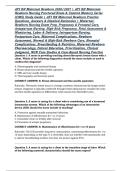
ATI RN Maternal Newborn 2026/2027 | ATI RN Maternal-
Newborn Nursing Proctored Exam & Content Mastery Series
(CMS) Study Guide | ATI RN Maternal Newborn Practice
Questions, Answers & Detailed Rationales | Maternal-
Newborn Nursing Exam Prep, Pregnancy & Prenatal Care,
Antepartum Nursing, High-Risk Pregnancy, Fetal Assessment &
Monitoring, Labor & Delivery, Intrapartum Nursing,
Postpartum Care, Maternal Complications, Newborn
Assessment, Normal & High-Risk Newborn Care, Neonatal
Complications, Breastfeeding & Nutrition, Maternal-Newborn
Pharmacology, Patient Education, Prioritization, Clinical
Judgment, NGN Case Studies & Case-Based Nursing Practice
Question 1: A nurse is providing teaching about fibrocystic breast tissue with a
client. Which of the following diagnostics should the nurse include as used to
confirm this diagnosis?
A. Mammography and excisional biopsy
B. Breast ultrasound and fine-needle aspiration
C. MRI and core needle biopsy
D. Thermography and hormone panel
CORRECT ANSWER: B. Breast ultrasound and fine-needle aspiration
Rationale: Fibrocystic breast tissue is a benign condition characterized by lumpy, tender
breasts. Diagnosis is typically confirmed through breast ultrasound to visualize the cysts
and fine-needle aspiration to differentiate solid masses from fluid-filled cysts .
Question 2: A nurse is caring for a client who is considering use of a hormonal
intrauterine system. Which of the following advantages of an intrauterine
device (IUD) should the nurse include in teaching?
A. Protection against sexually transmitted infections
B. Maintenance of effectiveness for 1 to 10 years
C. Immediate return to fertility after removal
D. Prevention of ectopic pregnancy
CORRECT ANSWER: B. Maintenance of effectiveness for 1 to 10 years
Rationale: The IUD provides long-term contraception, maintaining effectiveness for 1 to
10 years depending on the type. It is reversible, does not interfere with spontaneity, and
is safe for breastfeeding mothers, but does not protect against STIs .
Question 3: A nurse is caring for a client in the transition stage of labor. Which
of the following maternal characteristics should the nurse expect?
,A. Calm and cooperative behavior
B. Irritability and desire to push
C. Decreased intensity of contractions
D. First appearance of bloody show
CORRECT ANSWER: B. Irritability and desire to push
Rationale: The transition phase (8-10 cm dilation) is the most intense part of the first
stage of labor. Clients commonly exhibit irritability, restlessness, a feeling of being out of
control, nausea/vomiting, and an urge to push .
Question 4: A nurse is caring for a client who is positive for group B
streptococcus during labor. Which of the following medications should the
nurse anticipate administering?
A. Penicillin G or ampicillin
B. Ceftriaxone
C. Vancomycin
D. Metronidazole
CORRECT ANSWER: A. Penicillin G or ampicillin
Rationale: Penicillin G or ampicillin are the antibiotics of choice for intrapartum
prophylaxis against group B streptococcus. Penicillin is administered as a 5 million unit
IV bolus initially, followed by 2.5 million units every 4 hours .
Question 5: A nurse is reviewing laboratory values for a client with
preeclampsia. Which of the following findings should the nurse report to the
provider?
A. Hemoglobin 11 g/dL
B. Platelet count 180,000/mm³
C. Elevated liver enzymes
D. Blood glucose 90 mg/dL
CORRECT ANSWER: C. Elevated liver enzymes
Rationale: Preeclampsia can involve hepatic involvement. Elevated liver enzymes (LDH,
AST, ALT), increased creatinine, elevated plasma uric acid, and thrombocytopenia are
concerning findings that require provider notification .
Question 6: A nurse is caring for a client at 10-weeks gestation with
hyperemesis gravidarum. Which of the following laboratory findings should
the nurse report to the provider?
,A. Urine specific gravity 1.010
B. Large ketones in urine
C. Sodium 140 mEq/L
D. Hemoglobin 12 g/dL
CORRECT ANSWER: B. Large ketones in urine
Rationale: Large ketones in the urine indicate starvation and fat breakdown, which is a
significant finding in hyperemesis gravidarum. Elevated urine specific gravity (>1.030)
and electrolyte imbalances (sodium <136 mEq/L, potassium <3.5 mEq/L) are also
concerning .
Question 7: A nurse is caring for a client with placenta previa. Which of the
following interventions should the nurse implement?
A. Perform vaginal examinations to assess dilation
B. Administer IV fluids as prescribed
C. Encourage ambulation to promote comfort
D. Perform Leopold maneuvers to determine position
CORRECT ANSWER: B. Administer IV fluids as prescribed
Rationale: For placenta previa, vaginal exams are contraindicated as they may
exacerbate bleeding. The nurse should assess for bleeding, administer IV fluids, have
oxygen available, and prepare for possible cesarean birth. Leopold maneuvers may be
performed but are not the priority intervention .
Question 8: A nurse is providing teaching about maternal serum alpha-
fetoprotein (MSAFP) screening. At which of the following gestational ages
should the nurse instruct the client that this test is performed?
A. 8-12 weeks
B. 15-22 weeks
C. 24-28 weeks
D. 30-34 weeks
CORRECT ANSWER: B. 15-22 weeks
Rationale: MSAFP screening is typically performed between 15 and 22 weeks of
gestation. It is part of the quad screen, which screens for genetic problems such as
neural tube defects and chromosomal abnormalities .
Question 9: A nurse is teaching a pregnant client about expected weight gain
during pregnancy. Which of the following should the nurse include for a client
with a normal pre-pregnancy BMI?
, A. 10-15 lbs total
B. 25-35 lbs total
C. 3-4 lbs per week throughout pregnancy
D. 1 lb per week during the first trimester
CORRECT ANSWER: B. 25-35 lbs total
Rationale: For a client with a normal pre-pregnancy BMI, the recommended total weight
gain is 25-35 lbs. This typically includes 3-4 lbs in the first trimester and approximately 1
lb per week during the second and third trimesters .
Question 10: A nurse is teaching a pregnant client about folic acid
supplementation. Which of the following amounts should the nurse
recommend during pregnancy?
A. 200 mcg
B. 400 mcg
C. 600 mcg
D. 800 mcg
CORRECT ANSWER: C. 600 mcg
Rationale: The recommended folic acid intake during pregnancy is 600 mcg per day. For
lactating clients, the recommendation is 500 mcg. Folic acid helps prevent neural tube
defects .
Question 11: A nurse is teaching a pregnant client about iron absorption.
Which of the following vitamins should the nurse identify as aiding in iron
absorption?
A. Vitamin A
B. Vitamin C
C. Vitamin D
D. Vitamin K
CORRECT ANSWER: B. Vitamin C
Rationale: Vitamin C enhances the absorption of iron. Clients should be encouraged to
take iron supplements with a source of vitamin C, such as orange juice, to improve
absorption .
Question 12: A nurse is preparing a client for a biophysical profile (BPP).
Which of the following scores should the nurse identify as normal?
A. 2
B. 4
Newborn Nursing Proctored Exam & Content Mastery Series
(CMS) Study Guide | ATI RN Maternal Newborn Practice
Questions, Answers & Detailed Rationales | Maternal-
Newborn Nursing Exam Prep, Pregnancy & Prenatal Care,
Antepartum Nursing, High-Risk Pregnancy, Fetal Assessment &
Monitoring, Labor & Delivery, Intrapartum Nursing,
Postpartum Care, Maternal Complications, Newborn
Assessment, Normal & High-Risk Newborn Care, Neonatal
Complications, Breastfeeding & Nutrition, Maternal-Newborn
Pharmacology, Patient Education, Prioritization, Clinical
Judgment, NGN Case Studies & Case-Based Nursing Practice
Question 1: A nurse is providing teaching about fibrocystic breast tissue with a
client. Which of the following diagnostics should the nurse include as used to
confirm this diagnosis?
A. Mammography and excisional biopsy
B. Breast ultrasound and fine-needle aspiration
C. MRI and core needle biopsy
D. Thermography and hormone panel
CORRECT ANSWER: B. Breast ultrasound and fine-needle aspiration
Rationale: Fibrocystic breast tissue is a benign condition characterized by lumpy, tender
breasts. Diagnosis is typically confirmed through breast ultrasound to visualize the cysts
and fine-needle aspiration to differentiate solid masses from fluid-filled cysts .
Question 2: A nurse is caring for a client who is considering use of a hormonal
intrauterine system. Which of the following advantages of an intrauterine
device (IUD) should the nurse include in teaching?
A. Protection against sexually transmitted infections
B. Maintenance of effectiveness for 1 to 10 years
C. Immediate return to fertility after removal
D. Prevention of ectopic pregnancy
CORRECT ANSWER: B. Maintenance of effectiveness for 1 to 10 years
Rationale: The IUD provides long-term contraception, maintaining effectiveness for 1 to
10 years depending on the type. It is reversible, does not interfere with spontaneity, and
is safe for breastfeeding mothers, but does not protect against STIs .
Question 3: A nurse is caring for a client in the transition stage of labor. Which
of the following maternal characteristics should the nurse expect?
,A. Calm and cooperative behavior
B. Irritability and desire to push
C. Decreased intensity of contractions
D. First appearance of bloody show
CORRECT ANSWER: B. Irritability and desire to push
Rationale: The transition phase (8-10 cm dilation) is the most intense part of the first
stage of labor. Clients commonly exhibit irritability, restlessness, a feeling of being out of
control, nausea/vomiting, and an urge to push .
Question 4: A nurse is caring for a client who is positive for group B
streptococcus during labor. Which of the following medications should the
nurse anticipate administering?
A. Penicillin G or ampicillin
B. Ceftriaxone
C. Vancomycin
D. Metronidazole
CORRECT ANSWER: A. Penicillin G or ampicillin
Rationale: Penicillin G or ampicillin are the antibiotics of choice for intrapartum
prophylaxis against group B streptococcus. Penicillin is administered as a 5 million unit
IV bolus initially, followed by 2.5 million units every 4 hours .
Question 5: A nurse is reviewing laboratory values for a client with
preeclampsia. Which of the following findings should the nurse report to the
provider?
A. Hemoglobin 11 g/dL
B. Platelet count 180,000/mm³
C. Elevated liver enzymes
D. Blood glucose 90 mg/dL
CORRECT ANSWER: C. Elevated liver enzymes
Rationale: Preeclampsia can involve hepatic involvement. Elevated liver enzymes (LDH,
AST, ALT), increased creatinine, elevated plasma uric acid, and thrombocytopenia are
concerning findings that require provider notification .
Question 6: A nurse is caring for a client at 10-weeks gestation with
hyperemesis gravidarum. Which of the following laboratory findings should
the nurse report to the provider?
,A. Urine specific gravity 1.010
B. Large ketones in urine
C. Sodium 140 mEq/L
D. Hemoglobin 12 g/dL
CORRECT ANSWER: B. Large ketones in urine
Rationale: Large ketones in the urine indicate starvation and fat breakdown, which is a
significant finding in hyperemesis gravidarum. Elevated urine specific gravity (>1.030)
and electrolyte imbalances (sodium <136 mEq/L, potassium <3.5 mEq/L) are also
concerning .
Question 7: A nurse is caring for a client with placenta previa. Which of the
following interventions should the nurse implement?
A. Perform vaginal examinations to assess dilation
B. Administer IV fluids as prescribed
C. Encourage ambulation to promote comfort
D. Perform Leopold maneuvers to determine position
CORRECT ANSWER: B. Administer IV fluids as prescribed
Rationale: For placenta previa, vaginal exams are contraindicated as they may
exacerbate bleeding. The nurse should assess for bleeding, administer IV fluids, have
oxygen available, and prepare for possible cesarean birth. Leopold maneuvers may be
performed but are not the priority intervention .
Question 8: A nurse is providing teaching about maternal serum alpha-
fetoprotein (MSAFP) screening. At which of the following gestational ages
should the nurse instruct the client that this test is performed?
A. 8-12 weeks
B. 15-22 weeks
C. 24-28 weeks
D. 30-34 weeks
CORRECT ANSWER: B. 15-22 weeks
Rationale: MSAFP screening is typically performed between 15 and 22 weeks of
gestation. It is part of the quad screen, which screens for genetic problems such as
neural tube defects and chromosomal abnormalities .
Question 9: A nurse is teaching a pregnant client about expected weight gain
during pregnancy. Which of the following should the nurse include for a client
with a normal pre-pregnancy BMI?
, A. 10-15 lbs total
B. 25-35 lbs total
C. 3-4 lbs per week throughout pregnancy
D. 1 lb per week during the first trimester
CORRECT ANSWER: B. 25-35 lbs total
Rationale: For a client with a normal pre-pregnancy BMI, the recommended total weight
gain is 25-35 lbs. This typically includes 3-4 lbs in the first trimester and approximately 1
lb per week during the second and third trimesters .
Question 10: A nurse is teaching a pregnant client about folic acid
supplementation. Which of the following amounts should the nurse
recommend during pregnancy?
A. 200 mcg
B. 400 mcg
C. 600 mcg
D. 800 mcg
CORRECT ANSWER: C. 600 mcg
Rationale: The recommended folic acid intake during pregnancy is 600 mcg per day. For
lactating clients, the recommendation is 500 mcg. Folic acid helps prevent neural tube
defects .
Question 11: A nurse is teaching a pregnant client about iron absorption.
Which of the following vitamins should the nurse identify as aiding in iron
absorption?
A. Vitamin A
B. Vitamin C
C. Vitamin D
D. Vitamin K
CORRECT ANSWER: B. Vitamin C
Rationale: Vitamin C enhances the absorption of iron. Clients should be encouraged to
take iron supplements with a source of vitamin C, such as orange juice, to improve
absorption .
Question 12: A nurse is preparing a client for a biophysical profile (BPP).
Which of the following scores should the nurse identify as normal?
A. 2
B. 4


