
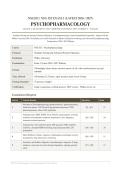
NSG552 / NSG 552 EXAM 2 (LATEST )
PSYCHOPHARMACOLOGY
GRADE A QUESTIONS AND VERIFIED ANSWERS | 100% CORRECT - WILKES
Graduate Nursing and Advanced Practice Education - Psychopharmacology Course Examination Preparation - Aligned with the
Wilkes University NSG 552 Syllabus, the AACN Essentials of Master's Education in Nursing, and Advanced Psychopharmacology
Competencies ( Edition)
Course NSG 552 - Psychopharmacology
Program Graduate Nursing and Advanced Practice Education
Institution Wilkes University
Examination Exam 2 (Latest Edition)
100 multiple-choice items, one best answer (A-D), with verified answer key and
Format
rationale
Time Allowed 180 minutes (2.5 hours), open-resource study review format
Passing Standard 75 percent or higher
Verification Grade A questions, verified answers, 100% correct - Wilkes review set
Examination Blueprint
Section Content Domain Questions Items
Principles of Psychopharmacology: pharmacokinetics, pharmacodynamics,
1 blood-brain barrier, CYP450 and P-glycoprotein interactions, TDM, Q1 - Q15 15
pharmacogenomics, ethics, DEA regulations
Antidepressants: SSRIs, SNRIs, TCAs, MAOIs, atypical agents; serotonin
2 syndrome, discontinuation syndrome, hypertensive crisis, pregnancy, Q16 - Q35 20
treatment-resistant depression
Antipsychotics: FGA and SGA agents, EPS spectrum, NMS, metabolic
3 syndrome, clozapine REMS monitoring, long-acting injectables, QT Q36 - Q55 20
prolongation
Mood Stabilizers: lithium, valproate, carbamazepine, lamotrigine; toxicity,
4 Q56 - Q70 15
teratogenicity, drug interactions, monitoring
Anxiolytics and Sedative-Hypnotics: benzodiazepines, buspirone, Z-drugs,
5 ramelteon, suvorexant, low-dose doxepin; dependence, tapering, geriatric Q71 - Q85 15
safety
NSG 552 Psychopharmacology - Examination Preparation - Wilkes University 1
,NSG552 / NSG 552 Exam 2 (Latest ): Psychopharmacology Wilkes University - Graduate Nursing
Section Content Domain Questions Items
Psychostimulants and ADHD Medications: methylphenidate,
6 amphetamines, atomoxetine, alpha-2A agonists, viloxazine; Schedule II Q86 - Q95 10
regulations, growth and cardiovascular monitoring
Substance Use Disorder Pharmacotherapy: alcohol, opioid, and nicotine use
7 Q96 - Q100 5
disorder treatments; MAT, harm reduction, prescriptive authority
Total Complete examination coverage Q1 - Q100 100
Cognitive Level Distribution: Recall 20% (approx. 20 items) | Application 50% (approx. 50 items) | Analysis 30%
(approx. 30 items)
Item Style: 75% scenario-based clinical decision-making (medication selection, side-effect management, patient
education) | 25% direct knowledge
Candidate Instructions
1. Select the ONE best answer (A, B, C, or D) for each of the 100 items.
2. Each item is followed by its verified correct answer and an evidence-based rationale for study review; when
self-testing, cover the answer and rationale lines before responding.
3. Approximately 75 percent of items are scenario-based clinical vignettes assessing medication selection, side-effect
management, monitoring, and patient education; 25 percent assess direct knowledge.
4. Cognitive levels follow the NSG 552 blueprint: 20 percent recall, 50 percent application, and 30 percent analysis,
including clinical reasoning across the pharmacologic lifespan.
5. Boxed (black box) warnings, REMS requirements, and DEA Schedule II-V implications are emphasized throughout
per AACN Essentials safety domains.
6. Recommended passing standard: 75 percent or higher. Review every missed item with its rationale before retesting.
Section 1: Principles of Psychopharmacology
Questions 1 - 15 of 100
Q1: A psychiatric-mental health nurse practitioner is reviewing pharmacokinetic principles with graduate
students. Which statement about oral bioavailability of psychotropic medications is most accurate?
A. Intravenous and oral doses of the same drug always produce identical plasma concentrations.
B. Hepatic first-pass metabolism can substantially reduce the fraction of an orally administered drug that
reaches the systemic circulation. [CORRECT]
C. Bioavailability depends only on the dose prescribed and not on the route of administration.
D. Sublingual administration guarantees complete avoidance of all hepatic metabolism.
NSG 552 Psychopharmacology - Examination Preparation - Wilkes University 2
,NSG552 / NSG 552 Exam 2 (Latest ): Psychopharmacology Wilkes University - Graduate Nursing
Correct Answer: B
Rationale: Bioavailability is the fraction of an administered dose that reaches systemic circulation unchanged. Orally
absorbed psychotropics pass through the portal circulation, where first-pass metabolism by hepatic enzymes may inactivate
a large portion of the dose before it reaches the systemic circulation, which is why some agents require much higher oral
than parenteral doses. Intravenous dosing yields essentially complete bioavailability, and route, formulation, and intestinal
metabolism all influence bioavailability, making options A, C, and D incorrect.
Q2: A 79-year-old woman stabilized on warfarin is prescribed fluoxetine, a highly protein-bound antidepressant.
Which pharmacokinetic interaction is the nurse practitioner most concerned about?
A. Fluoxetine increases the metabolism of warfarin through strong CYP1A2 induction.
B. Fluoxetine irreversibly binds warfarin and destroys its anticoagulant activity.
C. Fluoxetine decreases warfarin absorption from the gastrointestinal tract.
D. Displacement of warfarin from plasma protein binding sites transiently increases the free drug fraction
and the anticoagulant effect. [CORRECT]
Correct Answer: D
Rationale: Both fluoxetine and warfarin are extensively bound to albumin. When a highly protein-bound drug displaces
another, the transient rise in free drug concentration can amplify the anticoagulant effect and bleeding risk before the extra
free drug redistributes and is cleared. Fluoxetine can also impair warfarin metabolism and platelet function, but it does not
induce CYP1A2, destroy drug activity, or block absorption, making options A, C, and D incorrect.
Q3: Which drug property most favors crossing the blood-brain barrier and reaching central nervous system
receptor targets?
A. High ionization and strong water solubility at physiologic pH
B. Large molecular weight with extensive hydrogen bonding
C. High lipophilicity, small molecular size, and low ionization at physiologic pH [CORRECT]
D. Strong binding to serum albumin with a very low free fraction
Correct Answer: C
Rationale: The blood-brain barrier is formed by tight junctions between capillary endothelial cells surrounded by astrocytic
foot processes, so drugs must cross lipid membranes rather than pass between cells. Lipophilic, small, largely unionized
molecules such as most psychotropics penetrate best, while hydrophilic or highly ionized molecules are excluded. Extensive
albumin binding reduces the free fraction available to cross, and large water-soluble molecules penetrate poorly, making the
other options incorrect.
Q4: A 44-year-old patient with major depressive disorder reports intolerable sedation and anticholinergic
symptoms on nortriptyline 25 mg daily, yet the plasma level is markedly elevated for this dose.
Pharmacogenomic testing would most likely reveal which finding?
A. Ultrarapid CYP2D6 metabolizer status requiring a higher dose
B. A CYP2C19 loss-of-function allele as the primary cause
C. CYP2D6 poor metabolizer status with impaired clearance of the parent drug [CORRECT]
D. Completely normal CYP2D6 activity, making pharmacogenomics irrelevant
NSG 552 Psychopharmacology - Examination Preparation - Wilkes University 3
, NSG552 / NSG 552 Exam 2 (Latest ): Psychopharmacology Wilkes University - Graduate Nursing
Correct Answer: C
Rationale: Nortriptyline is a classic CYP2D6 substrate, and poor metabolizers accumulate parent drug even at low doses,
producing exaggerated anticholinergic and sedative effects. The combination of a low dose, a high plasma level, and toxicity
is the hallmark of CYP2D6 poor metabolism, which pharmacogenomic guidelines suggest should prompt dose reduction or
selection of an alternative agent. Ultrarapid metabolism would produce low levels and treatment failure rather than toxicity,
and CYP2C19 plays only a minor role in tricyclic clearance.
Q5: A 38-year-old woman stabilized on paroxetine 20 mg daily is newly prescribed desipramine by another
provider. Which pharmacokinetic effect should the nurse practitioner anticipate?
A. Decreased desipramine levels due to enzyme induction
B. No interaction because the drugs act at different receptors
C. Increased paroxetine levels due to competition for CYP2C19
D. Elevated desipramine concentrations from CYP2D6 inhibition, raising the risk of anticholinergic and
cardiac toxicity [CORRECT]
Correct Answer: D
Rationale: Paroxetine and fluoxetine are among the strongest CYP2D6 inhibitors in psychopharmacology, and desipramine
is a sensitive CYP2D6 substrate. Co-prescription raises desipramine plasma concentrations substantially and increases the
risk of anticholinergic effects, cardiac conduction delay, and seizures, so dose reduction and level monitoring are required.
Enzyme induction, receptor-based reasoning, and CYP2C19 competition do not describe this interaction.
Q6: Which statement best describes the role of P-glycoprotein at the blood-brain barrier?
A. It actively transports lipophilic drugs from the blood into brain tissue.
B. It metabolizes psychotropic drugs within the endothelial cell membrane.
C. It functions as an efflux transporter that pumps many drugs back into the capillary lumen, limiting
central nervous system penetration. [CORRECT]
D. It facilitates passive diffusion of ionized molecules across endothelial tight junctions.
Correct Answer: C
Rationale: P-glycoprotein is an ATP-dependent efflux transporter expressed on the luminal surface of brain capillary
endothelium. It exports a broad range of substrates back into the circulation, and inhibition by drugs such as quinidine or
cyclosporine can increase central effects, illustrated by loperamide producing opioid central effects when P-glycoprotein is
blocked. The transporter pumps drugs out of, not into, the brain, and it neither metabolizes drugs nor moves ionized
molecules between cells.
Q7: For which medication is routine therapeutic drug monitoring with serum concentrations most clearly
supported by evidence and clinical guidelines?
A. Sertraline, to confirm adequate serotonin reuptake blockade
B. Lithium, because of its narrow therapeutic index and concentration-dependent toxicity [CORRECT]
C. Aripiprazole, to predict response in all patients
D. Bupropion, to reduce seizure risk by keeping levels below a fixed threshold
NSG 552 Psychopharmacology - Examination Preparation - Wilkes University 4
PSYCHOPHARMACOLOGY
GRADE A QUESTIONS AND VERIFIED ANSWERS | 100% CORRECT - WILKES
Graduate Nursing and Advanced Practice Education - Psychopharmacology Course Examination Preparation - Aligned with the
Wilkes University NSG 552 Syllabus, the AACN Essentials of Master's Education in Nursing, and Advanced Psychopharmacology
Competencies ( Edition)
Course NSG 552 - Psychopharmacology
Program Graduate Nursing and Advanced Practice Education
Institution Wilkes University
Examination Exam 2 (Latest Edition)
100 multiple-choice items, one best answer (A-D), with verified answer key and
Format
rationale
Time Allowed 180 minutes (2.5 hours), open-resource study review format
Passing Standard 75 percent or higher
Verification Grade A questions, verified answers, 100% correct - Wilkes review set
Examination Blueprint
Section Content Domain Questions Items
Principles of Psychopharmacology: pharmacokinetics, pharmacodynamics,
1 blood-brain barrier, CYP450 and P-glycoprotein interactions, TDM, Q1 - Q15 15
pharmacogenomics, ethics, DEA regulations
Antidepressants: SSRIs, SNRIs, TCAs, MAOIs, atypical agents; serotonin
2 syndrome, discontinuation syndrome, hypertensive crisis, pregnancy, Q16 - Q35 20
treatment-resistant depression
Antipsychotics: FGA and SGA agents, EPS spectrum, NMS, metabolic
3 syndrome, clozapine REMS monitoring, long-acting injectables, QT Q36 - Q55 20
prolongation
Mood Stabilizers: lithium, valproate, carbamazepine, lamotrigine; toxicity,
4 Q56 - Q70 15
teratogenicity, drug interactions, monitoring
Anxiolytics and Sedative-Hypnotics: benzodiazepines, buspirone, Z-drugs,
5 ramelteon, suvorexant, low-dose doxepin; dependence, tapering, geriatric Q71 - Q85 15
safety
NSG 552 Psychopharmacology - Examination Preparation - Wilkes University 1
,NSG552 / NSG 552 Exam 2 (Latest ): Psychopharmacology Wilkes University - Graduate Nursing
Section Content Domain Questions Items
Psychostimulants and ADHD Medications: methylphenidate,
6 amphetamines, atomoxetine, alpha-2A agonists, viloxazine; Schedule II Q86 - Q95 10
regulations, growth and cardiovascular monitoring
Substance Use Disorder Pharmacotherapy: alcohol, opioid, and nicotine use
7 Q96 - Q100 5
disorder treatments; MAT, harm reduction, prescriptive authority
Total Complete examination coverage Q1 - Q100 100
Cognitive Level Distribution: Recall 20% (approx. 20 items) | Application 50% (approx. 50 items) | Analysis 30%
(approx. 30 items)
Item Style: 75% scenario-based clinical decision-making (medication selection, side-effect management, patient
education) | 25% direct knowledge
Candidate Instructions
1. Select the ONE best answer (A, B, C, or D) for each of the 100 items.
2. Each item is followed by its verified correct answer and an evidence-based rationale for study review; when
self-testing, cover the answer and rationale lines before responding.
3. Approximately 75 percent of items are scenario-based clinical vignettes assessing medication selection, side-effect
management, monitoring, and patient education; 25 percent assess direct knowledge.
4. Cognitive levels follow the NSG 552 blueprint: 20 percent recall, 50 percent application, and 30 percent analysis,
including clinical reasoning across the pharmacologic lifespan.
5. Boxed (black box) warnings, REMS requirements, and DEA Schedule II-V implications are emphasized throughout
per AACN Essentials safety domains.
6. Recommended passing standard: 75 percent or higher. Review every missed item with its rationale before retesting.
Section 1: Principles of Psychopharmacology
Questions 1 - 15 of 100
Q1: A psychiatric-mental health nurse practitioner is reviewing pharmacokinetic principles with graduate
students. Which statement about oral bioavailability of psychotropic medications is most accurate?
A. Intravenous and oral doses of the same drug always produce identical plasma concentrations.
B. Hepatic first-pass metabolism can substantially reduce the fraction of an orally administered drug that
reaches the systemic circulation. [CORRECT]
C. Bioavailability depends only on the dose prescribed and not on the route of administration.
D. Sublingual administration guarantees complete avoidance of all hepatic metabolism.
NSG 552 Psychopharmacology - Examination Preparation - Wilkes University 2
,NSG552 / NSG 552 Exam 2 (Latest ): Psychopharmacology Wilkes University - Graduate Nursing
Correct Answer: B
Rationale: Bioavailability is the fraction of an administered dose that reaches systemic circulation unchanged. Orally
absorbed psychotropics pass through the portal circulation, where first-pass metabolism by hepatic enzymes may inactivate
a large portion of the dose before it reaches the systemic circulation, which is why some agents require much higher oral
than parenteral doses. Intravenous dosing yields essentially complete bioavailability, and route, formulation, and intestinal
metabolism all influence bioavailability, making options A, C, and D incorrect.
Q2: A 79-year-old woman stabilized on warfarin is prescribed fluoxetine, a highly protein-bound antidepressant.
Which pharmacokinetic interaction is the nurse practitioner most concerned about?
A. Fluoxetine increases the metabolism of warfarin through strong CYP1A2 induction.
B. Fluoxetine irreversibly binds warfarin and destroys its anticoagulant activity.
C. Fluoxetine decreases warfarin absorption from the gastrointestinal tract.
D. Displacement of warfarin from plasma protein binding sites transiently increases the free drug fraction
and the anticoagulant effect. [CORRECT]
Correct Answer: D
Rationale: Both fluoxetine and warfarin are extensively bound to albumin. When a highly protein-bound drug displaces
another, the transient rise in free drug concentration can amplify the anticoagulant effect and bleeding risk before the extra
free drug redistributes and is cleared. Fluoxetine can also impair warfarin metabolism and platelet function, but it does not
induce CYP1A2, destroy drug activity, or block absorption, making options A, C, and D incorrect.
Q3: Which drug property most favors crossing the blood-brain barrier and reaching central nervous system
receptor targets?
A. High ionization and strong water solubility at physiologic pH
B. Large molecular weight with extensive hydrogen bonding
C. High lipophilicity, small molecular size, and low ionization at physiologic pH [CORRECT]
D. Strong binding to serum albumin with a very low free fraction
Correct Answer: C
Rationale: The blood-brain barrier is formed by tight junctions between capillary endothelial cells surrounded by astrocytic
foot processes, so drugs must cross lipid membranes rather than pass between cells. Lipophilic, small, largely unionized
molecules such as most psychotropics penetrate best, while hydrophilic or highly ionized molecules are excluded. Extensive
albumin binding reduces the free fraction available to cross, and large water-soluble molecules penetrate poorly, making the
other options incorrect.
Q4: A 44-year-old patient with major depressive disorder reports intolerable sedation and anticholinergic
symptoms on nortriptyline 25 mg daily, yet the plasma level is markedly elevated for this dose.
Pharmacogenomic testing would most likely reveal which finding?
A. Ultrarapid CYP2D6 metabolizer status requiring a higher dose
B. A CYP2C19 loss-of-function allele as the primary cause
C. CYP2D6 poor metabolizer status with impaired clearance of the parent drug [CORRECT]
D. Completely normal CYP2D6 activity, making pharmacogenomics irrelevant
NSG 552 Psychopharmacology - Examination Preparation - Wilkes University 3
, NSG552 / NSG 552 Exam 2 (Latest ): Psychopharmacology Wilkes University - Graduate Nursing
Correct Answer: C
Rationale: Nortriptyline is a classic CYP2D6 substrate, and poor metabolizers accumulate parent drug even at low doses,
producing exaggerated anticholinergic and sedative effects. The combination of a low dose, a high plasma level, and toxicity
is the hallmark of CYP2D6 poor metabolism, which pharmacogenomic guidelines suggest should prompt dose reduction or
selection of an alternative agent. Ultrarapid metabolism would produce low levels and treatment failure rather than toxicity,
and CYP2C19 plays only a minor role in tricyclic clearance.
Q5: A 38-year-old woman stabilized on paroxetine 20 mg daily is newly prescribed desipramine by another
provider. Which pharmacokinetic effect should the nurse practitioner anticipate?
A. Decreased desipramine levels due to enzyme induction
B. No interaction because the drugs act at different receptors
C. Increased paroxetine levels due to competition for CYP2C19
D. Elevated desipramine concentrations from CYP2D6 inhibition, raising the risk of anticholinergic and
cardiac toxicity [CORRECT]
Correct Answer: D
Rationale: Paroxetine and fluoxetine are among the strongest CYP2D6 inhibitors in psychopharmacology, and desipramine
is a sensitive CYP2D6 substrate. Co-prescription raises desipramine plasma concentrations substantially and increases the
risk of anticholinergic effects, cardiac conduction delay, and seizures, so dose reduction and level monitoring are required.
Enzyme induction, receptor-based reasoning, and CYP2C19 competition do not describe this interaction.
Q6: Which statement best describes the role of P-glycoprotein at the blood-brain barrier?
A. It actively transports lipophilic drugs from the blood into brain tissue.
B. It metabolizes psychotropic drugs within the endothelial cell membrane.
C. It functions as an efflux transporter that pumps many drugs back into the capillary lumen, limiting
central nervous system penetration. [CORRECT]
D. It facilitates passive diffusion of ionized molecules across endothelial tight junctions.
Correct Answer: C
Rationale: P-glycoprotein is an ATP-dependent efflux transporter expressed on the luminal surface of brain capillary
endothelium. It exports a broad range of substrates back into the circulation, and inhibition by drugs such as quinidine or
cyclosporine can increase central effects, illustrated by loperamide producing opioid central effects when P-glycoprotein is
blocked. The transporter pumps drugs out of, not into, the brain, and it neither metabolizes drugs nor moves ionized
molecules between cells.
Q7: For which medication is routine therapeutic drug monitoring with serum concentrations most clearly
supported by evidence and clinical guidelines?
A. Sertraline, to confirm adequate serotonin reuptake blockade
B. Lithium, because of its narrow therapeutic index and concentration-dependent toxicity [CORRECT]
C. Aripiprazole, to predict response in all patients
D. Bupropion, to reduce seizure risk by keeping levels below a fixed threshold
NSG 552 Psychopharmacology - Examination Preparation - Wilkes University 4


