

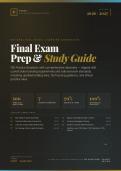
ED ITION
PERRY
P R E A L E S TAT E E X A M P R E P S E R I E S
N AT I O N AL R EAL E S TAT E L I CE N S I N G E XAMI N AT I O N
Final Exam
Prep & Study Guide
100 Practice Questions with comprehensive rationales — aligned with
current state licensing requirements and national exam standards,
including updated lending laws, fair housing guidance, and ethical
practice rules.
100 7 70% 100%
P R A C TI C E C ON TE N T D OM A I N S S C E N A R I O I TE M S R ATI ON A LE S
QU E S TI ON S P R OV I D E D
CONTENT DOMAIN MAP
01 Real Estate Principles & Concepts Q1–15 02 Agency, Brokerage & Fiduciary Duties Q16–28
03 Contracts & Real Estate Transactions Q29–44 04 Financing, Mortgages & Closing Q45–58
05 Land Use, Property Rights & Restrictions Q59–70 06 Valuation, Appraisal & Market Analysis Q71–80
07 Fair Housing, Ethics & Legal Compliance Q81–100 — Cognitive Levels: 30% Recall / 50% Application / 20% —
Analysis
RE
C O M P L ET E S T U D Y G U ID E
FO R M AT
A L IG N ED W IT H N AT IO N A L EX A M O U T L IN E 1 0 0 Q U E S T I O N S · 2 0 2 7
PE RRY · E XAM PRE P EDIT IO N
,PERRY Real Estate Licensing Final Exam Prep 100 Practice Questions & Study Guide | 2026/2027 Edition
PERRY Real Estate Licensing Final Exam Prep
100 Practice Questions and Complete Study Guide
This comprehensive examination has been developed to mirror the content outline of the national real estate
licensing examination and incorporates current state licensing requirements, federal lending laws, fair housing
guidance, and ethical practice standards in effect for the 2026/2027 testing cycle. The exam contains exactly 100
multiple-choice questions distributed across seven content domains that reflect the structural weighting of the
national licensing exam. Each question presents four options (A-D) with exactly one correct answer, and every
question is accompanied by a detailed rationale explaining why the correct answer is right and why each distractor is
wrong, including the underlying real estate legal principles, fiduciary duties, contract law, financing rules, and
practical brokerage applications.
Approximately 70 percent of the questions are scenario-based application items that test the candidate's ability to
apply legal and procedural knowledge to realistic real estate transactions, while 30 percent test direct recall of
definitions, statutes, and rules. Cognitive levels are weighted as 30 percent recall, 50 percent application, and 20
percent analysis. Distractors have been carefully constructed to reflect the most common pitfalls observed on the
national licensing exam, including confusion between agency types and fiduciary duties, misapplication of contract
contingencies, incorrect closing and proration calculations, confusion among deed types, misidentification of Fair
Housing protected classes, and confusion between RESPA and Truth in Lending requirements.
Exam Structure & Content Distribution
Secti
Content Domain Questions
on
Real Estate Principles and Concepts (Property Types, Land Characteristics, Estates, &
1 Q1 - Q15
Tenancy)
Agency, Brokerage, and Fiduciary Duties (Agency Relationships, Client vs. Customer, &
2 Q16 - Q28
Disclosure)
Contracts and Real Estate Transactions (Contract Law, Purchase Agreements,
3 Q29 - Q44
Contingencies, & Escrow)
Financing, Mortgages, and Closing (Loan Types, Lending Laws, Closing Statements, &
4 Q45 - Q58
Settlement)
Land Use, Property Rights, and Restrictions (Zoning, Easements, Encumbrances, &
5 Q59 - Q70
Deed Restrictions)
Valuation, Appraisal, and Market Analysis (Appraisal Methods, CMA, & Pricing
6 Q71 - Q80
Strategies)
Fair Housing, Ethics, and Legal Compliance (Fair Housing, RESPA, Sherman Antitrust,
7 Q81 - Q100
& Ethics)
PERRY Real Estate Licensing Final Exam Prep Page 1
,PERRY Real Estate Licensing Final Exam Prep 100 Practice Questions & Study Guide | 2026/2027 Edition
Secti
Content Domain Questions
on
100
TOTAL
Questions
How to Use This Study Guide
• Take the exam under timed conditions (allow approximately 2.5 to 3 hours) to simulate the actual testing
environment.
• Review the detailed rationale for each question, including those answered correctly, to reinforce
understanding of underlying legal principles.
• Pay particular attention to scenario-based questions involving agency, fiduciary duties, contract
contingencies, closing calculations, and Fair Housing compliance, as these areas consistently produce the
highest error rates on the national exam.
• Use the section-by-section structure to identify and remediate knowledge gaps before retesting.
• Verify all math-based answers by re-performing the calculations independently, as the national exam
frequently includes commission, net listing, proration, and profit calculations.
Cognitive Level Distribution: 30% Recall · 50% Application · 20% Analysis | Item Style: 70% Scenario-Based ·
30% Direct Recall
PERRY Real Estate Licensing Final Exam Prep Page 2
, PERRY Real Estate Licensing Final Exam Prep 100 Practice Questions & Study Guide | 2026/2027 Edition
Section 1: Real Estate Principles and Concepts (Property Types, Land
Characteristics, Estates, & Tenancy)
Q1-15
Q1: A homeowner installs a custom-built chandelier that is bolted to the ceiling joists of the dining
room and wired into the home's electrical system. When the property is later sold, the buyer
claims the chandelier was not included in the sale. Which legal principle MOST strongly
determines whether the chandelier conveys with the property?
A. The chandelier is personal property because the seller paid for it separately and can remove it at any time
prior to closing.
B. The chandelier is a trade fixture because it was professionally installed by a licensed electrician.
C. The chandelier is a fixture because it is attached to the real property in a manner intended to be
permanent, and it conveys with the real estate. [CORRECT]
D. The chandelier is an emblement because it was installed by the current owner during their ownership.
Correct Answer: C
Rationale: Under the common-law fixture test (attachment, adaptability, and intention), a chandelier bolted to structural
members and hardwired into the electrical system is annexed in a permanent manner and is therefore a fixture that conveys with
the real property. Trade fixtures apply only to tenant-installed items used in a trade or business (option B), emblements are
annually planted crops (option D), and a seller's payment source does not override the annexation analysis (option A).
Q2: A developer purchases 50 acres of land. Which physical characteristic of land BEST explains
why each acre commands a different market value despite being part of the same parcel?
A. Immobility, because the land cannot be relocated to a more desirable market.
B. Indestructibility, because the land will continue to exist regardless of use.
C. Nonhomogeneity (heterogeneity), because no two parcels are ever exactly alike in location or
physical attributes. [CORRECT]
D. Situs, because the economic location of the land determines its highest value.
Correct Answer: C
Rationale: Nonhomogeneity (also called heterogeneity) is the physical characteristic holding that no two parcels of land are ever
exactly the same, which directly explains varying per-acre values within one acquisition. Immobility (option A) and
indestructibility (option B) are also physical characteristics but do not explain intra-parcel value differences. Situs (option D) is
an economic, not physical, characteristic referring to a location's preference for a given use.
PERRY Real Estate Licensing Final Exam Prep Page 3
PERRY
P R E A L E S TAT E E X A M P R E P S E R I E S
N AT I O N AL R EAL E S TAT E L I CE N S I N G E XAMI N AT I O N
Final Exam
Prep & Study Guide
100 Practice Questions with comprehensive rationales — aligned with
current state licensing requirements and national exam standards,
including updated lending laws, fair housing guidance, and ethical
practice rules.
100 7 70% 100%
P R A C TI C E C ON TE N T D OM A I N S S C E N A R I O I TE M S R ATI ON A LE S
QU E S TI ON S P R OV I D E D
CONTENT DOMAIN MAP
01 Real Estate Principles & Concepts Q1–15 02 Agency, Brokerage & Fiduciary Duties Q16–28
03 Contracts & Real Estate Transactions Q29–44 04 Financing, Mortgages & Closing Q45–58
05 Land Use, Property Rights & Restrictions Q59–70 06 Valuation, Appraisal & Market Analysis Q71–80
07 Fair Housing, Ethics & Legal Compliance Q81–100 — Cognitive Levels: 30% Recall / 50% Application / 20% —
Analysis
RE
C O M P L ET E S T U D Y G U ID E
FO R M AT
A L IG N ED W IT H N AT IO N A L EX A M O U T L IN E 1 0 0 Q U E S T I O N S · 2 0 2 7
PE RRY · E XAM PRE P EDIT IO N
,PERRY Real Estate Licensing Final Exam Prep 100 Practice Questions & Study Guide | 2026/2027 Edition
PERRY Real Estate Licensing Final Exam Prep
100 Practice Questions and Complete Study Guide
This comprehensive examination has been developed to mirror the content outline of the national real estate
licensing examination and incorporates current state licensing requirements, federal lending laws, fair housing
guidance, and ethical practice standards in effect for the 2026/2027 testing cycle. The exam contains exactly 100
multiple-choice questions distributed across seven content domains that reflect the structural weighting of the
national licensing exam. Each question presents four options (A-D) with exactly one correct answer, and every
question is accompanied by a detailed rationale explaining why the correct answer is right and why each distractor is
wrong, including the underlying real estate legal principles, fiduciary duties, contract law, financing rules, and
practical brokerage applications.
Approximately 70 percent of the questions are scenario-based application items that test the candidate's ability to
apply legal and procedural knowledge to realistic real estate transactions, while 30 percent test direct recall of
definitions, statutes, and rules. Cognitive levels are weighted as 30 percent recall, 50 percent application, and 20
percent analysis. Distractors have been carefully constructed to reflect the most common pitfalls observed on the
national licensing exam, including confusion between agency types and fiduciary duties, misapplication of contract
contingencies, incorrect closing and proration calculations, confusion among deed types, misidentification of Fair
Housing protected classes, and confusion between RESPA and Truth in Lending requirements.
Exam Structure & Content Distribution
Secti
Content Domain Questions
on
Real Estate Principles and Concepts (Property Types, Land Characteristics, Estates, &
1 Q1 - Q15
Tenancy)
Agency, Brokerage, and Fiduciary Duties (Agency Relationships, Client vs. Customer, &
2 Q16 - Q28
Disclosure)
Contracts and Real Estate Transactions (Contract Law, Purchase Agreements,
3 Q29 - Q44
Contingencies, & Escrow)
Financing, Mortgages, and Closing (Loan Types, Lending Laws, Closing Statements, &
4 Q45 - Q58
Settlement)
Land Use, Property Rights, and Restrictions (Zoning, Easements, Encumbrances, &
5 Q59 - Q70
Deed Restrictions)
Valuation, Appraisal, and Market Analysis (Appraisal Methods, CMA, & Pricing
6 Q71 - Q80
Strategies)
Fair Housing, Ethics, and Legal Compliance (Fair Housing, RESPA, Sherman Antitrust,
7 Q81 - Q100
& Ethics)
PERRY Real Estate Licensing Final Exam Prep Page 1
,PERRY Real Estate Licensing Final Exam Prep 100 Practice Questions & Study Guide | 2026/2027 Edition
Secti
Content Domain Questions
on
100
TOTAL
Questions
How to Use This Study Guide
• Take the exam under timed conditions (allow approximately 2.5 to 3 hours) to simulate the actual testing
environment.
• Review the detailed rationale for each question, including those answered correctly, to reinforce
understanding of underlying legal principles.
• Pay particular attention to scenario-based questions involving agency, fiduciary duties, contract
contingencies, closing calculations, and Fair Housing compliance, as these areas consistently produce the
highest error rates on the national exam.
• Use the section-by-section structure to identify and remediate knowledge gaps before retesting.
• Verify all math-based answers by re-performing the calculations independently, as the national exam
frequently includes commission, net listing, proration, and profit calculations.
Cognitive Level Distribution: 30% Recall · 50% Application · 20% Analysis | Item Style: 70% Scenario-Based ·
30% Direct Recall
PERRY Real Estate Licensing Final Exam Prep Page 2
, PERRY Real Estate Licensing Final Exam Prep 100 Practice Questions & Study Guide | 2026/2027 Edition
Section 1: Real Estate Principles and Concepts (Property Types, Land
Characteristics, Estates, & Tenancy)
Q1-15
Q1: A homeowner installs a custom-built chandelier that is bolted to the ceiling joists of the dining
room and wired into the home's electrical system. When the property is later sold, the buyer
claims the chandelier was not included in the sale. Which legal principle MOST strongly
determines whether the chandelier conveys with the property?
A. The chandelier is personal property because the seller paid for it separately and can remove it at any time
prior to closing.
B. The chandelier is a trade fixture because it was professionally installed by a licensed electrician.
C. The chandelier is a fixture because it is attached to the real property in a manner intended to be
permanent, and it conveys with the real estate. [CORRECT]
D. The chandelier is an emblement because it was installed by the current owner during their ownership.
Correct Answer: C
Rationale: Under the common-law fixture test (attachment, adaptability, and intention), a chandelier bolted to structural
members and hardwired into the electrical system is annexed in a permanent manner and is therefore a fixture that conveys with
the real property. Trade fixtures apply only to tenant-installed items used in a trade or business (option B), emblements are
annually planted crops (option D), and a seller's payment source does not override the annexation analysis (option A).
Q2: A developer purchases 50 acres of land. Which physical characteristic of land BEST explains
why each acre commands a different market value despite being part of the same parcel?
A. Immobility, because the land cannot be relocated to a more desirable market.
B. Indestructibility, because the land will continue to exist regardless of use.
C. Nonhomogeneity (heterogeneity), because no two parcels are ever exactly alike in location or
physical attributes. [CORRECT]
D. Situs, because the economic location of the land determines its highest value.
Correct Answer: C
Rationale: Nonhomogeneity (also called heterogeneity) is the physical characteristic holding that no two parcels of land are ever
exactly the same, which directly explains varying per-acre values within one acquisition. Immobility (option A) and
indestructibility (option B) are also physical characteristics but do not explain intra-parcel value differences. Situs (option D) is
an economic, not physical, characteristic referring to a location's preference for a given use.
PERRY Real Estate Licensing Final Exam Prep Page 3


