
AMLS
POST-TEST QUESTIONS & ANSWERS
(All Correct)
Edition
Advanced Medical Life Support
Certification Examination Preparation
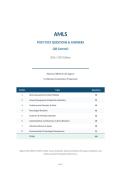
Section Topic Questions
1 AMLS Assessment & Critical Thinking 15
2 Airway Management & Respiratory Disorders 15
3 Cardiovascular Disorders & Shock 15
4 Neurological Disorders 12
5 Endocrine & Metabolic Disorders 12
6 Gastrointestinal, Genitourinary, & Renal Disorders 10
7 Infectious Diseases & Sepsis 10
8 Environmental & Toxicological Emergencies 11
TOTAL 100
Aligned with NAEMT AMLS Provider Course Standards, Advanced Medical Life Support Guidelines, and
Evidence-Based Prehospital Medical Care.
Page 1
,AMLS Post-Test Questions & Answers | Edition NAEMT AMLS Provider Course Standards
Cognitive Distribution: 20% Recall • 50% Application • 30% Analysis
Format: 80% Scenario-Based • 20% Direct Knowledge
Page 2
,AMLS Post-Test Questions & Answers | Edition NAEMT AMLS Provider Course Standards
Section 1: AMLS Assessment & Critical Thinking
15 Questions • Systematic assessment, critical thinking, SBAR/MIST, transport decisions
Q1: You arrive at the scene of a 62-year-old male complaining of chest pressure. Per the AMLS
systematic assessment approach, which phase should immediately follow the scene size-up?
A. Detailed secondary assessment focused on the cardiovascular system
B. Primary assessment focused on identifying life threats using the ABCs [CORRECT]
C. Obtaining a SAMPLE history from the patient and bystanders
D. Reassessment of vital signs every 5 minutes until destination
Correct Answer: B
Rationale:
Per NAEMT AMLS, the systematic assessment sequence is: scene size-up → primary assessment (ABCs and life
threats) → secondary assessment (history and focused physical exam) → reassessment. Skipping the primary
assessment to obtain history or perform a detailed exam delays identification of immediately life-threatening
conditions, which is the principal cause of preventable prehospital death.
Q2: A 54-year-old female presents with acute dyspnea, anxiety, and diaphoresis. During the primary
assessment, you note her airway is patent, breathing is 32/min and labored, and circulation is intact
with a radial pulse of 124. What is the most appropriate next step in the AMLS framework?
A. Initiate transport immediately and defer further assessment
B. Complete the primary assessment and address respiratory compromise before moving to secondary
assessment [CORRECT]
C. Begin a focused cardiovascular exam to identify the underlying cause
D. Obtain a 12-lead ECG before any other intervention
Correct Answer: B
Rationale:
AMLS emphasizes completing the primary assessment and addressing immediate life threats (here, respiratory
compromise) before transitioning to the secondary assessment or diagnostic procedures such as 12-lead ECG.
Premature transport or focused exams before stabilizing ABCs violates the systematic approach and may worsen
outcome in the deteriorating patient.
Page 3
, AMLS Post-Test Questions & Answers | Edition NAEMT AMLS Provider Course Standards
Q3: While assessing a 71-year-old male with altered mental status, your partner suggests using the
Glasgow Coma Scale. Which GCS finding most strongly indicates the need for immediate airway
protection?
A. Eye opening to pain, localizes pain, inappropriate words (GCS 9)
B. No eye opening, withdraws to pain, incomprehensible sounds (GCS 7)
C. Opens eyes to verbal, obeys commands, oriented speech (GCS 14)
D. No eye opening, abnormal extension, no verbal response (GCS 4) [CORRECT]
Correct Answer: D
Rationale:
A GCS of 8 or less is the classic indication for definitive airway management; a GCS of 4 (extension posturing, no
verbal, no eye opening) represents severe neurological injury with profoundly depressed protective reflexes. Per AMLS
and Brain Trauma Foundation guidance, this patient requires immediate airway protection and ventilatory support.
Q4: A 45-year-old male complains of tearing chest pain radiating to the back, with blood pressure
180/110 in the right arm and 138/88 in the left arm. Which AMLS differential diagnosis must be
prioritized and communicated to receiving facility?
A. Acute myocardial infarction with atypical presentation
B. Acute aortic dissection requiring surgical consultation [CORRECT]
C. Pulmonary embolism with secondary hypertension
D. Esophageal rupture secondary to vomiting
Correct Answer: B
Rationale:
Tearing chest pain radiating to the back with a >20 mmHg inter-arm blood pressure differential is the classic
presentation of acute aortic dissection. AMLS prioritizes early recognition because misdiagnosis as acute MI may lead
to harmful anticoagulation or fibrinolysis. Prehospital notification enables CT angiography and cardiothoracic
surgical consultation before arrival.
Q5: During a handoff at the emergency department, which SBAR component most appropriately conveys
the patient's current clinical condition and recent changes?
A. Situation
B. Background
C. Assessment [CORRECT]
D. Recommendation
Correct Answer: C
Rationale:
In SBAR (Situation, Background, Assessment, Recommendation), the Assessment conveys the provider's clinical
impression, current condition, and recent changes. Situation is the identity and chief complaint; Background is the
relevant history; Recommendation states what is needed from the receiver. AMLS identifies SBAR as a structured
handoff tool that reduces communication errors and missed information.
Page 4
POST-TEST QUESTIONS & ANSWERS
(All Correct)
Edition
Advanced Medical Life Support
Certification Examination Preparation
Section Topic Questions
1 AMLS Assessment & Critical Thinking 15
2 Airway Management & Respiratory Disorders 15
3 Cardiovascular Disorders & Shock 15
4 Neurological Disorders 12
5 Endocrine & Metabolic Disorders 12
6 Gastrointestinal, Genitourinary, & Renal Disorders 10
7 Infectious Diseases & Sepsis 10
8 Environmental & Toxicological Emergencies 11
TOTAL 100
Aligned with NAEMT AMLS Provider Course Standards, Advanced Medical Life Support Guidelines, and
Evidence-Based Prehospital Medical Care.
Page 1
,AMLS Post-Test Questions & Answers | Edition NAEMT AMLS Provider Course Standards
Cognitive Distribution: 20% Recall • 50% Application • 30% Analysis
Format: 80% Scenario-Based • 20% Direct Knowledge
Page 2
,AMLS Post-Test Questions & Answers | Edition NAEMT AMLS Provider Course Standards
Section 1: AMLS Assessment & Critical Thinking
15 Questions • Systematic assessment, critical thinking, SBAR/MIST, transport decisions
Q1: You arrive at the scene of a 62-year-old male complaining of chest pressure. Per the AMLS
systematic assessment approach, which phase should immediately follow the scene size-up?
A. Detailed secondary assessment focused on the cardiovascular system
B. Primary assessment focused on identifying life threats using the ABCs [CORRECT]
C. Obtaining a SAMPLE history from the patient and bystanders
D. Reassessment of vital signs every 5 minutes until destination
Correct Answer: B
Rationale:
Per NAEMT AMLS, the systematic assessment sequence is: scene size-up → primary assessment (ABCs and life
threats) → secondary assessment (history and focused physical exam) → reassessment. Skipping the primary
assessment to obtain history or perform a detailed exam delays identification of immediately life-threatening
conditions, which is the principal cause of preventable prehospital death.
Q2: A 54-year-old female presents with acute dyspnea, anxiety, and diaphoresis. During the primary
assessment, you note her airway is patent, breathing is 32/min and labored, and circulation is intact
with a radial pulse of 124. What is the most appropriate next step in the AMLS framework?
A. Initiate transport immediately and defer further assessment
B. Complete the primary assessment and address respiratory compromise before moving to secondary
assessment [CORRECT]
C. Begin a focused cardiovascular exam to identify the underlying cause
D. Obtain a 12-lead ECG before any other intervention
Correct Answer: B
Rationale:
AMLS emphasizes completing the primary assessment and addressing immediate life threats (here, respiratory
compromise) before transitioning to the secondary assessment or diagnostic procedures such as 12-lead ECG.
Premature transport or focused exams before stabilizing ABCs violates the systematic approach and may worsen
outcome in the deteriorating patient.
Page 3
, AMLS Post-Test Questions & Answers | Edition NAEMT AMLS Provider Course Standards
Q3: While assessing a 71-year-old male with altered mental status, your partner suggests using the
Glasgow Coma Scale. Which GCS finding most strongly indicates the need for immediate airway
protection?
A. Eye opening to pain, localizes pain, inappropriate words (GCS 9)
B. No eye opening, withdraws to pain, incomprehensible sounds (GCS 7)
C. Opens eyes to verbal, obeys commands, oriented speech (GCS 14)
D. No eye opening, abnormal extension, no verbal response (GCS 4) [CORRECT]
Correct Answer: D
Rationale:
A GCS of 8 or less is the classic indication for definitive airway management; a GCS of 4 (extension posturing, no
verbal, no eye opening) represents severe neurological injury with profoundly depressed protective reflexes. Per AMLS
and Brain Trauma Foundation guidance, this patient requires immediate airway protection and ventilatory support.
Q4: A 45-year-old male complains of tearing chest pain radiating to the back, with blood pressure
180/110 in the right arm and 138/88 in the left arm. Which AMLS differential diagnosis must be
prioritized and communicated to receiving facility?
A. Acute myocardial infarction with atypical presentation
B. Acute aortic dissection requiring surgical consultation [CORRECT]
C. Pulmonary embolism with secondary hypertension
D. Esophageal rupture secondary to vomiting
Correct Answer: B
Rationale:
Tearing chest pain radiating to the back with a >20 mmHg inter-arm blood pressure differential is the classic
presentation of acute aortic dissection. AMLS prioritizes early recognition because misdiagnosis as acute MI may lead
to harmful anticoagulation or fibrinolysis. Prehospital notification enables CT angiography and cardiothoracic
surgical consultation before arrival.
Q5: During a handoff at the emergency department, which SBAR component most appropriately conveys
the patient's current clinical condition and recent changes?
A. Situation
B. Background
C. Assessment [CORRECT]
D. Recommendation
Correct Answer: C
Rationale:
In SBAR (Situation, Background, Assessment, Recommendation), the Assessment conveys the provider's clinical
impression, current condition, and recent changes. Situation is the identity and chief complaint; Background is the
relevant history; Recommendation states what is needed from the receiver. AMLS identifies SBAR as a structured
handoff tool that reduces communication errors and missed information.
Page 4


