
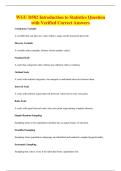
WGU D582 Introduction to Statistics Question
with Verified Correct Answers
Continuous Variable
A variable that can take any value within a range and be measured precisely.
Discrete Variable
A variable with countable, distinct whole-number values.
Nominal Scale
A scale that categorizes data without any inherent order or ranking.
Ordinal Scale
A scale with ordered categories, but unequal or undefined intervals between them.
Interval Scale
A scale with ordered, equal intervals between values but no true zero point.
Ratio Scale
A scale with equal intervals and a true zero point representing complete absence.
Simple Random Sampling
Sampling where every population member has an equal chance of selection.
Stratified Sampling
Sampling where population subgroups are identified and randomly sampled proportionally.
Systematic Sampling
Sampling that selects every k-th individual from a population list.
, Cluster Sampling
Sampling that selects entire randomly chosen groups or geographical clusters.
Convenience Sampling
A non-random sampling method selecting individuals who are easiest to reach.
Parameter vs. Statistic
A parameter describes a population; a statistic describes a sample.
Sampling Error
The difference between a sample statistic and its corresponding population parameter.
Law of Large Numbers
Principle stating as sample size grows, the sample mean approaches the population mean.
Mean
The average of a dataset, calculated by dividing the sum by total count.
Median
The middle value of an ordered dataset, robust against extreme outliers.
Mode
The value that appears most frequently in a dataset.
Positive Skewness (Right-Skewed)
A distribution with a long tail extending to the right (mean > median).
Negative Skewness (Left-Skewed)
A distribution with a long tail extending to the left (mean < median).
with Verified Correct Answers
Continuous Variable
A variable that can take any value within a range and be measured precisely.
Discrete Variable
A variable with countable, distinct whole-number values.
Nominal Scale
A scale that categorizes data without any inherent order or ranking.
Ordinal Scale
A scale with ordered categories, but unequal or undefined intervals between them.
Interval Scale
A scale with ordered, equal intervals between values but no true zero point.
Ratio Scale
A scale with equal intervals and a true zero point representing complete absence.
Simple Random Sampling
Sampling where every population member has an equal chance of selection.
Stratified Sampling
Sampling where population subgroups are identified and randomly sampled proportionally.
Systematic Sampling
Sampling that selects every k-th individual from a population list.
, Cluster Sampling
Sampling that selects entire randomly chosen groups or geographical clusters.
Convenience Sampling
A non-random sampling method selecting individuals who are easiest to reach.
Parameter vs. Statistic
A parameter describes a population; a statistic describes a sample.
Sampling Error
The difference between a sample statistic and its corresponding population parameter.
Law of Large Numbers
Principle stating as sample size grows, the sample mean approaches the population mean.
Mean
The average of a dataset, calculated by dividing the sum by total count.
Median
The middle value of an ordered dataset, robust against extreme outliers.
Mode
The value that appears most frequently in a dataset.
Positive Skewness (Right-Skewed)
A distribution with a long tail extending to the right (mean > median).
Negative Skewness (Left-Skewed)
A distribution with a long tail extending to the left (mean < median).


