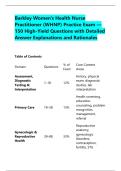
Barkley Women's Health Nurse
Practitioner (WHNP) Practice Exam —
150 High-Yield Questions with Detailed
Answer Explanations and Rationales
Table of Contents
% of Core Content
Domain Questions
Exam Areas
Assessment, History, physical
Diagnostic exam, diagnostic
1–18 12%
Testing & studies, lab
Interpretation interpretation
Health screening,
education,
counseling, problem
Primary Care 19–38 13%
recognition,
management,
referral
Reproductive
anatomy,
Gynecologic &
gynecologic
Reproductive 39–88 33%
disorders,
Health
contraception,
fertility, STIs
, % of Core Content
Domain Questions
Exam Areas
Prenatal care,
antepartum,
Obstetrics 89–132 29% intrapartum,
postpartum,
complications
Pharmacokinetics,
medications,
Pharmacology 133–147 10%
prescribing, adverse
effects
Scope of practice,
Professional
148–150 3% ethics, advocacy,
Practice Issues
quality improvement
The NCC WHNP-BC® exam consists of 150 scored questions to
be completed in 3 hours, distributed across the six competency
areas shown above.
Section 1: Assessment, Diagnostic Testing & Interpretation
(Questions 1–18)
1. A 45-year-old female presents with a family history of
breast cancer (mother diagnosed at age 48). She has no
breast symptoms. According to current guidelines, what is
the most appropriate breast cancer screening
recommendation for this patient?
A) Begin annual mammography at age 50
B) Begin annual mammography at age 40 with shared decision-
making
,C) Begin MRI screening immediately
D) Begin mammography at age 45
Correct Answer: B
Rationale: For women with a family history of breast cancer
(first-degree relative diagnosed before age 50), the
American Cancer Society recommends shared decision-
making about mammography starting at age 40. The
decision should consider the patient's risk factors and
preferences. MRI screening is reserved for women at very
high risk (e.g., BRCA mutations).
2. During a pelvic examination, the practitioner notes a
bulge in the anterior vaginal wall when the patient is asked
to bear down. The cervix is visualized through the introitus
with straining. What is the most appropriate description of
this finding?
A) Uterine prolapse, stage 1
B) Uterine prolapse, stage 2
C) Cystocele, stage 2
D) Rectocele, stage 2
Correct Answer: B
Rationale: This finding describes uterine prolapse. Stage 1
is when the cervix is above the hymen; stage 2 is when the
cervix descends to the introitus; stage 3 is when the cervix
extends beyond the introitus; and stage 4 is complete
procidentia. A cystocele involves bladder herniation into
the anterior vaginal wall; a rectocele involves bowel
herniation into the posterior wall.
3. A 32-year-old G2P1 female at 20 weeks gestation
presents for a routine prenatal visit. Her blood pressure is
, 138/86 mmHg. Urine dipstick shows 1+ protein. Which of
the following is the most appropriate next step?
A) Diagnose preeclampsia and admit for monitoring
B) Repeat blood pressure in 15 minutes; if elevated, order a 24-
hour urine protein or spot protein-to-creatinine ratio
C) Schedule a follow-up visit in 2 weeks
D) Start labetalol immediately
Correct Answer: B
Rationale: A single elevated BP reading with 1+ protein on
dipstick requires confirmation. The BP should be repeated
after rest. Proteinuria on dipstick should be confirmed with
a quantitative measure (spot P:C ratio or 24-hour urine).
Preeclampsia is diagnosed after 20 weeks with BP ≥140/90
and proteinuria ≥300 mg/24 hours.
4. A 28-year-old female presents with heavy, prolonged
menstrual bleeding. She has no known medical conditions.
Which of the following is the most appropriate initial
laboratory evaluation?
A) CBC, thyroid function tests, serum ferritin
B) CBC, coagulation studies, pregnancy test
C) CBC, TSH, serum ferritin, pregnancy test, coagulation studies
D) Pelvic ultrasound only
Correct Answer: C
Rationale: For heavy menstrual bleeding, the initial
evaluation should include CBC (to assess for anemia), TSH
(thyroid dysfunction can cause menorrhagia), serum ferritin
(iron stores), pregnancy test (to rule out pregnancy-related
bleeding), and coagulation studies (to rule out bleeding
disorders).
Practitioner (WHNP) Practice Exam —
150 High-Yield Questions with Detailed
Answer Explanations and Rationales
Table of Contents
% of Core Content
Domain Questions
Exam Areas
Assessment, History, physical
Diagnostic exam, diagnostic
1–18 12%
Testing & studies, lab
Interpretation interpretation
Health screening,
education,
counseling, problem
Primary Care 19–38 13%
recognition,
management,
referral
Reproductive
anatomy,
Gynecologic &
gynecologic
Reproductive 39–88 33%
disorders,
Health
contraception,
fertility, STIs
, % of Core Content
Domain Questions
Exam Areas
Prenatal care,
antepartum,
Obstetrics 89–132 29% intrapartum,
postpartum,
complications
Pharmacokinetics,
medications,
Pharmacology 133–147 10%
prescribing, adverse
effects
Scope of practice,
Professional
148–150 3% ethics, advocacy,
Practice Issues
quality improvement
The NCC WHNP-BC® exam consists of 150 scored questions to
be completed in 3 hours, distributed across the six competency
areas shown above.
Section 1: Assessment, Diagnostic Testing & Interpretation
(Questions 1–18)
1. A 45-year-old female presents with a family history of
breast cancer (mother diagnosed at age 48). She has no
breast symptoms. According to current guidelines, what is
the most appropriate breast cancer screening
recommendation for this patient?
A) Begin annual mammography at age 50
B) Begin annual mammography at age 40 with shared decision-
making
,C) Begin MRI screening immediately
D) Begin mammography at age 45
Correct Answer: B
Rationale: For women with a family history of breast cancer
(first-degree relative diagnosed before age 50), the
American Cancer Society recommends shared decision-
making about mammography starting at age 40. The
decision should consider the patient's risk factors and
preferences. MRI screening is reserved for women at very
high risk (e.g., BRCA mutations).
2. During a pelvic examination, the practitioner notes a
bulge in the anterior vaginal wall when the patient is asked
to bear down. The cervix is visualized through the introitus
with straining. What is the most appropriate description of
this finding?
A) Uterine prolapse, stage 1
B) Uterine prolapse, stage 2
C) Cystocele, stage 2
D) Rectocele, stage 2
Correct Answer: B
Rationale: This finding describes uterine prolapse. Stage 1
is when the cervix is above the hymen; stage 2 is when the
cervix descends to the introitus; stage 3 is when the cervix
extends beyond the introitus; and stage 4 is complete
procidentia. A cystocele involves bladder herniation into
the anterior vaginal wall; a rectocele involves bowel
herniation into the posterior wall.
3. A 32-year-old G2P1 female at 20 weeks gestation
presents for a routine prenatal visit. Her blood pressure is
, 138/86 mmHg. Urine dipstick shows 1+ protein. Which of
the following is the most appropriate next step?
A) Diagnose preeclampsia and admit for monitoring
B) Repeat blood pressure in 15 minutes; if elevated, order a 24-
hour urine protein or spot protein-to-creatinine ratio
C) Schedule a follow-up visit in 2 weeks
D) Start labetalol immediately
Correct Answer: B
Rationale: A single elevated BP reading with 1+ protein on
dipstick requires confirmation. The BP should be repeated
after rest. Proteinuria on dipstick should be confirmed with
a quantitative measure (spot P:C ratio or 24-hour urine).
Preeclampsia is diagnosed after 20 weeks with BP ≥140/90
and proteinuria ≥300 mg/24 hours.
4. A 28-year-old female presents with heavy, prolonged
menstrual bleeding. She has no known medical conditions.
Which of the following is the most appropriate initial
laboratory evaluation?
A) CBC, thyroid function tests, serum ferritin
B) CBC, coagulation studies, pregnancy test
C) CBC, TSH, serum ferritin, pregnancy test, coagulation studies
D) Pelvic ultrasound only
Correct Answer: C
Rationale: For heavy menstrual bleeding, the initial
evaluation should include CBC (to assess for anemia), TSH
(thyroid dysfunction can cause menorrhagia), serum ferritin
(iron stores), pregnancy test (to rule out pregnancy-related
bleeding), and coagulation studies (to rule out bleeding
disorders).