
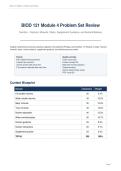
BIOD 121 Module 4 Problem Set Review
BIOD 121 Module 4 Problem Set Review
Nutrition - Vitamins, Minerals, Water, Supplement Guidance, and Nutrient Balance
Original comprehensive practice questions aligned to the published Portage Learning BIOL 121 Module 4 scope: vitamins,
minerals, water, nutrient balance, supplement guidance, and deficiency/excess states.
Format Quality controls
300 multiple-choice questions Exact count audit
4 options per question Unique concept IDs
Correct answer after each item Balanced A-D key positions
3-5 sentence rationale after each item Original wording
Source-based scope review
PDF visual QA
Content Blueprint
Domain Questions Weight
Fat-soluble vitamins 20 6.7%
Water-soluble vitamins 45 15.0%
Major minerals 30 10.0%
Trace minerals 45 15.0%
Nutrient absorption 40 13.3%
Water and electrolytes 50 16.7%
Nutrient guidance 25 8.3%
Nutrient interactions 20 6.7%
Supplement practice 25 8.3%
TOTAL 300 100%
Page 1
,BIOD 121 Module 4 Problem Set Review
300 Original Multiple-Choice Questions
Choose the single best answer for each question. The keyed answer and rationale appear immediately after the choices.
1. Which clinical interpretation best fits Vitamin D activation?
A) Kidney disease can impair final activation and disturb calcium-phosphate balance
B) Deficiency can develop with poor intake, malabsorption, or increased losses depending on the vitamin
C) Loss of intrinsic factor can cause pernicious anemia and neurologic B12 deficiency
D) Low vitamin D status can reduce calcium absorption and contribute to secondary hyperparathyroidism
Answer: A) Kidney disease can impair final activation and disturb calcium-phosphate balance
Rationale: Kidney disease can impair final activation and disturb calcium-phosphate balance directly identifies the clinical
relationship being tested for Vitamin D activation. The activation pathway explains why liver, kidney, parathyroid hormone,
calcium, and phosphate status are interrelated. Clinical interpretation links foundational science with recognizable patterns,
priorities, and consequences. The remaining choices describe other concepts in the same domain, which makes them plausible
distractors but not the best match for Vitamin D activation in this item.
2. Which clinical finding or consequence is most closely associated with Vitamin D?
A) Deficiency can present with prolonged bleeding and elevated coagulation times
B) Deficiency can cause night blindness and xerophthalmia
C) Severe deficiency can cause neurologic dysfunction and hemolytic anemia in high-risk patients
D) Deficiency can contribute to rickets in children and osteomalacia in adults
Answer: D) Deficiency can contribute to rickets in children and osteomalacia in adults
Rationale: Deficiency can contribute to rickets in children and osteomalacia in adults directly identifies the clinical relationship
being tested for Vitamin D. Vitamin D can be synthesized in skin after UVB exposure and is activated through liver and kidney
hydroxylation. Clinical interpretation links foundational science with recognizable patterns, priorities, and consequences. The
remaining choices describe other concepts in the same domain, which makes them plausible distractors but not the best match
for Vitamin D in this item.
3. Which clinical interpretation best fits Daily Value (DV)?
A) Regular intake above the UL raises concern for adverse effects but does not guarantee toxicity
B) A high percent Daily Value can help identify products rich in a nutrient but is not an individualized prescription
C) An intake below the AI does not establish that a person is deficient
D) Intakes below the RDA do not automatically prove deficiency in an individual
Answer: B) A high percent Daily Value can help identify products rich in a nutrient but is not an individualized
prescription
Rationale: A high percent Daily Value can help identify products rich in a nutrient but is not an individualized prescription directly
identifies the clinical relationship being tested for Daily Value (DV). Daily Values are designed for labeling and consumer
comparison rather than individual diagnosis. Clinical interpretation links foundational science with recognizable patterns, priorities,
and consequences. The remaining choices describe other concepts in the same domain, which makes them plausible distractors
but not the best match for Daily Value (DV) in this item.
Page 2
,BIOD 121 Module 4 Problem Set Review
4. Which finding most strongly supports involvement of Calcium absorption?
A) Low vitamin D status can reduce calcium absorption and contribute to secondary hyperparathyroidism
B) Deficiency can develop with poor intake, malabsorption, or increased losses depending on the vitamin
C) Two diets with identical nutrient content can yield different absorbed amounts
D) Low intake of iron-rich foods can contribute to iron deficiency in susceptible individuals
Answer: A) Low vitamin D status can reduce calcium absorption and contribute to secondary hyperparathyroidism
Rationale: Low vitamin D status can reduce calcium absorption and contribute to secondary hyperparathyroidism directly
identifies the clinical relationship being tested for Calcium absorption. Calcium absorption efficiency varies by age, dose, food
matrix, and physiologic need. Clinical interpretation links foundational science with recognizable patterns, priorities, and
consequences. The remaining choices describe other concepts in the same domain, which makes them plausible distractors but
not the best match for Calcium absorption in this item.
5. A mechanistic question about Aldosterone should be answered with which statement?
A) Aldosterone increases epithelial sodium-channel and sodium-potassium-pump activity in the distal nephron
B) Hypothalamic osmoreceptors and volume-related signals stimulate thirst
C) Cell membranes and capillary barriers allow selective solute and water movement
D) Reduced effective osmolality can shift water into cells, including brain cells
Answer: A) Aldosterone increases epithelial sodium-channel and sodium-potassium-pump activity in the distal
nephron
Rationale: Aldosterone increases epithelial sodium-channel and sodium-potassium-pump activity in the distal nephron directly
identifies the mechanistic relationship being tested for Aldosterone. Aldosterone is produced by the adrenal cortex and is a major
effector of the renin-angiotensin-aldosterone system. Mechanistic reasoning explains why an observation occurs instead of
relying only on memorized associations. The remaining choices describe other concepts in the same domain, which makes them
plausible distractors but not the best match for Aldosterone in this item.
6. Which option best demonstrates correct application of Chloride?
A) Interpret chloride together with sodium, bicarbonate, and clinical fluid status
B) Assess medication losses and gastrointestinal disease when magnesium deficiency is unexplained
C) Consider kidney function when evaluating persistent hyperphosphatemia
D) Spread calcium intake across meals and consider vitamin D status when evaluating calcium nutrition
Answer: A) Interpret chloride together with sodium, bicarbonate, and clinical fluid status
Rationale: Interpret chloride together with sodium, bicarbonate, and clinical fluid status directly identifies the applied relationship
being tested for Chloride. Chloride is the major extracellular anion and is commonly consumed as sodium chloride. Application
questions test whether the concept can be used in a realistic decision rather than merely recalled. The remaining choices
describe other concepts in the same domain, which makes them plausible distractors but not the best match for Chloride in this
item.
Page 3
, BIOD 121 Module 4 Problem Set Review
7. Which process is most closely associated with Supplement quality verification?
A) Third-party programs can test manufacturing quality, contaminants, and label accuracy
B) Whole foods provide nutrients together with protein, fiber, phytochemicals, and a food matrix
C) Pharmacologic doses can saturate normal pathways, alter metabolism, or create nutrient-drug interactions
D) Nutrient-dense foods supply vitamins, minerals, protein, fiber, or other valuable components without excessive calories
Answer: A) Third-party programs can test manufacturing quality, contaminants, and label accuracy
Rationale: Third-party programs can test manufacturing quality, contaminants, and label accuracy directly identifies the
mechanistic relationship being tested for Supplement quality verification. Dietary supplements are regulated differently from
prescription drugs, so product quality and claims require careful evaluation. Mechanistic reasoning explains why an observation
occurs instead of relying only on memorized associations. The remaining choices describe other concepts in the same domain,
which makes them plausible distractors but not the best match for Supplement quality verification in this item.
8. A professional must apply the concept of Thirst response. Which action or interpretation is best?
A) Interpret electrolyte values in clinical context and with renal function
B) Replace water and electrolytes according to the type and severity of loss
C) Provide scheduled access to fluids when cognition or mobility limits spontaneous drinking
D) Use osmotic principles to interpret fluid shifts between intracellular and extracellular compartments
Answer: C) Provide scheduled access to fluids when cognition or mobility limits spontaneous drinking
Rationale: Provide scheduled access to fluids when cognition or mobility limits spontaneous drinking directly identifies the
applied relationship being tested for Thirst response. Thirst is an important defense but may be blunted in some older adults and
neurologic conditions. Application questions test whether the concept can be used in a realistic decision rather than merely
recalled. The remaining choices describe other concepts in the same domain, which makes them plausible distractors but not the
best match for Thirst response in this item.
9. Which explanation best accounts for the effect of Niacin (B3)?
A) Biotin covalently carries activated carbon dioxide in carboxylase enzymes
B) Tetrahydrofolate derivatives donate and accept single-carbon units in nucleotide metabolism
C) Niacin-derived coenzymes transfer electrons in oxidation-reduction reactions
D) Thiamin pyrophosphate is a coenzyme for oxidative decarboxylation and transketolase reactions
Answer: C) Niacin-derived coenzymes transfer electrons in oxidation-reduction reactions
Rationale: Niacin-derived coenzymes transfer electrons in oxidation-reduction reactions directly identifies the mechanistic
relationship being tested for Niacin (B3). The body can synthesize some niacin from tryptophan, although dietary intake remains
important. Mechanistic reasoning explains why an observation occurs instead of relying only on memorized associations. The
remaining choices describe other concepts in the same domain, which makes them plausible distractors but not the best match
for Niacin (B3) in this item.
Page 4
BIOD 121 Module 4 Problem Set Review
Nutrition - Vitamins, Minerals, Water, Supplement Guidance, and Nutrient Balance
Original comprehensive practice questions aligned to the published Portage Learning BIOL 121 Module 4 scope: vitamins,
minerals, water, nutrient balance, supplement guidance, and deficiency/excess states.
Format Quality controls
300 multiple-choice questions Exact count audit
4 options per question Unique concept IDs
Correct answer after each item Balanced A-D key positions
3-5 sentence rationale after each item Original wording
Source-based scope review
PDF visual QA
Content Blueprint
Domain Questions Weight
Fat-soluble vitamins 20 6.7%
Water-soluble vitamins 45 15.0%
Major minerals 30 10.0%
Trace minerals 45 15.0%
Nutrient absorption 40 13.3%
Water and electrolytes 50 16.7%
Nutrient guidance 25 8.3%
Nutrient interactions 20 6.7%
Supplement practice 25 8.3%
TOTAL 300 100%
Page 1
,BIOD 121 Module 4 Problem Set Review
300 Original Multiple-Choice Questions
Choose the single best answer for each question. The keyed answer and rationale appear immediately after the choices.
1. Which clinical interpretation best fits Vitamin D activation?
A) Kidney disease can impair final activation and disturb calcium-phosphate balance
B) Deficiency can develop with poor intake, malabsorption, or increased losses depending on the vitamin
C) Loss of intrinsic factor can cause pernicious anemia and neurologic B12 deficiency
D) Low vitamin D status can reduce calcium absorption and contribute to secondary hyperparathyroidism
Answer: A) Kidney disease can impair final activation and disturb calcium-phosphate balance
Rationale: Kidney disease can impair final activation and disturb calcium-phosphate balance directly identifies the clinical
relationship being tested for Vitamin D activation. The activation pathway explains why liver, kidney, parathyroid hormone,
calcium, and phosphate status are interrelated. Clinical interpretation links foundational science with recognizable patterns,
priorities, and consequences. The remaining choices describe other concepts in the same domain, which makes them plausible
distractors but not the best match for Vitamin D activation in this item.
2. Which clinical finding or consequence is most closely associated with Vitamin D?
A) Deficiency can present with prolonged bleeding and elevated coagulation times
B) Deficiency can cause night blindness and xerophthalmia
C) Severe deficiency can cause neurologic dysfunction and hemolytic anemia in high-risk patients
D) Deficiency can contribute to rickets in children and osteomalacia in adults
Answer: D) Deficiency can contribute to rickets in children and osteomalacia in adults
Rationale: Deficiency can contribute to rickets in children and osteomalacia in adults directly identifies the clinical relationship
being tested for Vitamin D. Vitamin D can be synthesized in skin after UVB exposure and is activated through liver and kidney
hydroxylation. Clinical interpretation links foundational science with recognizable patterns, priorities, and consequences. The
remaining choices describe other concepts in the same domain, which makes them plausible distractors but not the best match
for Vitamin D in this item.
3. Which clinical interpretation best fits Daily Value (DV)?
A) Regular intake above the UL raises concern for adverse effects but does not guarantee toxicity
B) A high percent Daily Value can help identify products rich in a nutrient but is not an individualized prescription
C) An intake below the AI does not establish that a person is deficient
D) Intakes below the RDA do not automatically prove deficiency in an individual
Answer: B) A high percent Daily Value can help identify products rich in a nutrient but is not an individualized
prescription
Rationale: A high percent Daily Value can help identify products rich in a nutrient but is not an individualized prescription directly
identifies the clinical relationship being tested for Daily Value (DV). Daily Values are designed for labeling and consumer
comparison rather than individual diagnosis. Clinical interpretation links foundational science with recognizable patterns, priorities,
and consequences. The remaining choices describe other concepts in the same domain, which makes them plausible distractors
but not the best match for Daily Value (DV) in this item.
Page 2
,BIOD 121 Module 4 Problem Set Review
4. Which finding most strongly supports involvement of Calcium absorption?
A) Low vitamin D status can reduce calcium absorption and contribute to secondary hyperparathyroidism
B) Deficiency can develop with poor intake, malabsorption, or increased losses depending on the vitamin
C) Two diets with identical nutrient content can yield different absorbed amounts
D) Low intake of iron-rich foods can contribute to iron deficiency in susceptible individuals
Answer: A) Low vitamin D status can reduce calcium absorption and contribute to secondary hyperparathyroidism
Rationale: Low vitamin D status can reduce calcium absorption and contribute to secondary hyperparathyroidism directly
identifies the clinical relationship being tested for Calcium absorption. Calcium absorption efficiency varies by age, dose, food
matrix, and physiologic need. Clinical interpretation links foundational science with recognizable patterns, priorities, and
consequences. The remaining choices describe other concepts in the same domain, which makes them plausible distractors but
not the best match for Calcium absorption in this item.
5. A mechanistic question about Aldosterone should be answered with which statement?
A) Aldosterone increases epithelial sodium-channel and sodium-potassium-pump activity in the distal nephron
B) Hypothalamic osmoreceptors and volume-related signals stimulate thirst
C) Cell membranes and capillary barriers allow selective solute and water movement
D) Reduced effective osmolality can shift water into cells, including brain cells
Answer: A) Aldosterone increases epithelial sodium-channel and sodium-potassium-pump activity in the distal
nephron
Rationale: Aldosterone increases epithelial sodium-channel and sodium-potassium-pump activity in the distal nephron directly
identifies the mechanistic relationship being tested for Aldosterone. Aldosterone is produced by the adrenal cortex and is a major
effector of the renin-angiotensin-aldosterone system. Mechanistic reasoning explains why an observation occurs instead of
relying only on memorized associations. The remaining choices describe other concepts in the same domain, which makes them
plausible distractors but not the best match for Aldosterone in this item.
6. Which option best demonstrates correct application of Chloride?
A) Interpret chloride together with sodium, bicarbonate, and clinical fluid status
B) Assess medication losses and gastrointestinal disease when magnesium deficiency is unexplained
C) Consider kidney function when evaluating persistent hyperphosphatemia
D) Spread calcium intake across meals and consider vitamin D status when evaluating calcium nutrition
Answer: A) Interpret chloride together with sodium, bicarbonate, and clinical fluid status
Rationale: Interpret chloride together with sodium, bicarbonate, and clinical fluid status directly identifies the applied relationship
being tested for Chloride. Chloride is the major extracellular anion and is commonly consumed as sodium chloride. Application
questions test whether the concept can be used in a realistic decision rather than merely recalled. The remaining choices
describe other concepts in the same domain, which makes them plausible distractors but not the best match for Chloride in this
item.
Page 3
, BIOD 121 Module 4 Problem Set Review
7. Which process is most closely associated with Supplement quality verification?
A) Third-party programs can test manufacturing quality, contaminants, and label accuracy
B) Whole foods provide nutrients together with protein, fiber, phytochemicals, and a food matrix
C) Pharmacologic doses can saturate normal pathways, alter metabolism, or create nutrient-drug interactions
D) Nutrient-dense foods supply vitamins, minerals, protein, fiber, or other valuable components without excessive calories
Answer: A) Third-party programs can test manufacturing quality, contaminants, and label accuracy
Rationale: Third-party programs can test manufacturing quality, contaminants, and label accuracy directly identifies the
mechanistic relationship being tested for Supplement quality verification. Dietary supplements are regulated differently from
prescription drugs, so product quality and claims require careful evaluation. Mechanistic reasoning explains why an observation
occurs instead of relying only on memorized associations. The remaining choices describe other concepts in the same domain,
which makes them plausible distractors but not the best match for Supplement quality verification in this item.
8. A professional must apply the concept of Thirst response. Which action or interpretation is best?
A) Interpret electrolyte values in clinical context and with renal function
B) Replace water and electrolytes according to the type and severity of loss
C) Provide scheduled access to fluids when cognition or mobility limits spontaneous drinking
D) Use osmotic principles to interpret fluid shifts between intracellular and extracellular compartments
Answer: C) Provide scheduled access to fluids when cognition or mobility limits spontaneous drinking
Rationale: Provide scheduled access to fluids when cognition or mobility limits spontaneous drinking directly identifies the
applied relationship being tested for Thirst response. Thirst is an important defense but may be blunted in some older adults and
neurologic conditions. Application questions test whether the concept can be used in a realistic decision rather than merely
recalled. The remaining choices describe other concepts in the same domain, which makes them plausible distractors but not the
best match for Thirst response in this item.
9. Which explanation best accounts for the effect of Niacin (B3)?
A) Biotin covalently carries activated carbon dioxide in carboxylase enzymes
B) Tetrahydrofolate derivatives donate and accept single-carbon units in nucleotide metabolism
C) Niacin-derived coenzymes transfer electrons in oxidation-reduction reactions
D) Thiamin pyrophosphate is a coenzyme for oxidative decarboxylation and transketolase reactions
Answer: C) Niacin-derived coenzymes transfer electrons in oxidation-reduction reactions
Rationale: Niacin-derived coenzymes transfer electrons in oxidation-reduction reactions directly identifies the mechanistic
relationship being tested for Niacin (B3). The body can synthesize some niacin from tryptophan, although dietary intake remains
important. Mechanistic reasoning explains why an observation occurs instead of relying only on memorized associations. The
remaining choices describe other concepts in the same domain, which makes them plausible distractors but not the best match
for Niacin (B3) in this item.
Page 4


