
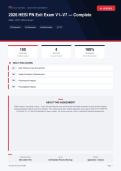
PRACTICAL NURSING · OBJECTIVE ASSESSMENT A+ VERIFIED
2026 HESI PN Exit Exam V1–V7 — Complete
Official Exam
150 Questions Full Rationales Verified Answers V1–V7
150 4 100%
QUESTIONS SECTIONS RATIONALES
Complete coverage Core exam domains Every answer explained
WHAT THIS COVERS
01 Safe, Effective Care Environment
02 Health Promotion & Maintenance
03 Psychosocial Integrity
04 Physiological Integrity
ABOUT THIS ASSESSMENT
Build mastery in practical nursing — from safe and effective care environment and health promotion to psychosocial integrity
and physiological integrity across the lifespan. This original study bank targets application and analysis skills for the HESI PN
Exit Exam V1–V7, with full rationales for every answer. For review use only; not an institutional proctored assessment.
PASSING SCORE LEVEL FORMAT
850 scaled (75%) Intermediate (Practical Nursing) Application / Analysis
STUVIA ACTUAL EXAM Page 1
, SECTION 1: Safe, Effective Care Environment
Q1. A practical nurse is preparing to administer medications on a medical-surgical unit. The nurse notices that the
electronic medication administration record (eMAR) for one client shows a newly ordered antibiotic that was entered by a
night-shift nurse but has not yet been verified by the pharmacy. The client is due for the first dose in 15 minutes. Which
action should the nurse take first?
A. Administer the dose as scheduled and document the verification later
B. Contact the pharmacy to confirm the order and obtain verification before giving the medication
C. Ask the charge nurse to co-sign the administration
D. Hold the medication until the next scheduled dose and notify the provider
Correct Answer: B
Rationale: Medication safety requires that all orders be verified by pharmacy before the first dose is given. Contacting the pharmacy
ensures the order is accurate and complete, preventing potential medication errors. Administering without verification or delaying without
clarification both increase risk to the client.
Q2. During a shift change handoff, a practical nurse receives report on a client who is on contact precautions for MRSA.
The off-going nurse states the client has a stage 2 pressure injury on the coccyx that was measured yesterday. Which
infection-control action is the priority when the oncoming nurse enters the room to perform a wound assessment?
A. Don gloves only after removing the existing dressing
B. Perform hand hygiene and don gloves and gown before entering the room
C. Wear a surgical mask and eye protection while measuring the wound
D. Place the client in a private room only if the culture is positive
Correct Answer: A
Rationale: Contact precautions for MRSA require gown and gloves upon room entry to prevent transmission. Hand hygiene before
donning PPE is essential. Mask and eye protection are not routinely required for contact precautions unless splash risk exists. Private
room status is already indicated by the isolation order.
Q3. A practical nurse is caring for four clients. Which client should the nurse assess first after receiving shift report?
A. A client with a recent total hip replacement who reports 4/10 pain at the surgical site
B. A client with type 2 diabetes whose morning blood glucose is 148 mg/dL
C. A client who received a new order for continuous bladder irrigation and has dark red urine with clots
D. A client scheduled for discharge later today who needs teaching on wound care
Correct Answer: B
Rationale: Dark red urine with clots after continuous bladder irrigation may indicate active bleeding or catheter obstruction and requires
immediate assessment. The other clients have expected findings or non-urgent needs.
Q4. While reviewing incident reports from the previous week, a practical nurse notes three falls occurred on the unit, all
involving clients who were attempting to get out of bed without assistance. Which unit-based intervention should the nurse
recommend to the charge nurse as the highest priority?
A. Increase the number of sitters for every client with a fall-risk score above 10
B. Implement hourly purposeful rounding with a focus on toileting needs and proximity of call lights
C. Place all fall-risk clients in rooms closest to the nurses’ station
D. Require two nurses to assist every fall-risk client with ambulation
Correct Answer: C
Rationale: Hourly purposeful rounding addresses the most common reason for unassisted exits (toileting and needing items within
reach) and has strong evidence for reducing falls. Blanket sitters or room moves are resource-intensive and less targeted.
STUVIA ACTUAL EXAM · Page 2
,Q5. A practical nurse is preparing to insert an indwelling urinary catheter in a female client. After opening the sterile kit and
donning sterile gloves, the nurse accidentally brushes the sterile drape against the client’s non-sterile bed linen. Which
action is most appropriate?
A. Continue with the procedure because the drape is still largely sterile
B. Discard the contaminated drape and obtain a new sterile kit
C. Ask another nurse to hold the drape away from the linen while proceeding
D. Clean the drape with an antiseptic wipe and proceed
Correct Answer: B
Rationale: Any break in sterile technique requires restarting with a new sterile field. Continuing with a contaminated drape risks
introducing pathogens into the urinary tract.
Q6. The practical nurse is reviewing laboratory results for a client who is scheduled for surgery in two hours. The client’s
potassium is 2.9 mEq/L. Which action should the nurse take?
A. Document the result and continue preparing the client for surgery
B. Notify the surgeon and the charge nurse of the critical value immediately
C. Administer a potassium supplement from the unit stock without an order
D. Wait until after surgery to address the electrolyte imbalance
Correct Answer: A
Rationale: Hypokalemia is a critical finding that increases the risk of cardiac dysrhythmias under anesthesia. Immediate notification of
the surgeon and charge nurse is required so the procedure can be delayed or the imbalance corrected.
Q7. A practical nurse discovers that a client who was to receive a unit of packed red blood cells has the wrong blood type
hanging and approximately 50 mL has already infused. The client reports feeling warm and has a new rash on the chest.
Which action should the nurse take first?
A. Slow the infusion rate and monitor vital signs every 15 minutes
B. Stop the transfusion, keep the IV line open with normal saline, and notify the provider
C. Administer diphenhydramine as ordered and continue the transfusion
D. Remove the IV catheter and apply pressure to the site
Correct Answer: C
Rationale: Any suspected transfusion reaction requires immediate cessation of the blood product, maintenance of IV access with normal
saline, and prompt notification of the provider. Continuing or slowing the infusion can worsen the reaction.
Q8. During a fire drill, the practical nurse is caring for a client who is on a ventilator and cannot be moved quickly. Which
fire-response priority is correct for this situation?
A. Immediately evacuate the client to the nearest stairwell
B. Rescue the client if possible, then activate the alarm and contain the fire
C. Leave the client and assist ambulatory clients first
D. Turn off the oxygen and wait for the fire department
Correct Answer: C
Rationale: The RACE protocol prioritizes Rescue of clients in immediate danger when it can be done safely. For a ventilator-dependent
client, the nurse must ensure airway support while moving the client only as far as needed to a safe zone, then complete the remaining
steps.
STUVIA ACTUAL EXAM · Page 3
, Q9. A practical nurse is reviewing the medication administration record and notices that two clients on the same unit have
similar names and birthdates that differ by only one year. Which action best reduces the risk of a wrong-client medication
error?
A. Administer medications to both clients at the same time to stay efficient
B. Use two unique identifiers and compare them to the eMAR and the client’s wristband before each medication
C. Ask each client to confirm their room number before giving medications
D. Rely solely on the room number posted on the medication cart
Correct Answer: B
Rationale: Using two unique identifiers (name and date of birth or medical record number) verified against both the eMAR and the
wristband is the standard safety practice for preventing wrong-client errors, especially with similar names.
Q10. A client who is confused attempts to climb over the side rails of the bed. The practical nurse has already lowered the
bed, placed a bed alarm, and ensured the call light is within reach. Which additional intervention is most appropriate?
A. Apply bilateral wrist restraints to prevent further attempts
B. Request a sitter or move the client closer to the nurses’ station and increase observation
C. Raise all four side rails and document the fall-risk score
D. Administer a PRN sedative ordered for sleep
Correct Answer: C
Rationale: Least-restrictive measures come first. Increasing observation or providing a sitter is preferred over restraints. Raising all four
rails is a restraint and increases fall risk; sedation is not the first-line response to confusion-related exit attempts.
Q11. The practical nurse is preparing to administer an intramuscular injection of ceftriaxone to an adult client. Which site
selection and technique is correct?
A. Deltoid muscle, 5/8-inch needle, 45-degree angle
B. Ventrogluteal muscle, 1- to 1.5-inch needle, 90-degree angle
C. Dorsogluteal muscle, 1-inch needle, 90-degree angle
D. Vastus lateralis, ½-inch needle, 45-degree angle
Correct Answer: D
Rationale: The ventrogluteal site is preferred for IM injections in adults because it is free of major nerves and vessels. A 1- to 1.5-inch
needle at 90 degrees ensures the medication reaches muscle tissue.
Q12. A practical nurse observes a colleague preparing to leave the unit with a controlled substance in a paper cup to
administer to a client who is off the unit for a procedure. Which response is most appropriate?
A. Ignore the situation because the colleague is experienced
B. Remind the colleague that controlled substances must remain secured and be transported according to facility policy
C. Offer to administer the medication later when the client returns
D. Report the colleague to the board of nursing immediately
Correct Answer: B
Rationale: Controlled substances must be handled according to institutional and legal requirements. Addressing the deviation promptly
with the colleague protects both client safety and regulatory compliance; immediate board reporting is not the first step for a single
observed policy breach.
STUVIA ACTUAL EXAM · Page 4
2026 HESI PN Exit Exam V1–V7 — Complete
Official Exam
150 Questions Full Rationales Verified Answers V1–V7
150 4 100%
QUESTIONS SECTIONS RATIONALES
Complete coverage Core exam domains Every answer explained
WHAT THIS COVERS
01 Safe, Effective Care Environment
02 Health Promotion & Maintenance
03 Psychosocial Integrity
04 Physiological Integrity
ABOUT THIS ASSESSMENT
Build mastery in practical nursing — from safe and effective care environment and health promotion to psychosocial integrity
and physiological integrity across the lifespan. This original study bank targets application and analysis skills for the HESI PN
Exit Exam V1–V7, with full rationales for every answer. For review use only; not an institutional proctored assessment.
PASSING SCORE LEVEL FORMAT
850 scaled (75%) Intermediate (Practical Nursing) Application / Analysis
STUVIA ACTUAL EXAM Page 1
, SECTION 1: Safe, Effective Care Environment
Q1. A practical nurse is preparing to administer medications on a medical-surgical unit. The nurse notices that the
electronic medication administration record (eMAR) for one client shows a newly ordered antibiotic that was entered by a
night-shift nurse but has not yet been verified by the pharmacy. The client is due for the first dose in 15 minutes. Which
action should the nurse take first?
A. Administer the dose as scheduled and document the verification later
B. Contact the pharmacy to confirm the order and obtain verification before giving the medication
C. Ask the charge nurse to co-sign the administration
D. Hold the medication until the next scheduled dose and notify the provider
Correct Answer: B
Rationale: Medication safety requires that all orders be verified by pharmacy before the first dose is given. Contacting the pharmacy
ensures the order is accurate and complete, preventing potential medication errors. Administering without verification or delaying without
clarification both increase risk to the client.
Q2. During a shift change handoff, a practical nurse receives report on a client who is on contact precautions for MRSA.
The off-going nurse states the client has a stage 2 pressure injury on the coccyx that was measured yesterday. Which
infection-control action is the priority when the oncoming nurse enters the room to perform a wound assessment?
A. Don gloves only after removing the existing dressing
B. Perform hand hygiene and don gloves and gown before entering the room
C. Wear a surgical mask and eye protection while measuring the wound
D. Place the client in a private room only if the culture is positive
Correct Answer: A
Rationale: Contact precautions for MRSA require gown and gloves upon room entry to prevent transmission. Hand hygiene before
donning PPE is essential. Mask and eye protection are not routinely required for contact precautions unless splash risk exists. Private
room status is already indicated by the isolation order.
Q3. A practical nurse is caring for four clients. Which client should the nurse assess first after receiving shift report?
A. A client with a recent total hip replacement who reports 4/10 pain at the surgical site
B. A client with type 2 diabetes whose morning blood glucose is 148 mg/dL
C. A client who received a new order for continuous bladder irrigation and has dark red urine with clots
D. A client scheduled for discharge later today who needs teaching on wound care
Correct Answer: B
Rationale: Dark red urine with clots after continuous bladder irrigation may indicate active bleeding or catheter obstruction and requires
immediate assessment. The other clients have expected findings or non-urgent needs.
Q4. While reviewing incident reports from the previous week, a practical nurse notes three falls occurred on the unit, all
involving clients who were attempting to get out of bed without assistance. Which unit-based intervention should the nurse
recommend to the charge nurse as the highest priority?
A. Increase the number of sitters for every client with a fall-risk score above 10
B. Implement hourly purposeful rounding with a focus on toileting needs and proximity of call lights
C. Place all fall-risk clients in rooms closest to the nurses’ station
D. Require two nurses to assist every fall-risk client with ambulation
Correct Answer: C
Rationale: Hourly purposeful rounding addresses the most common reason for unassisted exits (toileting and needing items within
reach) and has strong evidence for reducing falls. Blanket sitters or room moves are resource-intensive and less targeted.
STUVIA ACTUAL EXAM · Page 2
,Q5. A practical nurse is preparing to insert an indwelling urinary catheter in a female client. After opening the sterile kit and
donning sterile gloves, the nurse accidentally brushes the sterile drape against the client’s non-sterile bed linen. Which
action is most appropriate?
A. Continue with the procedure because the drape is still largely sterile
B. Discard the contaminated drape and obtain a new sterile kit
C. Ask another nurse to hold the drape away from the linen while proceeding
D. Clean the drape with an antiseptic wipe and proceed
Correct Answer: B
Rationale: Any break in sterile technique requires restarting with a new sterile field. Continuing with a contaminated drape risks
introducing pathogens into the urinary tract.
Q6. The practical nurse is reviewing laboratory results for a client who is scheduled for surgery in two hours. The client’s
potassium is 2.9 mEq/L. Which action should the nurse take?
A. Document the result and continue preparing the client for surgery
B. Notify the surgeon and the charge nurse of the critical value immediately
C. Administer a potassium supplement from the unit stock without an order
D. Wait until after surgery to address the electrolyte imbalance
Correct Answer: A
Rationale: Hypokalemia is a critical finding that increases the risk of cardiac dysrhythmias under anesthesia. Immediate notification of
the surgeon and charge nurse is required so the procedure can be delayed or the imbalance corrected.
Q7. A practical nurse discovers that a client who was to receive a unit of packed red blood cells has the wrong blood type
hanging and approximately 50 mL has already infused. The client reports feeling warm and has a new rash on the chest.
Which action should the nurse take first?
A. Slow the infusion rate and monitor vital signs every 15 minutes
B. Stop the transfusion, keep the IV line open with normal saline, and notify the provider
C. Administer diphenhydramine as ordered and continue the transfusion
D. Remove the IV catheter and apply pressure to the site
Correct Answer: C
Rationale: Any suspected transfusion reaction requires immediate cessation of the blood product, maintenance of IV access with normal
saline, and prompt notification of the provider. Continuing or slowing the infusion can worsen the reaction.
Q8. During a fire drill, the practical nurse is caring for a client who is on a ventilator and cannot be moved quickly. Which
fire-response priority is correct for this situation?
A. Immediately evacuate the client to the nearest stairwell
B. Rescue the client if possible, then activate the alarm and contain the fire
C. Leave the client and assist ambulatory clients first
D. Turn off the oxygen and wait for the fire department
Correct Answer: C
Rationale: The RACE protocol prioritizes Rescue of clients in immediate danger when it can be done safely. For a ventilator-dependent
client, the nurse must ensure airway support while moving the client only as far as needed to a safe zone, then complete the remaining
steps.
STUVIA ACTUAL EXAM · Page 3
, Q9. A practical nurse is reviewing the medication administration record and notices that two clients on the same unit have
similar names and birthdates that differ by only one year. Which action best reduces the risk of a wrong-client medication
error?
A. Administer medications to both clients at the same time to stay efficient
B. Use two unique identifiers and compare them to the eMAR and the client’s wristband before each medication
C. Ask each client to confirm their room number before giving medications
D. Rely solely on the room number posted on the medication cart
Correct Answer: B
Rationale: Using two unique identifiers (name and date of birth or medical record number) verified against both the eMAR and the
wristband is the standard safety practice for preventing wrong-client errors, especially with similar names.
Q10. A client who is confused attempts to climb over the side rails of the bed. The practical nurse has already lowered the
bed, placed a bed alarm, and ensured the call light is within reach. Which additional intervention is most appropriate?
A. Apply bilateral wrist restraints to prevent further attempts
B. Request a sitter or move the client closer to the nurses’ station and increase observation
C. Raise all four side rails and document the fall-risk score
D. Administer a PRN sedative ordered for sleep
Correct Answer: C
Rationale: Least-restrictive measures come first. Increasing observation or providing a sitter is preferred over restraints. Raising all four
rails is a restraint and increases fall risk; sedation is not the first-line response to confusion-related exit attempts.
Q11. The practical nurse is preparing to administer an intramuscular injection of ceftriaxone to an adult client. Which site
selection and technique is correct?
A. Deltoid muscle, 5/8-inch needle, 45-degree angle
B. Ventrogluteal muscle, 1- to 1.5-inch needle, 90-degree angle
C. Dorsogluteal muscle, 1-inch needle, 90-degree angle
D. Vastus lateralis, ½-inch needle, 45-degree angle
Correct Answer: D
Rationale: The ventrogluteal site is preferred for IM injections in adults because it is free of major nerves and vessels. A 1- to 1.5-inch
needle at 90 degrees ensures the medication reaches muscle tissue.
Q12. A practical nurse observes a colleague preparing to leave the unit with a controlled substance in a paper cup to
administer to a client who is off the unit for a procedure. Which response is most appropriate?
A. Ignore the situation because the colleague is experienced
B. Remind the colleague that controlled substances must remain secured and be transported according to facility policy
C. Offer to administer the medication later when the client returns
D. Report the colleague to the board of nursing immediately
Correct Answer: B
Rationale: Controlled substances must be handled according to institutional and legal requirements. Addressing the deviation promptly
with the colleague protects both client safety and regulatory compliance; immediate board reporting is not the first step for a single
observed policy breach.
STUVIA ACTUAL EXAM · Page 4


