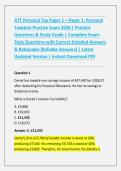
ATT Personal Tax Paper 1 – Paper 1: Personal
Taxation Practice Exam 2026 | Practice
Questions & Study Guide | Complete Exam-
Style Questions with Correct Detailed Answers
& Rationales (Reliable Answers) | Latest
Updated Version | Instant Download PDf
Question 1
Daniel has taxable non-savings income of £47,430 for 2026/27
after deducting his Personal Allowance. He has no savings or
dividend income.
What is Daniel's Income Tax liability?
A. £9,486
B. £10,692
C. £11,432
D. £18,972
Answer: C. £11,432
Daniel's first £37,700 of taxable income is taxed at 20%,
producing £7,540. His remaining £9,730 is taxed at 40%,
producing £3,892. Therefore, his total Income Tax liability is
,£7,540 + £3,892 = £11,432. The key point is that the basic-rate
band is applied first, with only the excess above £37,700 being
charged at the higher rate.
Question 2
For 2026/27, Olivia has adjusted net income of £110,000. She
has no Gift Aid donations or pension contributions that affect
the calculation of her adjusted net income.
What is her Personal Allowance?
A. £12,570
B. £10,000
C. £7,570
D. £2,570
Answer: C. £7,570
The Personal Allowance is reduced by £1 for every £2 of
adjusted net income above £100,000. Olivia is £10,000 above
the £100,000 threshold, so her allowance is reduced by £5,000.
The standard allowance of £12,570 therefore becomes £7,570.
The allowance is fully eliminated once adjusted net income
reaches £125,140.
Question 3
,Amir has taxable non-savings income of £3,000 for 2026/27 and
savings income of £2,000. He has no dividend income.
Which statement best describes the treatment of his savings
income?
A. All £2,000 is taxed at 20%
B. All £2,000 is taxed at 40%
C. The £2,000 savings income can fall within the 0% starting
rate for savings
D. The savings income is automatically exempt because it is
below £5,000
Answer: C. The £2,000 savings income can fall within the 0%
starting rate for savings
The starting rate for savings can apply where an individual's
non-savings income is below £5,000. Amir has only £3,000 of
taxable non-savings income, leaving room within the £5,000
starting-rate limit for savings income. The starting rate is not a
general savings allowance and does not mean that all savings
income below £5,000 is automatically exempt. The individual's
income ordering and available bands must be considered.
Question 4
, For 2026/27, Priya receives dividends of £10,000. Her taxable
non-dividend income uses £20,000 of her basic-rate band. No
other reliefs or allowances apply.
How much of her dividend income is covered by the dividend
allowance?
A. £250
B. £300
C. £500
D. £1,000
Answer: C. £500
The dividend allowance for 2026/27 is £500. It is not an
additional Personal Allowance and does not make the
underlying dividend income disappear for band purposes. Priya
therefore has £500 of her £10,000 dividend income covered by
the dividend allowance, leaving £9,500 potentially taxable at
the applicable dividend rate.
Question 5
Which 2026/27 dividend tax rate applies to dividend income
falling within an individual's basic-rate band?
A. 8.75%
B. 10.75%
Taxation Practice Exam 2026 | Practice
Questions & Study Guide | Complete Exam-
Style Questions with Correct Detailed Answers
& Rationales (Reliable Answers) | Latest
Updated Version | Instant Download PDf
Question 1
Daniel has taxable non-savings income of £47,430 for 2026/27
after deducting his Personal Allowance. He has no savings or
dividend income.
What is Daniel's Income Tax liability?
A. £9,486
B. £10,692
C. £11,432
D. £18,972
Answer: C. £11,432
Daniel's first £37,700 of taxable income is taxed at 20%,
producing £7,540. His remaining £9,730 is taxed at 40%,
producing £3,892. Therefore, his total Income Tax liability is
,£7,540 + £3,892 = £11,432. The key point is that the basic-rate
band is applied first, with only the excess above £37,700 being
charged at the higher rate.
Question 2
For 2026/27, Olivia has adjusted net income of £110,000. She
has no Gift Aid donations or pension contributions that affect
the calculation of her adjusted net income.
What is her Personal Allowance?
A. £12,570
B. £10,000
C. £7,570
D. £2,570
Answer: C. £7,570
The Personal Allowance is reduced by £1 for every £2 of
adjusted net income above £100,000. Olivia is £10,000 above
the £100,000 threshold, so her allowance is reduced by £5,000.
The standard allowance of £12,570 therefore becomes £7,570.
The allowance is fully eliminated once adjusted net income
reaches £125,140.
Question 3
,Amir has taxable non-savings income of £3,000 for 2026/27 and
savings income of £2,000. He has no dividend income.
Which statement best describes the treatment of his savings
income?
A. All £2,000 is taxed at 20%
B. All £2,000 is taxed at 40%
C. The £2,000 savings income can fall within the 0% starting
rate for savings
D. The savings income is automatically exempt because it is
below £5,000
Answer: C. The £2,000 savings income can fall within the 0%
starting rate for savings
The starting rate for savings can apply where an individual's
non-savings income is below £5,000. Amir has only £3,000 of
taxable non-savings income, leaving room within the £5,000
starting-rate limit for savings income. The starting rate is not a
general savings allowance and does not mean that all savings
income below £5,000 is automatically exempt. The individual's
income ordering and available bands must be considered.
Question 4
, For 2026/27, Priya receives dividends of £10,000. Her taxable
non-dividend income uses £20,000 of her basic-rate band. No
other reliefs or allowances apply.
How much of her dividend income is covered by the dividend
allowance?
A. £250
B. £300
C. £500
D. £1,000
Answer: C. £500
The dividend allowance for 2026/27 is £500. It is not an
additional Personal Allowance and does not make the
underlying dividend income disappear for band purposes. Priya
therefore has £500 of her £10,000 dividend income covered by
the dividend allowance, leaving £9,500 potentially taxable at
the applicable dividend rate.
Question 5
Which 2026/27 dividend tax rate applies to dividend income
falling within an individual's basic-rate band?
A. 8.75%
B. 10.75%