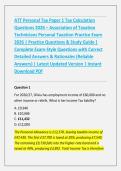
ATT Personal Tax Paper 1 Tax Calculation
Questions 2026 – Association of Taxation
Technicians Personal Taxation Practice Exam
2026 | Practice Questions & Study Guide |
Complete Exam-Style Questions with Correct
Detailed Answers & Rationales (Reliable
Answers) | Latest Updated Version | Instant
Download PDf
Question 1
For 2026/27, Olivia has employment income of £60,000 and no
other income or reliefs. What is her Income Tax liability?
A. £9,940
B. £10,686
C. £11,432
D. £12,000
The Personal Allowance is £12,570, leaving taxable income of
£47,430. The first £37,700 is taxed at 20%, producing £7,540.
The remaining £9,730 falls into the higher-rate band and is
taxed at 40%, producing £3,892. Total Income Tax is therefore
,£7,540 + £3,892 = £11,432. The calculation assumes Olivia is
not affected by the Personal Allowance taper.
Question 2
Daniel has adjusted net income of £110,000 for 2026/27.
Ignoring pension contributions and Gift Aid, what is his
Personal Allowance?
A. £12,570
B. £10,000
C. £7,570
D. £7,570
The Personal Allowance is reduced by £1 for every £2 of
adjusted net income above £100,000. Daniel is £10,000 above
the threshold, so the reduction is £5,000. His Personal
Allowance is therefore £12,570 − £5,000 = £7,570. The taper
can reduce the allowance to nil once adjusted net income
reaches £125,140.
Question 3
Amira has employment income of £16,000 and savings interest
of £2,000 in 2026/27. Which statement is correct concerning
the starting rate for savings?
,A. She receives no starting-rate benefit because she has
employment income.
B. Her starting-rate band is £1,570.
C. Her £2,000 savings interest can fall within the starting-rate-
for-savings band and be taxed at 0%.
D. The savings interest is automatically taxed at 20%.
Amira's employment income above the Personal Allowance is
£3,430 (£16,000 − £12,570). The £5,000 starting-rate-for-
savings limit is reduced by this amount, leaving £1,570 of
starting-rate capacity. The remaining £430 of interest can
potentially be covered by the Personal Savings Allowance
because she is a basic-rate taxpayer. Therefore, the entire
£2,000 interest can be sheltered from Income Tax in this
scenario.
Question 4
In 2026/27, Marcus receives £55,000 of non-savings income
and £2,000 of bank interest. He has used his Personal
Allowance against his non-savings income. What Personal
Savings Allowance is generally available to him?
A. £2,000
B. £1,000
, C. £500
D. Nil
Marcus is a higher-rate taxpayer because his taxable non-
savings income exceeds the basic-rate band. A higher-rate
taxpayer normally receives a Personal Savings Allowance of
£500. The allowance is applied to savings income after
considering the taxpayer's overall tax position. Therefore, £500
of the £2,000 interest can be covered by the Personal Savings
Allowance, subject to the normal ordering rules.
Question 5
For 2026/27, Priya has taxable non-savings income of £30,000
and taxable savings income of £8,000. Ignoring the Personal
Savings Allowance, how much of the savings income falls within
the basic-rate band?
A. £0
B. £7,700
C. £8,000
D. £37,700
The basic-rate band is £37,700. Priya has already used £30,000
of that band with her non-savings income, leaving £7,700.
Therefore, £7,700 of the savings income falls within the basic-
rate band and the remaining £300 is taxed at the higher savings
Questions 2026 – Association of Taxation
Technicians Personal Taxation Practice Exam
2026 | Practice Questions & Study Guide |
Complete Exam-Style Questions with Correct
Detailed Answers & Rationales (Reliable
Answers) | Latest Updated Version | Instant
Download PDf
Question 1
For 2026/27, Olivia has employment income of £60,000 and no
other income or reliefs. What is her Income Tax liability?
A. £9,940
B. £10,686
C. £11,432
D. £12,000
The Personal Allowance is £12,570, leaving taxable income of
£47,430. The first £37,700 is taxed at 20%, producing £7,540.
The remaining £9,730 falls into the higher-rate band and is
taxed at 40%, producing £3,892. Total Income Tax is therefore
,£7,540 + £3,892 = £11,432. The calculation assumes Olivia is
not affected by the Personal Allowance taper.
Question 2
Daniel has adjusted net income of £110,000 for 2026/27.
Ignoring pension contributions and Gift Aid, what is his
Personal Allowance?
A. £12,570
B. £10,000
C. £7,570
D. £7,570
The Personal Allowance is reduced by £1 for every £2 of
adjusted net income above £100,000. Daniel is £10,000 above
the threshold, so the reduction is £5,000. His Personal
Allowance is therefore £12,570 − £5,000 = £7,570. The taper
can reduce the allowance to nil once adjusted net income
reaches £125,140.
Question 3
Amira has employment income of £16,000 and savings interest
of £2,000 in 2026/27. Which statement is correct concerning
the starting rate for savings?
,A. She receives no starting-rate benefit because she has
employment income.
B. Her starting-rate band is £1,570.
C. Her £2,000 savings interest can fall within the starting-rate-
for-savings band and be taxed at 0%.
D. The savings interest is automatically taxed at 20%.
Amira's employment income above the Personal Allowance is
£3,430 (£16,000 − £12,570). The £5,000 starting-rate-for-
savings limit is reduced by this amount, leaving £1,570 of
starting-rate capacity. The remaining £430 of interest can
potentially be covered by the Personal Savings Allowance
because she is a basic-rate taxpayer. Therefore, the entire
£2,000 interest can be sheltered from Income Tax in this
scenario.
Question 4
In 2026/27, Marcus receives £55,000 of non-savings income
and £2,000 of bank interest. He has used his Personal
Allowance against his non-savings income. What Personal
Savings Allowance is generally available to him?
A. £2,000
B. £1,000
, C. £500
D. Nil
Marcus is a higher-rate taxpayer because his taxable non-
savings income exceeds the basic-rate band. A higher-rate
taxpayer normally receives a Personal Savings Allowance of
£500. The allowance is applied to savings income after
considering the taxpayer's overall tax position. Therefore, £500
of the £2,000 interest can be covered by the Personal Savings
Allowance, subject to the normal ordering rules.
Question 5
For 2026/27, Priya has taxable non-savings income of £30,000
and taxable savings income of £8,000. Ignoring the Personal
Savings Allowance, how much of the savings income falls within
the basic-rate band?
A. £0
B. £7,700
C. £8,000
D. £37,700
The basic-rate band is £37,700. Priya has already used £30,000
of that band with her non-savings income, leaving £7,700.
Therefore, £7,700 of the savings income falls within the basic-
rate band and the remaining £300 is taxed at the higher savings