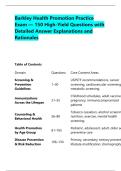
Barkley Health Promotion Practice
Exam — 150 High-Yield Questions with
Detailed Answer Explanations and
Rationales
Table of Contents
Domain Questions Core Content Areas
Screening & USPSTF recommendations, cancer
Prevention 1–30 screening, cardiovascular screening
Guidelines metabolic screening
Childhood schedules, adult vaccines
Immunizations
31–55 pregnancy, immunocompromised
Across the Lifespan
patients
Tobacco cessation, alcohol screenin
Counseling &
56–80 nutrition, exercise, mental health
Behavioral Health
screening
Health Promotion Pediatric, adolescent, adult, older ad
81–105
by Age Group preventive care
Disease Prevention Primary, secondary, tertiary prevent
106–130
& Risk Reduction lifestyle modification; chemoprophy
,Domain Questions Core Content Areas
Special Populations LGBTQ+ health, cultural considerati
131–150
& Health Equity social determinants, global health
Section 1: Screening & Prevention Guidelines (Questions 1–
30)
1. A 55-year-old woman of average risk asks when she can
stop screening mammography. According to the USPSTF,
the recommendation is to:
A) Stop at age 65
B) Stop at age 70
C) Continue biennial screening through age 74, with insufficient
evidence for women ≥75
D) Continue annual screening for life
Correct Answer: C
Rationale: The USPSTF recommends biennial screening
mammography for women aged 50–74. For women ≥75,
evidence is insufficient to assess the balance of benefits and
harms. The decision should be individualized based on the
patient's preferences and health status.
2. A 50-year-old man at average risk asks about colorectal
cancer screening. Which of the following is a recommended
option by the USPSTF?
A) Fecal immunochemical test (FIT) annually
B) Colonoscopy every 10 years
C) CT colonography every 5 years
D) All of the above
Correct Answer: D
,Rationale: The USPSTF recommends screening for adults
aged 45–75 using one of several strategies, including FIT
annually, colonoscopy every 10 years, FIT-DNA every 3
years, CT colonography every 5 years, or flexible
sigmoidoscopy every 5 years (with FIT annually).
3. A 55-year-old woman with no chronic conditions asks
which screening tests are recommended for her age.
According to the USPSTF, which combination of screenings
should the NP recommend?
A) Mammogram every 2 years, colonoscopy every 10 years,
annual Pap smear
B) Mammogram every 2 years, colonoscopy every 10 years, Pap
smear every 3 years or HPV testing every 5 years
C) Mammogram annually, colonoscopy every 5 years, Pap
smear every 5 years
D) Mammogram annually, CT colonography every 5 years, Pap
smear every year
Correct Answer: B
Rationale: For average-risk women aged 50–74, USPSTF
recommends biennial mammography. Colorectal cancer
screening (colonoscopy every 10 years) is recommended
from ages 45–75. Cervical cancer screening: Pap smear
every 3 years (age 21–65) or primary HPV testing every 5
years (age 30–65). Annual Pap is not recommended.
4. A 65-year-old man with a 40-pack-year smoking history
asks about lung cancer screening. According to USPSTF,
which of the following criteria must be met for annual low-
dose CT screening?
A) Age 55–80, current smoker, any smoking history
B) Age 50–80, ≥20 pack-year history, currently smoke or quit
, within the past 15 years
C) Age 60–75, ≥30 pack-year history, quit within 5 years
D) Age 50–70, any smoking history, family history of lung
cancer
Correct Answer: B
Rationale: USPSTF recommends annual low-dose CT for
adults aged 50–80 with a ≥20 pack-year history who
currently smoke or have quit within the past 15 years.
Screening stops if the person has not smoked for 15 years
or develops a health problem limiting life expectancy.
5. A 65-year-old man asks which vaccines he needs.
According to the CDC, he should receive all of the following
EXCEPT:
A) Influenza (inactivated) annually
B) Tdap (once, then Td booster every 10 years)
C) Shingrix (recombinant zoster vaccine)
D) MMR (live attenuated)
Correct Answer: D
Rationale: Adults born before 1957 are generally
considered immune to measles, mumps, and rubella. MMR
is not routinely given to this age group unless there is a
specific indication (e.g., lack of immunity). The other
vaccines are recommended.
6. A 30-year-old woman with no chronic conditions
presents for a well-woman exam. Her blood pressure is
118/76 mmHg, BMI 22. She exercises regularly. What is the
appropriate interval for lipid screening?
A) Every 5 years
B) Every 2 years
Exam — 150 High-Yield Questions with
Detailed Answer Explanations and
Rationales
Table of Contents
Domain Questions Core Content Areas
Screening & USPSTF recommendations, cancer
Prevention 1–30 screening, cardiovascular screening
Guidelines metabolic screening
Childhood schedules, adult vaccines
Immunizations
31–55 pregnancy, immunocompromised
Across the Lifespan
patients
Tobacco cessation, alcohol screenin
Counseling &
56–80 nutrition, exercise, mental health
Behavioral Health
screening
Health Promotion Pediatric, adolescent, adult, older ad
81–105
by Age Group preventive care
Disease Prevention Primary, secondary, tertiary prevent
106–130
& Risk Reduction lifestyle modification; chemoprophy
,Domain Questions Core Content Areas
Special Populations LGBTQ+ health, cultural considerati
131–150
& Health Equity social determinants, global health
Section 1: Screening & Prevention Guidelines (Questions 1–
30)
1. A 55-year-old woman of average risk asks when she can
stop screening mammography. According to the USPSTF,
the recommendation is to:
A) Stop at age 65
B) Stop at age 70
C) Continue biennial screening through age 74, with insufficient
evidence for women ≥75
D) Continue annual screening for life
Correct Answer: C
Rationale: The USPSTF recommends biennial screening
mammography for women aged 50–74. For women ≥75,
evidence is insufficient to assess the balance of benefits and
harms. The decision should be individualized based on the
patient's preferences and health status.
2. A 50-year-old man at average risk asks about colorectal
cancer screening. Which of the following is a recommended
option by the USPSTF?
A) Fecal immunochemical test (FIT) annually
B) Colonoscopy every 10 years
C) CT colonography every 5 years
D) All of the above
Correct Answer: D
,Rationale: The USPSTF recommends screening for adults
aged 45–75 using one of several strategies, including FIT
annually, colonoscopy every 10 years, FIT-DNA every 3
years, CT colonography every 5 years, or flexible
sigmoidoscopy every 5 years (with FIT annually).
3. A 55-year-old woman with no chronic conditions asks
which screening tests are recommended for her age.
According to the USPSTF, which combination of screenings
should the NP recommend?
A) Mammogram every 2 years, colonoscopy every 10 years,
annual Pap smear
B) Mammogram every 2 years, colonoscopy every 10 years, Pap
smear every 3 years or HPV testing every 5 years
C) Mammogram annually, colonoscopy every 5 years, Pap
smear every 5 years
D) Mammogram annually, CT colonography every 5 years, Pap
smear every year
Correct Answer: B
Rationale: For average-risk women aged 50–74, USPSTF
recommends biennial mammography. Colorectal cancer
screening (colonoscopy every 10 years) is recommended
from ages 45–75. Cervical cancer screening: Pap smear
every 3 years (age 21–65) or primary HPV testing every 5
years (age 30–65). Annual Pap is not recommended.
4. A 65-year-old man with a 40-pack-year smoking history
asks about lung cancer screening. According to USPSTF,
which of the following criteria must be met for annual low-
dose CT screening?
A) Age 55–80, current smoker, any smoking history
B) Age 50–80, ≥20 pack-year history, currently smoke or quit
, within the past 15 years
C) Age 60–75, ≥30 pack-year history, quit within 5 years
D) Age 50–70, any smoking history, family history of lung
cancer
Correct Answer: B
Rationale: USPSTF recommends annual low-dose CT for
adults aged 50–80 with a ≥20 pack-year history who
currently smoke or have quit within the past 15 years.
Screening stops if the person has not smoked for 15 years
or develops a health problem limiting life expectancy.
5. A 65-year-old man asks which vaccines he needs.
According to the CDC, he should receive all of the following
EXCEPT:
A) Influenza (inactivated) annually
B) Tdap (once, then Td booster every 10 years)
C) Shingrix (recombinant zoster vaccine)
D) MMR (live attenuated)
Correct Answer: D
Rationale: Adults born before 1957 are generally
considered immune to measles, mumps, and rubella. MMR
is not routinely given to this age group unless there is a
specific indication (e.g., lack of immunity). The other
vaccines are recommended.
6. A 30-year-old woman with no chronic conditions
presents for a well-woman exam. Her blood pressure is
118/76 mmHg, BMI 22. She exercises regularly. What is the
appropriate interval for lipid screening?
A) Every 5 years
B) Every 2 years