Barkley Geriatrics Practice Exam — 150 High-
Yield Questions with Detailed Answer
Explanations and Rationales
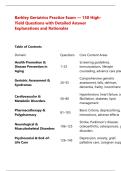
Table of Contents
Domain Questions Core Content Areas
Health Promotion & Screening guidelines,
Disease Prevention in 1–25 immunizations, lifestyle
Aging counseling, advance care plan
Comprehensive geriatric
Geriatric Assessment &
26–55 assessment, falls, delirium,
Syndromes
dementia, frailty, incontinence
Hypertension, heart failure, at
Cardiovascular &
56–80 fibrillation, diabetes, lipid
Metabolic Disorders
management
Pharmacotherapy & Beers Criteria, deprescribing,
81–105
Polypharmacy interactions, adverse effects
Stroke, Parkinson's disease,
Neurological &
106–125 osteoarthritis, osteoporosis, g
Musculoskeletal Disorders
disorders
Psychosocial & End-of- Depression, anxiety, grief,
126–145
Life Care palliative care, caregiver supp
,Domain Questions Core Content Areas
Professional Practice & Scope of practice, reimbursem
146–150
Ethics ethics, quality improvement
The Barkley Adult–Gerontology Primary Care Nurse Practitioner
curriculum includes extensive geriatric content covering
assessment, management, pharmacology, and professional
practice in older adults.
Section 1: Health Promotion & Disease Prevention in Aging
(Questions 1–25)
1. A 68-year-old woman presents for a wellness visit. Which
screening is recommended for all women aged 65 and
older?
A) DEXA scan for osteoporosis
B) Mammography annually
C) Colonoscopy every 5 years
D) Thyroid-stimulating hormone
Correct Answer: A
Rationale: DEXA (dual-energy X-ray absorptiometry) is
recommended for all women aged 65 and older for
osteoporosis screening. Mammography is recommended
through age 74, colonoscopy through age 75, and routine
TSH screening is not recommended.
2. A 72-year-old man with a 40-pack-year smoking history
asks about lung cancer screening. Which recommendation
is most appropriate?
A) Annual chest X-ray
B) Annual low-dose CT (LDCT) of the chest
,C) Sputum cytology every 6 months
D) No screening indicated
Correct Answer: B
Rationale: The USPSTF recommends annual LDCT for adults
aged 50–80 years with a ≥20 pack-year smoking history
who currently smoke or have quit within the past 15 years.
3. A 75-year-old woman presents for a routine visit. Which
immunization is recommended for all adults aged 65 and
older?
A) MMR
B) Pneumococcal vaccine
C) Varicella
D) Hepatitis A
Correct Answer: B
Rationale: Pneumococcal vaccination is recommended for
all adults aged 65 and older. MMR and varicella are
recommended for adults without evidence of immunity.
Hepatitis A is recommended for at-risk populations.
4. Which of the following is a recommended screening for
abdominal aortic aneurysm?
A) All adults aged 65 and older
B) Men aged 65–75 who have ever smoked
C) Women aged 65–75 who have ever smoked
D) All men aged 50 and older
Correct Answer: B
Rationale: The USPSTF recommends one-time screening for
AAA with ultrasound in men aged 65–75 who have ever
, smoked. Screening is not routinely recommended for
women or never-smokers.
5. A 70-year-old woman is being counseled on fall
prevention. Which intervention is most effective in
reducing fall risk?
A) Vitamin D supplementation
B) Regular exercise (strength and balance training)
C) Environmental modification
D) Vision correction
Correct Answer: B
Rationale: Regular exercise, particularly strength and
balance training, is the most effective single intervention
for reducing fall risk in older adults.
6. A 75-year-old man is being counseled on advance care
planning. Which document allows him to specify his wishes
for end-of-life care?
A) Durable power of attorney for healthcare
B) Living will
C) Do not resuscitate order
D) Informed consent
Correct Answer: B
Rationale: A living will specifies the patient's wishes for
end-of-life care, including treatments they do or do not
want. A durable power of attorney designates a healthcare
proxy.
7. Which of the following is a recommended screening for
alcohol misuse in older adults?
A) CAGE questionnaire
Yield Questions with Detailed Answer
Explanations and Rationales
Table of Contents
Domain Questions Core Content Areas
Health Promotion & Screening guidelines,
Disease Prevention in 1–25 immunizations, lifestyle
Aging counseling, advance care plan
Comprehensive geriatric
Geriatric Assessment &
26–55 assessment, falls, delirium,
Syndromes
dementia, frailty, incontinence
Hypertension, heart failure, at
Cardiovascular &
56–80 fibrillation, diabetes, lipid
Metabolic Disorders
management
Pharmacotherapy & Beers Criteria, deprescribing,
81–105
Polypharmacy interactions, adverse effects
Stroke, Parkinson's disease,
Neurological &
106–125 osteoarthritis, osteoporosis, g
Musculoskeletal Disorders
disorders
Psychosocial & End-of- Depression, anxiety, grief,
126–145
Life Care palliative care, caregiver supp
,Domain Questions Core Content Areas
Professional Practice & Scope of practice, reimbursem
146–150
Ethics ethics, quality improvement
The Barkley Adult–Gerontology Primary Care Nurse Practitioner
curriculum includes extensive geriatric content covering
assessment, management, pharmacology, and professional
practice in older adults.
Section 1: Health Promotion & Disease Prevention in Aging
(Questions 1–25)
1. A 68-year-old woman presents for a wellness visit. Which
screening is recommended for all women aged 65 and
older?
A) DEXA scan for osteoporosis
B) Mammography annually
C) Colonoscopy every 5 years
D) Thyroid-stimulating hormone
Correct Answer: A
Rationale: DEXA (dual-energy X-ray absorptiometry) is
recommended for all women aged 65 and older for
osteoporosis screening. Mammography is recommended
through age 74, colonoscopy through age 75, and routine
TSH screening is not recommended.
2. A 72-year-old man with a 40-pack-year smoking history
asks about lung cancer screening. Which recommendation
is most appropriate?
A) Annual chest X-ray
B) Annual low-dose CT (LDCT) of the chest
,C) Sputum cytology every 6 months
D) No screening indicated
Correct Answer: B
Rationale: The USPSTF recommends annual LDCT for adults
aged 50–80 years with a ≥20 pack-year smoking history
who currently smoke or have quit within the past 15 years.
3. A 75-year-old woman presents for a routine visit. Which
immunization is recommended for all adults aged 65 and
older?
A) MMR
B) Pneumococcal vaccine
C) Varicella
D) Hepatitis A
Correct Answer: B
Rationale: Pneumococcal vaccination is recommended for
all adults aged 65 and older. MMR and varicella are
recommended for adults without evidence of immunity.
Hepatitis A is recommended for at-risk populations.
4. Which of the following is a recommended screening for
abdominal aortic aneurysm?
A) All adults aged 65 and older
B) Men aged 65–75 who have ever smoked
C) Women aged 65–75 who have ever smoked
D) All men aged 50 and older
Correct Answer: B
Rationale: The USPSTF recommends one-time screening for
AAA with ultrasound in men aged 65–75 who have ever
, smoked. Screening is not routinely recommended for
women or never-smokers.
5. A 70-year-old woman is being counseled on fall
prevention. Which intervention is most effective in
reducing fall risk?
A) Vitamin D supplementation
B) Regular exercise (strength and balance training)
C) Environmental modification
D) Vision correction
Correct Answer: B
Rationale: Regular exercise, particularly strength and
balance training, is the most effective single intervention
for reducing fall risk in older adults.
6. A 75-year-old man is being counseled on advance care
planning. Which document allows him to specify his wishes
for end-of-life care?
A) Durable power of attorney for healthcare
B) Living will
C) Do not resuscitate order
D) Informed consent
Correct Answer: B
Rationale: A living will specifies the patient's wishes for
end-of-life care, including treatments they do or do not
want. A durable power of attorney designates a healthcare
proxy.
7. Which of the following is a recommended screening for
alcohol misuse in older adults?
A) CAGE questionnaire