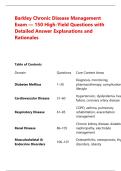
Barkley Chronic Disease Management
Exam — 150 High-Yield Questions with
Detailed Answer Explanations and
Rationales
Table of Contents
Domain Questions Core Content Areas
Diagnosis, monitoring,
Diabetes Mellitus 1–30 pharmacotherapy, complication
lifestyle
Hypertension, dyslipidemia, hea
Cardiovascular Disease 31–60
failure, coronary artery disease
COPD, asthma, pulmonary
Respiratory Disease 61–85 rehabilitation, exacerbation
management
Chronic kidney disease, diabetic
Renal Disease 86–105 nephropathy, electrolyte
management
Musculoskeletal & Osteoarthritis, osteoporosis, thy
106–125
Endocrine Disorders disorders, obesity
,Domain Questions Core Content Areas
Mental Health & Depression, anxiety, polypharma
126–150
Geriatric Chronic Care falls, caregiver support
Barkley & Associates' curriculum includes comprehensive
chronic disease management content across these domains,
reflecting the core competencies required for adult-
gerontology and family nurse practitioner certification.
Section 1: Diabetes Mellitus (Questions 1–30)
1. A 52-year-old man with a BMI of 31 kg/m² presents for a
routine visit. His fasting plasma glucose is 128 mg/dL. What
is the most appropriate next step to confirm the diagnosis
of diabetes?
A) Start metformin immediately
B) Repeat fasting plasma glucose or check HbA1c
C) Order an oral glucose tolerance test
D) Check random blood glucose
Correct Answer: B
Rationale: A single fasting glucose ≥126 mg/dL is
diagnostic of diabetes if confirmed. The diagnosis should
be confirmed with a second abnormal test (repeat fasting
glucose, HbA1c ≥6.5%, or OGTT). Starting medication
without confirmation is premature.
2. A 58-year-old woman with type 2 diabetes has an HbA1c
of 7.8% on metformin 1,000 mg twice daily. She has no
cardiovascular disease or renal impairment. What is the
most appropriate next step?
A) Add a sulfonylurea
,B) Add a GLP-1 receptor agonist
C) Add an SGLT2 inhibitor
D) Add insulin
Correct Answer: C
Rationale: For patients with type 2 diabetes and no
cardiovascular or renal disease, adding an SGLT2 inhibitor
or GLP-1 receptor agonist is recommended if HbA1c is
above target. SGLT2 inhibitors have the added benefit of
weight loss and blood pressure reduction.
3. A 65-year-old man with type 2 diabetes and a history of
myocardial infarction has an HbA1c of 7.2%. His
medications include metformin and lisinopril. What
medication should be added to reduce cardiovascular risk?
A) Sulfonylurea
B) SGLT2 inhibitor
C) DPP-4 inhibitor
D) Insulin
Correct Answer: B
Rationale: For patients with type 2 diabetes and established
atherosclerotic cardiovascular disease, SGLT2 inhibitors or
GLP-1 receptor agonists with proven cardiovascular benefit
are recommended to reduce major adverse cardiovascular
events.
4. A 45-year-old woman with type 1 diabetes presents with
polyuria, polydipsia, and blood glucose of 480 mg/dL. She
is nauseated and has deep, rapid respirations. What is the
most likely diagnosis?
A) Hyperosmolar hyperglycemic state
B) Diabetic ketoacidosis
, C) Hypoglycemia
D) Lactic acidosis
Correct Answer: B
Rationale: Diabetic ketoacidosis (DKA) is characterized by
hyperglycemia, ketosis, and metabolic acidosis. Kussmaul
respirations (deep, rapid breathing) are a compensatory
mechanism for metabolic acidosis. It is more common in
type 1 diabetes.
5. A 70-year-old man with type 2 diabetes has an eGFR of
32 mL/min/1.73 m². Which medication should be avoided?
A) Metformin
B) Insulin
C) Glipizide
D) Sitagliptin
Correct Answer: A
Rationale: Metformin should be avoided when eGFR <30
mL/min/1.73 m² due to the risk of lactic acidosis. It should
be used with caution in patients with eGFR 30–45.
6. A 55-year-old woman with type 2 diabetes asks about
the recommended frequency of HbA1c monitoring. Her
current HbA1c is at goal on stable therapy. What is the
recommended interval?
A) Every month
B) Every 3 months
C) Every 6 months
D) Annually
Correct Answer: C
Exam — 150 High-Yield Questions with
Detailed Answer Explanations and
Rationales
Table of Contents
Domain Questions Core Content Areas
Diagnosis, monitoring,
Diabetes Mellitus 1–30 pharmacotherapy, complication
lifestyle
Hypertension, dyslipidemia, hea
Cardiovascular Disease 31–60
failure, coronary artery disease
COPD, asthma, pulmonary
Respiratory Disease 61–85 rehabilitation, exacerbation
management
Chronic kidney disease, diabetic
Renal Disease 86–105 nephropathy, electrolyte
management
Musculoskeletal & Osteoarthritis, osteoporosis, thy
106–125
Endocrine Disorders disorders, obesity
,Domain Questions Core Content Areas
Mental Health & Depression, anxiety, polypharma
126–150
Geriatric Chronic Care falls, caregiver support
Barkley & Associates' curriculum includes comprehensive
chronic disease management content across these domains,
reflecting the core competencies required for adult-
gerontology and family nurse practitioner certification.
Section 1: Diabetes Mellitus (Questions 1–30)
1. A 52-year-old man with a BMI of 31 kg/m² presents for a
routine visit. His fasting plasma glucose is 128 mg/dL. What
is the most appropriate next step to confirm the diagnosis
of diabetes?
A) Start metformin immediately
B) Repeat fasting plasma glucose or check HbA1c
C) Order an oral glucose tolerance test
D) Check random blood glucose
Correct Answer: B
Rationale: A single fasting glucose ≥126 mg/dL is
diagnostic of diabetes if confirmed. The diagnosis should
be confirmed with a second abnormal test (repeat fasting
glucose, HbA1c ≥6.5%, or OGTT). Starting medication
without confirmation is premature.
2. A 58-year-old woman with type 2 diabetes has an HbA1c
of 7.8% on metformin 1,000 mg twice daily. She has no
cardiovascular disease or renal impairment. What is the
most appropriate next step?
A) Add a sulfonylurea
,B) Add a GLP-1 receptor agonist
C) Add an SGLT2 inhibitor
D) Add insulin
Correct Answer: C
Rationale: For patients with type 2 diabetes and no
cardiovascular or renal disease, adding an SGLT2 inhibitor
or GLP-1 receptor agonist is recommended if HbA1c is
above target. SGLT2 inhibitors have the added benefit of
weight loss and blood pressure reduction.
3. A 65-year-old man with type 2 diabetes and a history of
myocardial infarction has an HbA1c of 7.2%. His
medications include metformin and lisinopril. What
medication should be added to reduce cardiovascular risk?
A) Sulfonylurea
B) SGLT2 inhibitor
C) DPP-4 inhibitor
D) Insulin
Correct Answer: B
Rationale: For patients with type 2 diabetes and established
atherosclerotic cardiovascular disease, SGLT2 inhibitors or
GLP-1 receptor agonists with proven cardiovascular benefit
are recommended to reduce major adverse cardiovascular
events.
4. A 45-year-old woman with type 1 diabetes presents with
polyuria, polydipsia, and blood glucose of 480 mg/dL. She
is nauseated and has deep, rapid respirations. What is the
most likely diagnosis?
A) Hyperosmolar hyperglycemic state
B) Diabetic ketoacidosis
, C) Hypoglycemia
D) Lactic acidosis
Correct Answer: B
Rationale: Diabetic ketoacidosis (DKA) is characterized by
hyperglycemia, ketosis, and metabolic acidosis. Kussmaul
respirations (deep, rapid breathing) are a compensatory
mechanism for metabolic acidosis. It is more common in
type 1 diabetes.
5. A 70-year-old man with type 2 diabetes has an eGFR of
32 mL/min/1.73 m². Which medication should be avoided?
A) Metformin
B) Insulin
C) Glipizide
D) Sitagliptin
Correct Answer: A
Rationale: Metformin should be avoided when eGFR <30
mL/min/1.73 m² due to the risk of lactic acidosis. It should
be used with caution in patients with eGFR 30–45.
6. A 55-year-old woman with type 2 diabetes asks about
the recommended frequency of HbA1c monitoring. Her
current HbA1c is at goal on stable therapy. What is the
recommended interval?
A) Every month
B) Every 3 months
C) Every 6 months
D) Annually
Correct Answer: C