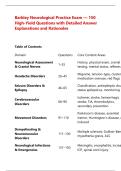
Barkley Neurological Practice Exam — 150
High-Yield Questions with Detailed Answer
Explanations and Rationales
Table of Contents
Domain Questions Core Content Areas
Neurological Assessment History, physical exam, cranial
1–25
& Cranial Nerves testing, mental status, reflexes
Migraine, tension-type, cluster
Headache Disorders 26–45
medication-overuse, red flags
Seizure Disorders & Classification, antiepileptic dru
46–65
Epilepsy status epilepticus, monitoring
Ischemic stroke, hemorrhagic
Cerebrovascular
66–90 stroke, TIA, thrombolytics,
Disorders
secondary prevention
Parkinson's disease, essential
Movement Disorders 91–110 tremor, Huntington's disease, d
induced
Demyelinating &
Multiple sclerosis, Guillain-Barr
Neuromuscular 111–130
myasthenia gravis, ALS
Disorders
Neurological Infections Meningitis, encephalitis, increa
131–150
& Emergencies ICP, spinal cord injury
,Section 1: Neurological Assessment & Cranial Nerves
(Questions 1–25)
1. A nurse practitioner is assessing a patient's visual fields.
Which cranial nerve is being tested?
A) CN I
B) CN II
C) CN III
D) CN IV
Correct Answer: B
Rationale: CN II (optic nerve) conveys visual information
from the retina to the brain and is responsible for vision
and visual fields. CN I is olfactory (smell), CN III is
oculomotor (eye movement), and CN IV is trochlear (eye
movement).
2. A patient is unable to move their eyes upward and
inward. Which cranial nerve is most likely affected?
A) CN II
B) CN III
C) CN V
D) CN VII
Correct Answer: B
Rationale: CN III (oculomotor nerve) is responsible for
upward and inward eye movement, as well as eyelid
elevation and pupil constriction. CN II is optic (vision), CN V
is trigeminal (facial sensation), and CN VII is facial (facial
expression).
3. Loss of the corneal reflex is partially seen in dysfunction
of which cranial nerve?
,A) CN III
B) CN V
C) CN VII
D) Both B and C
Correct Answer: D
Rationale: The corneal reflex involves both the trigeminal
nerve (CN V, afferent limb—sensation) and the facial nerve
(CN VII, efferent limb—blinking). Dysfunction of either
nerve can diminish or abolish the reflex.
4. A patient presents with a resting tremor, bradykinesia,
and rigidity. Which condition is most consistent with these
findings?
A) Parkinson's disease
B) Alzheimer's disease
C) Huntington's disease
D) Multiple sclerosis
Correct Answer: A
Rationale: The classic triad of resting tremor, bradykinesia,
and rigidity is characteristic of Parkinson's disease, caused
by dopaminergic neuron loss in the substantia nigra.
Alzheimer's presents with cognitive decline, Huntington's
with chorea and psychiatric symptoms, and MS with
sensory/motor deficits and visual changes.
5. Which cranial nerve is assessed by having the patient
shrug their shoulders against resistance?
A) CN X
B) CN XI
C) CN XII
D) CN IX
, Correct Answer: B
Rationale: CN XI (accessory nerve) innervates the
sternocleidomastoid and trapezius muscles, responsible for
shoulder shrug and head rotation. CN X is vagus
(swallowing, voice), CN XII is hypoglossal (tongue
movement), and CN IX is glossopharyngeal (taste,
swallowing).
6. A patient with diabetes is unable to feel vibrations on the
great toe and ankle bilaterally but can feel vibrations on
both patellae. What is the most likely finding?
A) Normal vibration sense
B) Peripheral neuropathy
C) Spinal cord lesion
D) Cerebellar dysfunction
Correct Answer: B
Rationale: A stocking-glove distribution of sensory loss,
starting distally and progressing proximally, is classic for
diabetic peripheral neuropathy. Vibratory sensation is often
the first modality affected.
7. During a neurological exam, a patient's deep tendon
reflexes are graded as 3+ throughout. What is the
appropriate interpretation?
A) Normal reflex
B) Brisk reflex, possibly pathological
C) Hyporeflexia
D) Clonus with sustained contractions
Correct Answer: B
High-Yield Questions with Detailed Answer
Explanations and Rationales
Table of Contents
Domain Questions Core Content Areas
Neurological Assessment History, physical exam, cranial
1–25
& Cranial Nerves testing, mental status, reflexes
Migraine, tension-type, cluster
Headache Disorders 26–45
medication-overuse, red flags
Seizure Disorders & Classification, antiepileptic dru
46–65
Epilepsy status epilepticus, monitoring
Ischemic stroke, hemorrhagic
Cerebrovascular
66–90 stroke, TIA, thrombolytics,
Disorders
secondary prevention
Parkinson's disease, essential
Movement Disorders 91–110 tremor, Huntington's disease, d
induced
Demyelinating &
Multiple sclerosis, Guillain-Barr
Neuromuscular 111–130
myasthenia gravis, ALS
Disorders
Neurological Infections Meningitis, encephalitis, increa
131–150
& Emergencies ICP, spinal cord injury
,Section 1: Neurological Assessment & Cranial Nerves
(Questions 1–25)
1. A nurse practitioner is assessing a patient's visual fields.
Which cranial nerve is being tested?
A) CN I
B) CN II
C) CN III
D) CN IV
Correct Answer: B
Rationale: CN II (optic nerve) conveys visual information
from the retina to the brain and is responsible for vision
and visual fields. CN I is olfactory (smell), CN III is
oculomotor (eye movement), and CN IV is trochlear (eye
movement).
2. A patient is unable to move their eyes upward and
inward. Which cranial nerve is most likely affected?
A) CN II
B) CN III
C) CN V
D) CN VII
Correct Answer: B
Rationale: CN III (oculomotor nerve) is responsible for
upward and inward eye movement, as well as eyelid
elevation and pupil constriction. CN II is optic (vision), CN V
is trigeminal (facial sensation), and CN VII is facial (facial
expression).
3. Loss of the corneal reflex is partially seen in dysfunction
of which cranial nerve?
,A) CN III
B) CN V
C) CN VII
D) Both B and C
Correct Answer: D
Rationale: The corneal reflex involves both the trigeminal
nerve (CN V, afferent limb—sensation) and the facial nerve
(CN VII, efferent limb—blinking). Dysfunction of either
nerve can diminish or abolish the reflex.
4. A patient presents with a resting tremor, bradykinesia,
and rigidity. Which condition is most consistent with these
findings?
A) Parkinson's disease
B) Alzheimer's disease
C) Huntington's disease
D) Multiple sclerosis
Correct Answer: A
Rationale: The classic triad of resting tremor, bradykinesia,
and rigidity is characteristic of Parkinson's disease, caused
by dopaminergic neuron loss in the substantia nigra.
Alzheimer's presents with cognitive decline, Huntington's
with chorea and psychiatric symptoms, and MS with
sensory/motor deficits and visual changes.
5. Which cranial nerve is assessed by having the patient
shrug their shoulders against resistance?
A) CN X
B) CN XI
C) CN XII
D) CN IX
, Correct Answer: B
Rationale: CN XI (accessory nerve) innervates the
sternocleidomastoid and trapezius muscles, responsible for
shoulder shrug and head rotation. CN X is vagus
(swallowing, voice), CN XII is hypoglossal (tongue
movement), and CN IX is glossopharyngeal (taste,
swallowing).
6. A patient with diabetes is unable to feel vibrations on the
great toe and ankle bilaterally but can feel vibrations on
both patellae. What is the most likely finding?
A) Normal vibration sense
B) Peripheral neuropathy
C) Spinal cord lesion
D) Cerebellar dysfunction
Correct Answer: B
Rationale: A stocking-glove distribution of sensory loss,
starting distally and progressing proximally, is classic for
diabetic peripheral neuropathy. Vibratory sensation is often
the first modality affected.
7. During a neurological exam, a patient's deep tendon
reflexes are graded as 3+ throughout. What is the
appropriate interpretation?
A) Normal reflex
B) Brisk reflex, possibly pathological
C) Hyporeflexia
D) Clonus with sustained contractions
Correct Answer: B