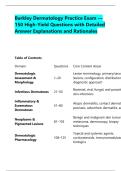
Barkley Dermatology Practice Exam —
150 High-Yield Questions with Detailed
Answer Explanations and Rationales
Table of Contents
Domain Questions Core Content Areas
Dermatologic Lesion terminology, primary/secon
Assessment & 1–20 lesions, configuration, distribution
Morphology diagnostic approach
Bacterial, viral, fungal, and parasit
Infectious Dermatoses 21–50
skin infections
Inflammatory &
Atopic dermatitis, contact dermat
Eczematous 51–80
psoriasis, seborrheic dermatitis, ac
Dermatoses
Benign and malignant skin tumors
Neoplasms &
81–105 melanoma, dermoscopy, biopsy
Pigmented Lesions
techniques
Topical and systemic agents,
Dermatologic
106–125 corticosteroids, immunomodulato
Pharmacology
biologics
,Domain Questions Core Content Areas
Pediatric & Special Neonatal, pediatric, geriatric,
126–140
Populations pregnancy dermatoses
Dermatologic
Life-threatening skin conditions,
Emergencies & 141–150
cutaneous markers of systemic dis
Systemic Disease
The Dermatology Nurse Practitioner Certification (DCNP) exam
covers Neoplasms (20%), Papulosquamous and Eczematous
Dermatoses (20%), Adnexal Disease (15%),
Infections/Infestations/Bites/Stings (10%), Photodamage/Aging
Skin/Pigmentary Disorders (10%), and other categories
including Genodermatoses (5%). Barkley's Brain Boosters app
includes dermatologic conditions among essential clinical
topics.
Section 1: Dermatologic Assessment & Morphology
(Questions 1–20)
1. A nurse practitioner is describing a skin lesion that is flat,
non-palpable, and less than 1 cm in diameter. What is the
correct term for this primary lesion?
A) Papule
B) Macule
C) Nodule
D) Plaque
Correct Answer: B
Rationale: A macule is a flat, non-palpable area of
discoloration less than 1 cm in diameter (e.g., freckle, flat
nevus). A papule is a raised, palpable lesion less than 1 cm.
,A nodule is a raised, palpable lesion greater than 1 cm. A
plaque is a raised, flat-topped lesion greater than 1 cm.
2. A patient presents with a 2 cm raised, flat-topped,
palpable lesion on the elbow. What is the correct
morphologic term?
A) Macule
B) Papule
C) Plaque
D) Vesicle
Correct Answer: C
Rationale: A plaque is a raised, flat-topped, palpable lesion
greater than 1 cm in diameter. Psoriasis plaques are classic
examples. A papule is less than 1 cm, a macule is flat, and a
vesicle is fluid-filled.
3. Which term describes a fluid-filled lesion greater than 1
cm in diameter?
A) Vesicle
B) Bulla
C) Pustule
D) Wheal
Correct Answer: B
Rationale: A bulla is a fluid-filled lesion greater than 1 cm
(e.g., bullous pemphigoid, second-degree burns). A vesicle
is less than 1 cm (e.g., herpes simplex). A pustule contains
pus, and a wheal is a transient, edematous papule or plaque
(e.g., urticaria).
4. A patient presents with a "dimple sign" when a firm
papule on the lower extremity is pinched. What is the most
, likely diagnosis?
A) Lipoma
B) Epidermoid cyst
C) Dermatofibroma
D) Basal cell carcinoma
Correct Answer: C
Rationale: Dermatofibroma is a firm papule that dimples
when pinched (dimple sign) due to tethering to the dermis.
Lipomas are soft, epidermoid cysts have a punctum and are
fluctuant, and basal cell carcinoma presents with a pearly,
telangiectatic appearance.
5. A patient has a lesion with central clearing and an
advancing border. What is the most appropriate term for
this configuration?
A) Annular
B) Linear
C) Serpiginous
D) Reticular
Correct Answer: A
Rationale: Annular lesions have a ring-like configuration
with central clearing (e.g., tinea corporis, erythema
migrans). Linear lesions follow a line (e.g., poison ivy),
serpiginous lesions are wavy (e.g., cutaneous larva
migrans), and reticular lesions form a net-like pattern (e.g.,
livedo reticularis).
6. Which diagnostic technique involves pressing a glass
slide against the skin to assess for blanching?
A) Diascopy
B) Dermoscopy
150 High-Yield Questions with Detailed
Answer Explanations and Rationales
Table of Contents
Domain Questions Core Content Areas
Dermatologic Lesion terminology, primary/secon
Assessment & 1–20 lesions, configuration, distribution
Morphology diagnostic approach
Bacterial, viral, fungal, and parasit
Infectious Dermatoses 21–50
skin infections
Inflammatory &
Atopic dermatitis, contact dermat
Eczematous 51–80
psoriasis, seborrheic dermatitis, ac
Dermatoses
Benign and malignant skin tumors
Neoplasms &
81–105 melanoma, dermoscopy, biopsy
Pigmented Lesions
techniques
Topical and systemic agents,
Dermatologic
106–125 corticosteroids, immunomodulato
Pharmacology
biologics
,Domain Questions Core Content Areas
Pediatric & Special Neonatal, pediatric, geriatric,
126–140
Populations pregnancy dermatoses
Dermatologic
Life-threatening skin conditions,
Emergencies & 141–150
cutaneous markers of systemic dis
Systemic Disease
The Dermatology Nurse Practitioner Certification (DCNP) exam
covers Neoplasms (20%), Papulosquamous and Eczematous
Dermatoses (20%), Adnexal Disease (15%),
Infections/Infestations/Bites/Stings (10%), Photodamage/Aging
Skin/Pigmentary Disorders (10%), and other categories
including Genodermatoses (5%). Barkley's Brain Boosters app
includes dermatologic conditions among essential clinical
topics.
Section 1: Dermatologic Assessment & Morphology
(Questions 1–20)
1. A nurse practitioner is describing a skin lesion that is flat,
non-palpable, and less than 1 cm in diameter. What is the
correct term for this primary lesion?
A) Papule
B) Macule
C) Nodule
D) Plaque
Correct Answer: B
Rationale: A macule is a flat, non-palpable area of
discoloration less than 1 cm in diameter (e.g., freckle, flat
nevus). A papule is a raised, palpable lesion less than 1 cm.
,A nodule is a raised, palpable lesion greater than 1 cm. A
plaque is a raised, flat-topped lesion greater than 1 cm.
2. A patient presents with a 2 cm raised, flat-topped,
palpable lesion on the elbow. What is the correct
morphologic term?
A) Macule
B) Papule
C) Plaque
D) Vesicle
Correct Answer: C
Rationale: A plaque is a raised, flat-topped, palpable lesion
greater than 1 cm in diameter. Psoriasis plaques are classic
examples. A papule is less than 1 cm, a macule is flat, and a
vesicle is fluid-filled.
3. Which term describes a fluid-filled lesion greater than 1
cm in diameter?
A) Vesicle
B) Bulla
C) Pustule
D) Wheal
Correct Answer: B
Rationale: A bulla is a fluid-filled lesion greater than 1 cm
(e.g., bullous pemphigoid, second-degree burns). A vesicle
is less than 1 cm (e.g., herpes simplex). A pustule contains
pus, and a wheal is a transient, edematous papule or plaque
(e.g., urticaria).
4. A patient presents with a "dimple sign" when a firm
papule on the lower extremity is pinched. What is the most
, likely diagnosis?
A) Lipoma
B) Epidermoid cyst
C) Dermatofibroma
D) Basal cell carcinoma
Correct Answer: C
Rationale: Dermatofibroma is a firm papule that dimples
when pinched (dimple sign) due to tethering to the dermis.
Lipomas are soft, epidermoid cysts have a punctum and are
fluctuant, and basal cell carcinoma presents with a pearly,
telangiectatic appearance.
5. A patient has a lesion with central clearing and an
advancing border. What is the most appropriate term for
this configuration?
A) Annular
B) Linear
C) Serpiginous
D) Reticular
Correct Answer: A
Rationale: Annular lesions have a ring-like configuration
with central clearing (e.g., tinea corporis, erythema
migrans). Linear lesions follow a line (e.g., poison ivy),
serpiginous lesions are wavy (e.g., cutaneous larva
migrans), and reticular lesions form a net-like pattern (e.g.,
livedo reticularis).
6. Which diagnostic technique involves pressing a glass
slide against the skin to assess for blanching?
A) Diascopy
B) Dermoscopy