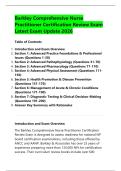
Barkley Comprehensive Nurse
Practitioner Certification Review Exam
Latest Exam Update 2026
Table of Contents
1. Introduction and Exam Overview
2. Section 1: Advanced Practice Foundations & Professional
Issues (Questions 1-30)
3. Section 2: Advanced Pathophysiology (Questions 31-70)
4. Section 3: Advanced Pharmacology (Questions 71-110)
5. Section 4: Advanced Physical Assessment (Questions 111-
150)
6. Section 5: Health Promotion & Disease Prevention
(Questions 151-170)
7. Section 6: Management of Acute & Chronic Conditions
(Questions 171-190)
8. Section 7: Diagnostic Testing & Clinical Decision-Making
(Questions 191-200)
9. Answer Key Summary with Rationales
Introduction and Exam Overview
The Barkley Comprehensive Nurse Practitioner Certification
Review Exam is designed to assess readiness for national NP
board certification examinations, including those offered by
ANCC and AANP. Barkley & Associates has over 23 years of
experience preparing more than 135,000 NPs for certification
success. Their curriculum review books include over 600
,practice questions covering assessment, labs/diagnostics,
management/treatment, pharmacology, and professional
practice for Adult-Gerontology Primary Care NPs, and over 325
practice questions for PMHNPs.
The Barkley 3Ps Review Exam covers the three core areas of
advanced practice nursing: Advanced Pathophysiology,
Advanced Pharmacology, and Advanced Physical
Assessment, along with professional issues and clinical
decision-making.
This comprehensive practice exam contains 200 questions
covering all core NP certification content areas. Each question
includes the correct answer marked in italics with a detailed
rationale in bold.
Section 1: Advanced Practice Foundations & Professional
Issues (Questions 1-30)
1. Diagnoses that are reportable to the Department of
Health include:
A. Gonorrhea, Chlamydia, Syphilis, HIV
B. Tuberculosis (TB)
C. Suspected or actual child or elder abuse
D. All of the above
Correct Answer: D
Rationale: Reportable diseases include communicable
infections (gonorrhea, chlamydia, syphilis, HIV, TB, COVID-
19), animal bites, and suspected or actual child or elder
,abuse. Reporting is legally mandated for public health
surveillance.
2. Which ethical principle is upheld when a nurse
practitioner ensures a patient understands all risks before a
procedure?
A. Beneficence
B. Autonomy
C. Justice
D. Fidelity
Correct Answer: B
Rationale: Autonomy refers to the patient's right to self-
determination and informed decision-making. Ensuring the
patient understands risks supports their autonomous
decision-making.
3. The purpose of the Diagnostic Readiness Test (DRT)
according to Barkley's model is to:
A. Replace the national certification exam
B. Pinpoint areas of strength and weakness for focused
remediation
C. Provide course credit for certification
D. Substitute for clinical experience
Correct Answer: B
Rationale: DRTs are 100-item online NP exams complete
with detailed rationales. They help students identify areas
of strength and weakness and remediate accordingly to
prepare for national NP certification exams.
, 4. Which of the following are covered entities under
HIPAA?
A. Health Plans
B. Most Healthcare Providers
C. Healthcare Clearinghouses
D. All of the above
Correct Answer: D
Rationale: HIPAA covered entities include health plans,
healthcare providers who transmit health information
electronically, and healthcare clearinghouses.
5. According to Barkley's review, the four distinct roles for
the NP include:
A. Clinician, Consultant/Collaborator, Educator, Researcher
B. Clinician, Manager, Educator, Advocate
C. Clinician, Consultant, Advocate, Researcher
D. Clinician, Manager, Researcher, Educator
Correct Answer: A
Rationale: The four distinct roles for the NP include
clinician, consultant/collaborator, educator, and researcher.
These encompass the full scope of advanced practice
nursing.
6. Credentialing is necessary to:
A. Ensure that safe healthcare is provided by qualified
individuals
B. Comply with federal and state laws relating to advanced
practice nursing
Practitioner Certification Review Exam
Latest Exam Update 2026
Table of Contents
1. Introduction and Exam Overview
2. Section 1: Advanced Practice Foundations & Professional
Issues (Questions 1-30)
3. Section 2: Advanced Pathophysiology (Questions 31-70)
4. Section 3: Advanced Pharmacology (Questions 71-110)
5. Section 4: Advanced Physical Assessment (Questions 111-
150)
6. Section 5: Health Promotion & Disease Prevention
(Questions 151-170)
7. Section 6: Management of Acute & Chronic Conditions
(Questions 171-190)
8. Section 7: Diagnostic Testing & Clinical Decision-Making
(Questions 191-200)
9. Answer Key Summary with Rationales
Introduction and Exam Overview
The Barkley Comprehensive Nurse Practitioner Certification
Review Exam is designed to assess readiness for national NP
board certification examinations, including those offered by
ANCC and AANP. Barkley & Associates has over 23 years of
experience preparing more than 135,000 NPs for certification
success. Their curriculum review books include over 600
,practice questions covering assessment, labs/diagnostics,
management/treatment, pharmacology, and professional
practice for Adult-Gerontology Primary Care NPs, and over 325
practice questions for PMHNPs.
The Barkley 3Ps Review Exam covers the three core areas of
advanced practice nursing: Advanced Pathophysiology,
Advanced Pharmacology, and Advanced Physical
Assessment, along with professional issues and clinical
decision-making.
This comprehensive practice exam contains 200 questions
covering all core NP certification content areas. Each question
includes the correct answer marked in italics with a detailed
rationale in bold.
Section 1: Advanced Practice Foundations & Professional
Issues (Questions 1-30)
1. Diagnoses that are reportable to the Department of
Health include:
A. Gonorrhea, Chlamydia, Syphilis, HIV
B. Tuberculosis (TB)
C. Suspected or actual child or elder abuse
D. All of the above
Correct Answer: D
Rationale: Reportable diseases include communicable
infections (gonorrhea, chlamydia, syphilis, HIV, TB, COVID-
19), animal bites, and suspected or actual child or elder
,abuse. Reporting is legally mandated for public health
surveillance.
2. Which ethical principle is upheld when a nurse
practitioner ensures a patient understands all risks before a
procedure?
A. Beneficence
B. Autonomy
C. Justice
D. Fidelity
Correct Answer: B
Rationale: Autonomy refers to the patient's right to self-
determination and informed decision-making. Ensuring the
patient understands risks supports their autonomous
decision-making.
3. The purpose of the Diagnostic Readiness Test (DRT)
according to Barkley's model is to:
A. Replace the national certification exam
B. Pinpoint areas of strength and weakness for focused
remediation
C. Provide course credit for certification
D. Substitute for clinical experience
Correct Answer: B
Rationale: DRTs are 100-item online NP exams complete
with detailed rationales. They help students identify areas
of strength and weakness and remediate accordingly to
prepare for national NP certification exams.
, 4. Which of the following are covered entities under
HIPAA?
A. Health Plans
B. Most Healthcare Providers
C. Healthcare Clearinghouses
D. All of the above
Correct Answer: D
Rationale: HIPAA covered entities include health plans,
healthcare providers who transmit health information
electronically, and healthcare clearinghouses.
5. According to Barkley's review, the four distinct roles for
the NP include:
A. Clinician, Consultant/Collaborator, Educator, Researcher
B. Clinician, Manager, Educator, Advocate
C. Clinician, Consultant, Advocate, Researcher
D. Clinician, Manager, Researcher, Educator
Correct Answer: A
Rationale: The four distinct roles for the NP include
clinician, consultant/collaborator, educator, and researcher.
These encompass the full scope of advanced practice
nursing.
6. Credentialing is necessary to:
A. Ensure that safe healthcare is provided by qualified
individuals
B. Comply with federal and state laws relating to advanced
practice nursing