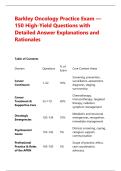
Barkley Oncology Practice Exam —
150 High-Yield Questions with
Detailed Answer Explanations and
Rationales
Table of Contents
% of
Domain Questions Core Content Areas
Exam
Screening, prevention,
Cancer surveillance, assessment,
1–52 35%
Continuum diagnosis, staging,
survivorship
Chemotherapy,
Cancer
immunotherapy, targeted
Treatment & 53–119 45%
therapy, radiation,
Supportive Care
symptom management
Metabolic and structural
Oncologic
120–134 10% emergencies, recognition,
Emergencies
immediate management
Distress screening, coping,
Psychosocial
135–142 5% caregiver support,
Issues
communication
Professional Scope of practice, ethics,
Practice & Roles 143–150 5% care coordination,
of the APRN advocacy
,The AOCNP® examination is a 3-hour, 165-item multiple-choice test
(125 scored, 40 pretest) based on the ONCC Test Content Outline, which
includes five major subject areas with assigned percentages. Many
nurses who have passed the test tell us the Test Content Outline was
essential in helping them know what areas to study.
Section 1: Cancer Continuum (Questions 1–52)
1. A 52-year-old woman with no family history of breast cancer asks
when she should begin mammography screening. According to the
USPSTF, what is the recommendation?
A) Begin at age 35
B) Begin at age 40, every 2 years
C) Begin at age 50, every 2 years
D) Begin at age 45, annually
Correct Answer: B
Rationale: The USPSTF recommends biennial screening
mammography for women aged 40–74, with shared decision-
making for women 40–49. The American Cancer Society suggests
screening as long as the patient is in good health or has a life
expectancy of at least 10 years.
2. A 58-year-old man with a 30-pack-year smoking history asks
about lung cancer screening. According to the USPSTF, which
criteria must be met for annual low-dose CT screening?
A) Age 55–80, current smoker
B) Age 50–80, ≥20 pack-year history, currently smoke or quit within 15
years
C) Age 60–75, ≥30 pack-year history
D) Age 50–70, any smoking history
Correct Answer: B
Rationale: Guidelines recommend lung cancer screening for patients
aged 50–80 with at least a 20-pack-year smoking history who are
able and willing to have curative surgery.
,3. A 45-year-old woman asks about cervical cancer screening.
According to current guidelines, what is the recommended interval
for women aged 30–65 who have had adequate prior screening?
A) Pap test every year
B) Pap test every 3 years or HPV testing every 5 years
C) Pap test every 5 years
D) No further screening after age 30
Correct Answer: B
Rationale: For women aged 30–65 years, screening options include
cervical cytology alone every 3 years or high-risk HPV testing every
5 years. Screening should stop at 65 years of age in patients who have
adequate prior screening results and do not have high risk**.
4. A 62-year-old man asks about colorectal cancer screening.
According to the USPSTF, what is the recommended screening
option?
A) Colonoscopy every 10 years
B) FIT annually
C) CT colonography every 5 years
D) All of the above are acceptable options
Correct Answer: D
Rationale: USPSTF and ACS recommend routine colorectal cancer
screening until 75 years of age, after which individualized screening
can occur based on shared decision-making until 85 years of age.
5. A 55-year-old man asks about prostate cancer screening.
According to the USPSTF, what is the recommendation for men
aged 55–69?
A) Annual PSA screening for all men
B) Individualized decision-making with shared decision-making
C) No screening at any age
D) Digital rectal exam only
Correct Answer: B
, Rationale: The USPSTF recommends that men 55–69 years of age
discuss the potential benefits and harms of prostate-specific antigen
screening with their doctor before making an individual decision;
for men 70 years and older, routine screening is not recommended.
6. A patient asks about the purpose of a cancer survivorship care
plan. What is the most appropriate response?
A) It is only for patients with terminal cancer
B) It summarizes the care received, treatment team, and follow-up care
guidelines
C) It replaces the need for oncology follow-up
D) It is only needed for 1 year after treatment
Correct Answer: B
Rationale: A survivorship care plan summarizes the type of cancer,
treatment received, and care team, and synthesizes information to
help the patient manage follow-up care and other health care and
lifestyle recommendations. The NCCN Guidelines for Survivorship
provide a framework for coordination of survivorship care and
recommendations to help survivors enhance wellness and maintain a
healthy lifestyle.
7. Which genetic syndrome is associated with an increased risk of
breast and ovarian cancer?
A) Lynch syndrome
B) BRCA1/BRCA2 mutation
C) Li-Fraumeni syndrome
D) Familial adenomatous polyposis
Correct Answer: B
Rationale: BRCA1 and BRCA2 mutations significantly increase the
risk of breast and ovarian cancer. Lynch syndrome is associated with
colorectal and endometrial cancer. Li-Fraumeni syndrome is
associated with multiple cancers including sarcoma and breast
cancer.
150 High-Yield Questions with
Detailed Answer Explanations and
Rationales
Table of Contents
% of
Domain Questions Core Content Areas
Exam
Screening, prevention,
Cancer surveillance, assessment,
1–52 35%
Continuum diagnosis, staging,
survivorship
Chemotherapy,
Cancer
immunotherapy, targeted
Treatment & 53–119 45%
therapy, radiation,
Supportive Care
symptom management
Metabolic and structural
Oncologic
120–134 10% emergencies, recognition,
Emergencies
immediate management
Distress screening, coping,
Psychosocial
135–142 5% caregiver support,
Issues
communication
Professional Scope of practice, ethics,
Practice & Roles 143–150 5% care coordination,
of the APRN advocacy
,The AOCNP® examination is a 3-hour, 165-item multiple-choice test
(125 scored, 40 pretest) based on the ONCC Test Content Outline, which
includes five major subject areas with assigned percentages. Many
nurses who have passed the test tell us the Test Content Outline was
essential in helping them know what areas to study.
Section 1: Cancer Continuum (Questions 1–52)
1. A 52-year-old woman with no family history of breast cancer asks
when she should begin mammography screening. According to the
USPSTF, what is the recommendation?
A) Begin at age 35
B) Begin at age 40, every 2 years
C) Begin at age 50, every 2 years
D) Begin at age 45, annually
Correct Answer: B
Rationale: The USPSTF recommends biennial screening
mammography for women aged 40–74, with shared decision-
making for women 40–49. The American Cancer Society suggests
screening as long as the patient is in good health or has a life
expectancy of at least 10 years.
2. A 58-year-old man with a 30-pack-year smoking history asks
about lung cancer screening. According to the USPSTF, which
criteria must be met for annual low-dose CT screening?
A) Age 55–80, current smoker
B) Age 50–80, ≥20 pack-year history, currently smoke or quit within 15
years
C) Age 60–75, ≥30 pack-year history
D) Age 50–70, any smoking history
Correct Answer: B
Rationale: Guidelines recommend lung cancer screening for patients
aged 50–80 with at least a 20-pack-year smoking history who are
able and willing to have curative surgery.
,3. A 45-year-old woman asks about cervical cancer screening.
According to current guidelines, what is the recommended interval
for women aged 30–65 who have had adequate prior screening?
A) Pap test every year
B) Pap test every 3 years or HPV testing every 5 years
C) Pap test every 5 years
D) No further screening after age 30
Correct Answer: B
Rationale: For women aged 30–65 years, screening options include
cervical cytology alone every 3 years or high-risk HPV testing every
5 years. Screening should stop at 65 years of age in patients who have
adequate prior screening results and do not have high risk**.
4. A 62-year-old man asks about colorectal cancer screening.
According to the USPSTF, what is the recommended screening
option?
A) Colonoscopy every 10 years
B) FIT annually
C) CT colonography every 5 years
D) All of the above are acceptable options
Correct Answer: D
Rationale: USPSTF and ACS recommend routine colorectal cancer
screening until 75 years of age, after which individualized screening
can occur based on shared decision-making until 85 years of age.
5. A 55-year-old man asks about prostate cancer screening.
According to the USPSTF, what is the recommendation for men
aged 55–69?
A) Annual PSA screening for all men
B) Individualized decision-making with shared decision-making
C) No screening at any age
D) Digital rectal exam only
Correct Answer: B
, Rationale: The USPSTF recommends that men 55–69 years of age
discuss the potential benefits and harms of prostate-specific antigen
screening with their doctor before making an individual decision;
for men 70 years and older, routine screening is not recommended.
6. A patient asks about the purpose of a cancer survivorship care
plan. What is the most appropriate response?
A) It is only for patients with terminal cancer
B) It summarizes the care received, treatment team, and follow-up care
guidelines
C) It replaces the need for oncology follow-up
D) It is only needed for 1 year after treatment
Correct Answer: B
Rationale: A survivorship care plan summarizes the type of cancer,
treatment received, and care team, and synthesizes information to
help the patient manage follow-up care and other health care and
lifestyle recommendations. The NCCN Guidelines for Survivorship
provide a framework for coordination of survivorship care and
recommendations to help survivors enhance wellness and maintain a
healthy lifestyle.
7. Which genetic syndrome is associated with an increased risk of
breast and ovarian cancer?
A) Lynch syndrome
B) BRCA1/BRCA2 mutation
C) Li-Fraumeni syndrome
D) Familial adenomatous polyposis
Correct Answer: B
Rationale: BRCA1 and BRCA2 mutations significantly increase the
risk of breast and ovarian cancer. Lynch syndrome is associated with
colorectal and endometrial cancer. Li-Fraumeni syndrome is
associated with multiple cancers including sarcoma and breast
cancer.