

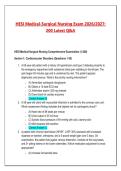
HESI Medical-Surgical Nursing Exam 2026/2027:
200 Latest Q&A
HESI Medical-Surgical Nursing Comprehensive Examination (1-200)
Section 1: Cardiovascular Disorders (Questions 1-30)
1. A 65-year-old patient with a history of hypertension and type 2 diabetes presents to
the emergency department with substernal chest pain radiating to the left jaw. The
pain began 45 minutes ago and is unrelieved by rest. The patient appears
diaphoretic and anxious. What is the priority nursing intervention?
o A) Administer sublingual nitroglycerin
o B) Obtain a 12-lead ECG stat
o C) Administer aspirin 325 mg chewed
o D) Draw blood for cardiac enzymes
o Correct Answer: B
2. A 58-year-old client with myocardial infarction is admitted to the coronary care unit.
Which assessment finding indicates the highest risk for cardiogenic shock?
o A) Heart rate of 88 beats per minute
o B) Urine output of 25 mL/hour
o C) Systolic blood pressure of 94 mmHg with cold, clammy skin
o D) Mild dyspnea with exertion
o Correct Answer: C
3. A patient with chronic heart failure (HFrEF, LVEF 30%) presents with increased
dyspnea on exertion, orthopnea, and a 5-pound weight gain over 3 days. On
examination, the patient has jugular venous distension, crackles at the lung bases,
and 2+ pitting edema in the lower extremities. Which medication adjustment is most
appropriate?
o A) Increase furosemide dose
, o B) Decrease carvedilol dose
o C) Add digoxin
o D) Decrease lisinopril dose
o Correct Answer: A
4. A 72-year-old patient with chronic heart failure exhibits a left ventricular end-diastolic
volume increase from 120 mL to 180 mL, while stroke volume rises from 55 mL to 70
mL. Which physiologic principle best explains this change?
o A) Starling's law of the heart
o B) Bernoulli's principle
o C) Frank-Frankel hypothesis
o D) Guyton's renal compensation model
o Correct Answer: A
5. A nurse is assessing a client with heart failure who has crackles in the lung bases,
jugular vein distention, and peripheral edema. Which phase of the cardiac cycle is
most likely impaired?
o A) Diastole
o B) Systole
o C) Atrial kick
o D) Ventricular ejection
o Correct Answer: A
6. A patient with peripheral arterial disease (PAD) reports intermittent claudication in
the right calf after walking 100 yards. Which nursing instruction is most appropriate?
o A) "Limit walking to avoid pain"
o B) "Walk until pain occurs, rest, and then resume walking"
o C) "Elevate your legs when resting"
o D) "Apply heat to the affected leg"
o Correct Answer: B
7. A nurse is caring for a client with acute decompensated heart failure receiving a
continuous IV infusion of milrinone. Which hemodynamic parameter requires the
most frequent assessment during dosage titration?
o A) Central venous pressure
o B) Systemic blood pressure
o C) Pulmonary artery wedge pressure
200 Latest Q&A
HESI Medical-Surgical Nursing Comprehensive Examination (1-200)
Section 1: Cardiovascular Disorders (Questions 1-30)
1. A 65-year-old patient with a history of hypertension and type 2 diabetes presents to
the emergency department with substernal chest pain radiating to the left jaw. The
pain began 45 minutes ago and is unrelieved by rest. The patient appears
diaphoretic and anxious. What is the priority nursing intervention?
o A) Administer sublingual nitroglycerin
o B) Obtain a 12-lead ECG stat
o C) Administer aspirin 325 mg chewed
o D) Draw blood for cardiac enzymes
o Correct Answer: B
2. A 58-year-old client with myocardial infarction is admitted to the coronary care unit.
Which assessment finding indicates the highest risk for cardiogenic shock?
o A) Heart rate of 88 beats per minute
o B) Urine output of 25 mL/hour
o C) Systolic blood pressure of 94 mmHg with cold, clammy skin
o D) Mild dyspnea with exertion
o Correct Answer: C
3. A patient with chronic heart failure (HFrEF, LVEF 30%) presents with increased
dyspnea on exertion, orthopnea, and a 5-pound weight gain over 3 days. On
examination, the patient has jugular venous distension, crackles at the lung bases,
and 2+ pitting edema in the lower extremities. Which medication adjustment is most
appropriate?
o A) Increase furosemide dose
, o B) Decrease carvedilol dose
o C) Add digoxin
o D) Decrease lisinopril dose
o Correct Answer: A
4. A 72-year-old patient with chronic heart failure exhibits a left ventricular end-diastolic
volume increase from 120 mL to 180 mL, while stroke volume rises from 55 mL to 70
mL. Which physiologic principle best explains this change?
o A) Starling's law of the heart
o B) Bernoulli's principle
o C) Frank-Frankel hypothesis
o D) Guyton's renal compensation model
o Correct Answer: A
5. A nurse is assessing a client with heart failure who has crackles in the lung bases,
jugular vein distention, and peripheral edema. Which phase of the cardiac cycle is
most likely impaired?
o A) Diastole
o B) Systole
o C) Atrial kick
o D) Ventricular ejection
o Correct Answer: A
6. A patient with peripheral arterial disease (PAD) reports intermittent claudication in
the right calf after walking 100 yards. Which nursing instruction is most appropriate?
o A) "Limit walking to avoid pain"
o B) "Walk until pain occurs, rest, and then resume walking"
o C) "Elevate your legs when resting"
o D) "Apply heat to the affected leg"
o Correct Answer: B
7. A nurse is caring for a client with acute decompensated heart failure receiving a
continuous IV infusion of milrinone. Which hemodynamic parameter requires the
most frequent assessment during dosage titration?
o A) Central venous pressure
o B) Systemic blood pressure
o C) Pulmonary artery wedge pressure


