
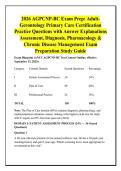
2026 AGPCNP-BC Exam Prep: Adult-
Gerontology Primary Care Certification
Practice Questions with Answer Explanations
Assessment, Diagnosis, Pharmacology &
Chronic Disease Management Exam
Preparation Study Guide
Exam Blueprint (ANCC AGPCNP-BC Test Content Outline, effective
September 13, 2023):
Category Content Domain Scored Questions Percentage
I Patient Assessment Process 36 24%
II Plan of Care 90 60%
III Professional Practice 24 16%
TOTAL 150 100%
Note: The Plan of Care domain (60%) contains diagnosis, pharmacology, and
implementation/evaluation content, making it the highest-yield area for study.
ANCC reports an 85% first-time pass rate (2024).
DOMAIN I: PATIENT ASSESSMENT PROCESS (24% — 36 Scored
Questions)
Question 1
A 68-year-old male presents for his annual wellness visit. He has a 30 pack-year
smoking history and quit 8 years ago. Which screening test is most appropriate to
recommend at this visit?
,A. Chest X-ray
B. Low-dose CT scan for lung cancer
C. Carotid artery ultrasound
D. Cardiac stress test
Rationale: Low-dose CT scan for lung cancer screening is recommended annually
for adults aged 50-80 with a 20 pack-year smoking history who currently smoke or
quit within the past 15 years. The USPSTF recommends this as a Grade B
screening. Chest X-ray is not recommended for lung cancer screening. Carotid
ultrasound and cardiac stress test are not routine screening tests for asymptomatic
patients without specific indications.
Question 2
During the cardiovascular examination of a 72-year-old female, the NP auscultates
an S4 heart sound. This finding most commonly indicates:
A. Mitral valve regurgitation
B. Left ventricular hypertrophy
C. Aortic stenosis
D. Atrial fibrillation
Rationale: An S4 heart sound (atrial gallop) is caused by atrial contraction against
a stiff, non-compliant left ventricle. It is most commonly associated with left
ventricular hypertrophy due to hypertension, which is prevalent in older adults.
Mitral regurgitation typically causes a holosystolic murmur, aortic stenosis causes
a crescendo-decrescendo systolic murmur, and atrial fibrillation is characterized by
an irregularly irregular rhythm.
Question 3
A 55-year-old patient reports progressive hearing loss in both ears over the past
year. The NP performs the whisper test and notes decreased hearing bilaterally.
The next most appropriate step is:
A. Immediate referral to an audiologist
B. Prescribe hearing aids
,C. Perform pneumatic otoscopy and order audiometry
D. Order CT scan of the temporal bones
Rationale: For suspected hearing loss, the NP should first perform a complete ear
examination including pneumatic otoscopy to assess for cerumen impaction,
tympanic membrane abnormalities, or middle ear effusion, followed by formal
audiometry for objective assessment. Immediate audiologist referral, prescribing
hearing aids, or CT imaging before basic examination and audiometry is
premature.
Question 4
A 70-year-old patient presents with a 3-month history of fatigue and pallor.
Laboratory findings reveal hemoglobin 9.8 g/dL, MCV 72 fL, and ferritin 8
ng/mL. Which is the most appropriate next step?
A. Start oral iron supplementation and recheck in 3 months
B. Refer for colonoscopy to evaluate for gastrointestinal bleeding
C. Order serum B12 and folate levels
D. Transfuse packed red blood cells
Rationale: This presentation is consistent with iron deficiency anemia (microcytic
anemia with low ferritin). In adults over 50, iron deficiency anemia requires
evaluation for gastrointestinal malignancy until proven otherwise, making
colonoscopy the priority. Oral iron alone without identifying the source is
inadequate. B12/folate would evaluate macrocytic anemia. Transfusion is not
indicated for asymptomatic anemia at this level.
Question 5
A 65-year-old female presents with sudden onset of "thunderclap" headache that
reached maximum intensity within seconds. Which is the most appropriate initial
diagnostic study?
A. MRI of the brain without contrast
B. Non-contrast CT of the head, followed by lumbar puncture if negative
C. Carotid duplex ultrasound
D. EEG
, Rationale: Thunderclap headache raises concern for subarachnoid hemorrhage.
Non-contrast CT is the initial study, and if negative and clinical suspicion remains,
lumbar puncture for xanthochromia should follow. MRI, carotid ultrasound, and
EEG are not first-line for acute subarachnoid hemorrhage evaluation.
Question 6
A 78-year-old male with a history of heart failure presents with worsening
dyspnea. Which diagnostic test is most useful for confirming acute
decompensation?
A. Chest X-ray
B. D-dimer
C. BNP (B-type natriuretic peptide)
D. CT pulmonary angiogram
Rationale: BNP is released by ventricular myocytes in response to stretch and is a
sensitive biomarker for heart failure. It helps differentiate cardiac from pulmonary
causes of dyspnea. D-dimer and CT pulmonary angiogram evaluate for pulmonary
embolism. Chest X-ray may show cardiomegaly or pulmonary edema but is less
specific than BNP.
Question 7
A 62-year-old female presents with a 2-week history of productive cough, fever,
and pleuritic chest pain. Vital signs: T 38.5°C, HR 105, RR 24, BP 118/72, SpO2
92% on room air. Which tool is most appropriate for determining disposition?
A. CURB-65
B. CHA2DS2-VASc
C. Wells Score
D. PERC Rule
Rationale: CURB-65 assesses Confusion, Urea, Respiratory rate, Blood pressure,
and age ≥65 to determine pneumonia severity and need for hospitalization. This
patient has a CURB-65 score of at least 1-2, which may warrant hospitalization or
close outpatient follow-up. CHA2DS2-VASc assesses stroke risk, Wells Score
assesses DVT/PE risk, and PERC Rule rules out PE.
Gerontology Primary Care Certification
Practice Questions with Answer Explanations
Assessment, Diagnosis, Pharmacology &
Chronic Disease Management Exam
Preparation Study Guide
Exam Blueprint (ANCC AGPCNP-BC Test Content Outline, effective
September 13, 2023):
Category Content Domain Scored Questions Percentage
I Patient Assessment Process 36 24%
II Plan of Care 90 60%
III Professional Practice 24 16%
TOTAL 150 100%
Note: The Plan of Care domain (60%) contains diagnosis, pharmacology, and
implementation/evaluation content, making it the highest-yield area for study.
ANCC reports an 85% first-time pass rate (2024).
DOMAIN I: PATIENT ASSESSMENT PROCESS (24% — 36 Scored
Questions)
Question 1
A 68-year-old male presents for his annual wellness visit. He has a 30 pack-year
smoking history and quit 8 years ago. Which screening test is most appropriate to
recommend at this visit?
,A. Chest X-ray
B. Low-dose CT scan for lung cancer
C. Carotid artery ultrasound
D. Cardiac stress test
Rationale: Low-dose CT scan for lung cancer screening is recommended annually
for adults aged 50-80 with a 20 pack-year smoking history who currently smoke or
quit within the past 15 years. The USPSTF recommends this as a Grade B
screening. Chest X-ray is not recommended for lung cancer screening. Carotid
ultrasound and cardiac stress test are not routine screening tests for asymptomatic
patients without specific indications.
Question 2
During the cardiovascular examination of a 72-year-old female, the NP auscultates
an S4 heart sound. This finding most commonly indicates:
A. Mitral valve regurgitation
B. Left ventricular hypertrophy
C. Aortic stenosis
D. Atrial fibrillation
Rationale: An S4 heart sound (atrial gallop) is caused by atrial contraction against
a stiff, non-compliant left ventricle. It is most commonly associated with left
ventricular hypertrophy due to hypertension, which is prevalent in older adults.
Mitral regurgitation typically causes a holosystolic murmur, aortic stenosis causes
a crescendo-decrescendo systolic murmur, and atrial fibrillation is characterized by
an irregularly irregular rhythm.
Question 3
A 55-year-old patient reports progressive hearing loss in both ears over the past
year. The NP performs the whisper test and notes decreased hearing bilaterally.
The next most appropriate step is:
A. Immediate referral to an audiologist
B. Prescribe hearing aids
,C. Perform pneumatic otoscopy and order audiometry
D. Order CT scan of the temporal bones
Rationale: For suspected hearing loss, the NP should first perform a complete ear
examination including pneumatic otoscopy to assess for cerumen impaction,
tympanic membrane abnormalities, or middle ear effusion, followed by formal
audiometry for objective assessment. Immediate audiologist referral, prescribing
hearing aids, or CT imaging before basic examination and audiometry is
premature.
Question 4
A 70-year-old patient presents with a 3-month history of fatigue and pallor.
Laboratory findings reveal hemoglobin 9.8 g/dL, MCV 72 fL, and ferritin 8
ng/mL. Which is the most appropriate next step?
A. Start oral iron supplementation and recheck in 3 months
B. Refer for colonoscopy to evaluate for gastrointestinal bleeding
C. Order serum B12 and folate levels
D. Transfuse packed red blood cells
Rationale: This presentation is consistent with iron deficiency anemia (microcytic
anemia with low ferritin). In adults over 50, iron deficiency anemia requires
evaluation for gastrointestinal malignancy until proven otherwise, making
colonoscopy the priority. Oral iron alone without identifying the source is
inadequate. B12/folate would evaluate macrocytic anemia. Transfusion is not
indicated for asymptomatic anemia at this level.
Question 5
A 65-year-old female presents with sudden onset of "thunderclap" headache that
reached maximum intensity within seconds. Which is the most appropriate initial
diagnostic study?
A. MRI of the brain without contrast
B. Non-contrast CT of the head, followed by lumbar puncture if negative
C. Carotid duplex ultrasound
D. EEG
, Rationale: Thunderclap headache raises concern for subarachnoid hemorrhage.
Non-contrast CT is the initial study, and if negative and clinical suspicion remains,
lumbar puncture for xanthochromia should follow. MRI, carotid ultrasound, and
EEG are not first-line for acute subarachnoid hemorrhage evaluation.
Question 6
A 78-year-old male with a history of heart failure presents with worsening
dyspnea. Which diagnostic test is most useful for confirming acute
decompensation?
A. Chest X-ray
B. D-dimer
C. BNP (B-type natriuretic peptide)
D. CT pulmonary angiogram
Rationale: BNP is released by ventricular myocytes in response to stretch and is a
sensitive biomarker for heart failure. It helps differentiate cardiac from pulmonary
causes of dyspnea. D-dimer and CT pulmonary angiogram evaluate for pulmonary
embolism. Chest X-ray may show cardiomegaly or pulmonary edema but is less
specific than BNP.
Question 7
A 62-year-old female presents with a 2-week history of productive cough, fever,
and pleuritic chest pain. Vital signs: T 38.5°C, HR 105, RR 24, BP 118/72, SpO2
92% on room air. Which tool is most appropriate for determining disposition?
A. CURB-65
B. CHA2DS2-VASc
C. Wells Score
D. PERC Rule
Rationale: CURB-65 assesses Confusion, Urea, Respiratory rate, Blood pressure,
and age ≥65 to determine pneumonia severity and need for hospitalization. This
patient has a CURB-65 score of at least 1-2, which may warrant hospitalization or
close outpatient follow-up. CHA2DS2-VASc assesses stroke risk, Wells Score
assesses DVT/PE risk, and PERC Rule rules out PE.


