
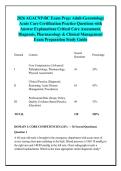
2026 AGACNP-BC Exam Prep: Adult-Gerontology
Acute Care Certification Practice Questions with
Answer Explanations Critical Care Assessment,
Diagnosis, Pharmacology & Clinical Management
Exam Preparation Study Guide
Scored
Domain Content Percentage
Questions
Core Competencies (Advanced
I Pathophysiology, Pharmacology, 36 24%
Physical Assessment)
Clinical Practice (Diagnostic
II Reasoning, Acute Disease 65 43%
Management, Procedures)
Professional Role (Scope, Policy,
III Quality, Evidence-Based Practice, 49 33%
Education)
TOTAL 150 100%
DOMAIN I: CORE COMPETENCIES (24% — 36 Scored Questions)
Question 1
A 68-year-old male is brought to the emergency department with acute onset of
severe tearing chest pain radiating to the back. Blood pressure is 180/110 mmHg in
the right arm and 140/80 mmHg in the left arm. Chest radiograph reveals a
widened mediastinum. Which is the most appropriate initial diagnostic study?
,A. Transthoracic echocardiography
B. Chest CT angiography with intravenous contrast
C. Cardiac catheterization with coronary angiography
D. MRI of the chest without contrast
Rationale: CT angiography is the gold standard for diagnosing aortic dissection
due to its high sensitivity and specificity, rapid acquisition time, and ability to
identify the type and extent of dissection. Transthoracic echocardiography has
limited sensitivity for descending aortic dissection. Cardiac catheterization is not
the initial study of choice and delays diagnosis. MRI is accurate but time-
consuming and less practical in an acute setting.
Question 2
A 55-year-old woman with rheumatoid arthritis on chronic prednisone therapy
presents with fever, altered mental status, and hypotension. Examination reveals a
diffuse erythematous rash. Laboratory studies show WBC 22,000/mm³ and lactate
5.2 mmol/L. What should the AGACNP do first?
A. Perform a lumbar puncture to rule out meningitis
B. Obtain blood cultures and await results before starting antibiotics
C. Administer broad-spectrum antibiotics and initiate fluid resuscitation
D. Start vasopressor therapy before fluid resuscitation
Rationale: In septic shock, the Surviving Sepsis Campaign guidelines recommend
initiating broad-spectrum antibiotics within one hour and administering 30 mL/kg
crystalloid fluid resuscitation. Delaying antibiotics for culture results significantly
increases mortality. Vasopressors should only be initiated after adequate fluid
resuscitation.
Question 3
A 72-year-old man with atrial fibrillation on warfarin presents with progressive
decline in renal function. His INR has been consistently supratherapeutic at 4.2,
and urinalysis shows hematuria. Which is the most likely cause of his acute kidney
injury?
,A. Cholesterol embolization from cardiac thrombus
B. Acute interstitial nephritis from warfarin hypersensitivity
C. Renal artery thrombosis secondary to atrial fibrillation
D. Warfarin-related nephropathy
Rationale: Cholesterol embolization syndrome (atheroembolic renal disease)
occurs when cholesterol crystals embolize from atherosclerotic plaques to the
kidneys, often triggered by anticoagulation. It presents with progressive renal
failure, hematuria, and livedo reticularis. Warfarin-related nephropathy is a
consideration but less likely given the supratherapeutic INR and hematuria pattern.
Acute interstitial nephritis is a hypersensitivity reaction. Renal artery thrombosis
presents more acutely with flank pain.
Question 4
A 60-year-old male is admitted with acute decompensated heart failure. Which
hemodynamic profile is most consistent with cardiogenic shock?
A. Low CVP, low PCWP, high cardiac output
B. High CVP, high PCWP, low cardiac output
C. Low CVP, high PCWP, low cardiac output
D. High CVP, low PCWP, high cardiac output
Rationale: Cardiogenic shock is characterized by elevated left ventricular filling
pressures (high PCWP), elevated right-sided pressures (high CVP), and reduced
cardiac output. The low CVP option in (C) is incorrect for cardiogenic shock;
however, the combination of high PCWP and low cardiac output is the key feature.
The correct profile for cardiogenic shock includes elevated CVP, elevated PCWP,
and low cardiac output.
Question 5
A 70-year-old female with a history of COPD presents with worsening dyspnea.
Arterial blood gas reveals pH 7.28, PaCO₂ 62 mmHg, PaO₂ 55 mmHg, and HCO₃⁻
28 mEq/L. Which acid-base disturbance is most consistent with these findings?
A. Acute respiratory alkalosis
B. Acute-on-chronic respiratory acidosis
, C. Metabolic acidosis
D. Metabolic alkalosis
Rationale: The elevated PaCO₂ with acidemia indicates respiratory acidosis. The
elevated HCO₃⁻ (28 mEq/L) suggests chronic compensation, and the pH of 7.28
indicates acute decompensation superimposed on chronic respiratory acidosis. This
is consistent with acute-on-chronic respiratory acidosis in a patient with COPD.
Question 6
A 58-year-old male is started on vancomycin for MRSA bacteremia. Which
parameter is most important to monitor for safety?
A. Serum potassium
B. Serum creatinine and vancomycin trough levels
C. Liver function tests
D. Serum magnesium
Rationale: Vancomycin is nephrotoxic, and adequate dosing requires monitoring
of renal function (serum creatinine) and trough levels to ensure therapeutic efficacy
while minimizing toxicity. Potassium, liver function, and magnesium are not the
primary parameters for vancomycin monitoring.
Question 7
A 65-year-old female with type 2 diabetes is admitted with DKA. Which
laboratory finding is most consistent with this diagnosis?
A. pH 7.50, HCO₃⁻ 32 mEq/L, glucose 450 mg/dL
B. pH 7.20, HCO₃⁻ 12 mEq/L, glucose 520 mg/dL, positive ketones
C. pH 7.35, HCO₃⁻ 24 mEq/L, glucose 180 mg/dL
D. pH 7.25, HCO₃⁻ 18 mEq/L, glucose 600 mg/dL, negative ketones
Rationale: DKA is characterized by metabolic acidosis (low pH, low HCO₃⁻),
hyperglycemia, and positive ketones. Option (B) is most consistent. Option (D)
suggests hyperosmolar hyperglycemic state (HHS) without significant ketosis.
Question 8
Acute Care Certification Practice Questions with
Answer Explanations Critical Care Assessment,
Diagnosis, Pharmacology & Clinical Management
Exam Preparation Study Guide
Scored
Domain Content Percentage
Questions
Core Competencies (Advanced
I Pathophysiology, Pharmacology, 36 24%
Physical Assessment)
Clinical Practice (Diagnostic
II Reasoning, Acute Disease 65 43%
Management, Procedures)
Professional Role (Scope, Policy,
III Quality, Evidence-Based Practice, 49 33%
Education)
TOTAL 150 100%
DOMAIN I: CORE COMPETENCIES (24% — 36 Scored Questions)
Question 1
A 68-year-old male is brought to the emergency department with acute onset of
severe tearing chest pain radiating to the back. Blood pressure is 180/110 mmHg in
the right arm and 140/80 mmHg in the left arm. Chest radiograph reveals a
widened mediastinum. Which is the most appropriate initial diagnostic study?
,A. Transthoracic echocardiography
B. Chest CT angiography with intravenous contrast
C. Cardiac catheterization with coronary angiography
D. MRI of the chest without contrast
Rationale: CT angiography is the gold standard for diagnosing aortic dissection
due to its high sensitivity and specificity, rapid acquisition time, and ability to
identify the type and extent of dissection. Transthoracic echocardiography has
limited sensitivity for descending aortic dissection. Cardiac catheterization is not
the initial study of choice and delays diagnosis. MRI is accurate but time-
consuming and less practical in an acute setting.
Question 2
A 55-year-old woman with rheumatoid arthritis on chronic prednisone therapy
presents with fever, altered mental status, and hypotension. Examination reveals a
diffuse erythematous rash. Laboratory studies show WBC 22,000/mm³ and lactate
5.2 mmol/L. What should the AGACNP do first?
A. Perform a lumbar puncture to rule out meningitis
B. Obtain blood cultures and await results before starting antibiotics
C. Administer broad-spectrum antibiotics and initiate fluid resuscitation
D. Start vasopressor therapy before fluid resuscitation
Rationale: In septic shock, the Surviving Sepsis Campaign guidelines recommend
initiating broad-spectrum antibiotics within one hour and administering 30 mL/kg
crystalloid fluid resuscitation. Delaying antibiotics for culture results significantly
increases mortality. Vasopressors should only be initiated after adequate fluid
resuscitation.
Question 3
A 72-year-old man with atrial fibrillation on warfarin presents with progressive
decline in renal function. His INR has been consistently supratherapeutic at 4.2,
and urinalysis shows hematuria. Which is the most likely cause of his acute kidney
injury?
,A. Cholesterol embolization from cardiac thrombus
B. Acute interstitial nephritis from warfarin hypersensitivity
C. Renal artery thrombosis secondary to atrial fibrillation
D. Warfarin-related nephropathy
Rationale: Cholesterol embolization syndrome (atheroembolic renal disease)
occurs when cholesterol crystals embolize from atherosclerotic plaques to the
kidneys, often triggered by anticoagulation. It presents with progressive renal
failure, hematuria, and livedo reticularis. Warfarin-related nephropathy is a
consideration but less likely given the supratherapeutic INR and hematuria pattern.
Acute interstitial nephritis is a hypersensitivity reaction. Renal artery thrombosis
presents more acutely with flank pain.
Question 4
A 60-year-old male is admitted with acute decompensated heart failure. Which
hemodynamic profile is most consistent with cardiogenic shock?
A. Low CVP, low PCWP, high cardiac output
B. High CVP, high PCWP, low cardiac output
C. Low CVP, high PCWP, low cardiac output
D. High CVP, low PCWP, high cardiac output
Rationale: Cardiogenic shock is characterized by elevated left ventricular filling
pressures (high PCWP), elevated right-sided pressures (high CVP), and reduced
cardiac output. The low CVP option in (C) is incorrect for cardiogenic shock;
however, the combination of high PCWP and low cardiac output is the key feature.
The correct profile for cardiogenic shock includes elevated CVP, elevated PCWP,
and low cardiac output.
Question 5
A 70-year-old female with a history of COPD presents with worsening dyspnea.
Arterial blood gas reveals pH 7.28, PaCO₂ 62 mmHg, PaO₂ 55 mmHg, and HCO₃⁻
28 mEq/L. Which acid-base disturbance is most consistent with these findings?
A. Acute respiratory alkalosis
B. Acute-on-chronic respiratory acidosis
, C. Metabolic acidosis
D. Metabolic alkalosis
Rationale: The elevated PaCO₂ with acidemia indicates respiratory acidosis. The
elevated HCO₃⁻ (28 mEq/L) suggests chronic compensation, and the pH of 7.28
indicates acute decompensation superimposed on chronic respiratory acidosis. This
is consistent with acute-on-chronic respiratory acidosis in a patient with COPD.
Question 6
A 58-year-old male is started on vancomycin for MRSA bacteremia. Which
parameter is most important to monitor for safety?
A. Serum potassium
B. Serum creatinine and vancomycin trough levels
C. Liver function tests
D. Serum magnesium
Rationale: Vancomycin is nephrotoxic, and adequate dosing requires monitoring
of renal function (serum creatinine) and trough levels to ensure therapeutic efficacy
while minimizing toxicity. Potassium, liver function, and magnesium are not the
primary parameters for vancomycin monitoring.
Question 7
A 65-year-old female with type 2 diabetes is admitted with DKA. Which
laboratory finding is most consistent with this diagnosis?
A. pH 7.50, HCO₃⁻ 32 mEq/L, glucose 450 mg/dL
B. pH 7.20, HCO₃⁻ 12 mEq/L, glucose 520 mg/dL, positive ketones
C. pH 7.35, HCO₃⁻ 24 mEq/L, glucose 180 mg/dL
D. pH 7.25, HCO₃⁻ 18 mEq/L, glucose 600 mg/dL, negative ketones
Rationale: DKA is characterized by metabolic acidosis (low pH, low HCO₃⁻),
hyperglycemia, and positive ketones. Option (B) is most consistent. Option (D)
suggests hyperosmolar hyperglycemic state (HHS) without significant ketosis.
Question 8


