

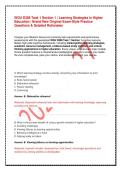
WGU D389 Task 1 Section 1 | Learning Strategies in Higher
Education | Brand New Original Exam-Style Practice
Questions & Detailed Rationales
Conquer your Western Governors University task requirements and performance
assessments with this specialized WGU D389 Task 1 Section 1 practice resource.
Master high-yield cognitive frameworks, including metacognitive learning strategies,
academic resource management, evidence-based study methods, and critical
thinking applications in higher education. Every unique, original exam-style multiple-
choice question features a comprehensive pedagogical rationale to ensure you master
the core competencies, pass your rubrics, and accelerate through your degree.
1. Which learning strategy involves actively connecting new information to prior
knowledge?
A. Rote memorization
B. Elaborative rehearsal
C. Passive reading
D. Cramming
Answer: B. Elaborative rehearsal
Rationale: Elaborative rehearsal links new information with existing knowledge, improving
encoding and retrieval.
2. What is the primary benefit of using a growth mindset in higher education?
A. Avoiding challenges
B. Viewing failures as learning opportunities
C. Believing intelligence is fixed
D. Relying solely on talent
Answer: B. Viewing failures as learning opportunities
Rationale: A growth mindset, developed by Carol Dweck, encourages persistence and
resilience by viewing abilities as developable.
,3. Which time management technique involves prioritizing tasks based on urgency and
importance?
A. Pomodoro Technique
B. Eisenhower Matrix
C. Time blocking
D. Multitasking
Answer: B. Eisenhower Matrix
Rationale: The Eisenhower Matrix categorizes tasks into four quadrants: urgent/important,
not urgent/important, urgent/not important, and not urgent/not important.
4. What is the purpose of the SQ3R reading method?
A. To speed read
B. To improve comprehension and retention
C. To memorize facts
D. To skip irrelevant details
Answer: B. To improve comprehension and retention
Rationale: SQ3R stands for Survey, Question, Read, Recite, Review. It is an active reading
strategy that enhances understanding.
5. Which note-taking method uses a two-column format with cues and a summary?
A. Outlining
B. Mapping
C. Cornell Method
D. Charting
Answer: C. Cornell Method
Rationale: The Cornell Method divides the page into a cue column, note-taking area, and
summary section, promoting active review.
,6. What is metacognition?
A. Thinking about thinking
B. Memorizing facts
C. Reading quickly
D. Taking notes
Answer: A. Thinking about thinking
Rationale: Metacognition involves self-awareness and regulation of one’s own learning
processes.
7. Which strategy is most effective for long-term retention of information?
A. Cramming the night before
B. Spaced repetition
C. Re-reading notes multiple times
D. Highlighting text
Answer: B. Spaced repetition
Rationale: Spaced repetition involves reviewing material at increasing intervals, which
strengthens memory and retention.
8. What is academic integrity?
A. Cheating on exams
B. Honesty and responsibility in academic work
C. Plagiarizing sources
D. Sharing answers
Answer: B. Honesty and responsibility in academic work
Rationale: Academic integrity means upholding ethical standards, including avoiding
plagiarism, cheating, and fabrication.
, 9. Which of the following is an example of plagiarism?
A. Citing a source properly
B. Using quotation marks for direct quotes
C. Copying text without citation
D. Paraphrasing with citation
Answer: C. Copying text without citation
Rationale: Plagiarism is using someone else’s work or ideas without proper attribution.
10. What is the best way to avoid procrastination?
A. Wait for motivation
B. Break tasks into smaller steps
C. Multitask
D. Set unrealistic goals
Answer: B. Break tasks into smaller steps
Rationale: Breaking tasks into manageable parts reduces overwhelm and increases
motivation to start.
11. Which learning style is based on the theory of multiple intelligences?
A. Visual
B. Auditory
C. Kinesthetic
D. All of the above
Answer: D. All of the above
Rationale: Howard Gardner’s multiple intelligences include visual-spatial, auditory,
kinesthetic, and others. However, learning styles are not strongly supported by evidence,
but the question refers to the theory.
Education | Brand New Original Exam-Style Practice
Questions & Detailed Rationales
Conquer your Western Governors University task requirements and performance
assessments with this specialized WGU D389 Task 1 Section 1 practice resource.
Master high-yield cognitive frameworks, including metacognitive learning strategies,
academic resource management, evidence-based study methods, and critical
thinking applications in higher education. Every unique, original exam-style multiple-
choice question features a comprehensive pedagogical rationale to ensure you master
the core competencies, pass your rubrics, and accelerate through your degree.
1. Which learning strategy involves actively connecting new information to prior
knowledge?
A. Rote memorization
B. Elaborative rehearsal
C. Passive reading
D. Cramming
Answer: B. Elaborative rehearsal
Rationale: Elaborative rehearsal links new information with existing knowledge, improving
encoding and retrieval.
2. What is the primary benefit of using a growth mindset in higher education?
A. Avoiding challenges
B. Viewing failures as learning opportunities
C. Believing intelligence is fixed
D. Relying solely on talent
Answer: B. Viewing failures as learning opportunities
Rationale: A growth mindset, developed by Carol Dweck, encourages persistence and
resilience by viewing abilities as developable.
,3. Which time management technique involves prioritizing tasks based on urgency and
importance?
A. Pomodoro Technique
B. Eisenhower Matrix
C. Time blocking
D. Multitasking
Answer: B. Eisenhower Matrix
Rationale: The Eisenhower Matrix categorizes tasks into four quadrants: urgent/important,
not urgent/important, urgent/not important, and not urgent/not important.
4. What is the purpose of the SQ3R reading method?
A. To speed read
B. To improve comprehension and retention
C. To memorize facts
D. To skip irrelevant details
Answer: B. To improve comprehension and retention
Rationale: SQ3R stands for Survey, Question, Read, Recite, Review. It is an active reading
strategy that enhances understanding.
5. Which note-taking method uses a two-column format with cues and a summary?
A. Outlining
B. Mapping
C. Cornell Method
D. Charting
Answer: C. Cornell Method
Rationale: The Cornell Method divides the page into a cue column, note-taking area, and
summary section, promoting active review.
,6. What is metacognition?
A. Thinking about thinking
B. Memorizing facts
C. Reading quickly
D. Taking notes
Answer: A. Thinking about thinking
Rationale: Metacognition involves self-awareness and regulation of one’s own learning
processes.
7. Which strategy is most effective for long-term retention of information?
A. Cramming the night before
B. Spaced repetition
C. Re-reading notes multiple times
D. Highlighting text
Answer: B. Spaced repetition
Rationale: Spaced repetition involves reviewing material at increasing intervals, which
strengthens memory and retention.
8. What is academic integrity?
A. Cheating on exams
B. Honesty and responsibility in academic work
C. Plagiarizing sources
D. Sharing answers
Answer: B. Honesty and responsibility in academic work
Rationale: Academic integrity means upholding ethical standards, including avoiding
plagiarism, cheating, and fabrication.
, 9. Which of the following is an example of plagiarism?
A. Citing a source properly
B. Using quotation marks for direct quotes
C. Copying text without citation
D. Paraphrasing with citation
Answer: C. Copying text without citation
Rationale: Plagiarism is using someone else’s work or ideas without proper attribution.
10. What is the best way to avoid procrastination?
A. Wait for motivation
B. Break tasks into smaller steps
C. Multitask
D. Set unrealistic goals
Answer: B. Break tasks into smaller steps
Rationale: Breaking tasks into manageable parts reduces overwhelm and increases
motivation to start.
11. Which learning style is based on the theory of multiple intelligences?
A. Visual
B. Auditory
C. Kinesthetic
D. All of the above
Answer: D. All of the above
Rationale: Howard Gardner’s multiple intelligences include visual-spatial, auditory,
kinesthetic, and others. However, learning styles are not strongly supported by evidence,
but the question refers to the theory.


