

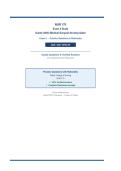
NUR 170
Exam 2 Study
Guide (2026) Medical-Surgical Nursing Galen
Exam 2 • Practice Questions & Rationales
UPDATE
Actual Questions & Verified Answers
with Detailed Clinical Rationales
Practice Questions with Rationales
Galen College of Nursing
NUR 170
✓ 100% Verified Answers
✓ Complete Rationales Included
Exam (elaborations)
Instant PDF Download • Ready for Study
,NUR 170 Exam 2 Study Guide (2026) | Medical-Surgical Nursing | Galen
1. A nurse is preparing a client for an elective cholecystectomy. Which action by the nurse is
the priority regarding informed consent?
A. Explaining the risks and benefits of the surgical procedure to the client.
B. Ensuring the surgeon has provided the necessary information and witnessing the client’s
signature.
C. Determining if the client understands the alternative treatments available.
D. Obtaining the signature from a family member if the client expresses anxiety.
Answer: B
Rationale: The nurse’s role in informed consent is to witness the client’s signature and
verify that the client is competent and the signature is voluntary. The surgeon is
responsible for explaining risks, benefits, and alternatives.
2. During the intraoperative phase, a client develops a heart rate of 140 bpm, muscle rigidity,
and a rapidly rising core temperature. Which medication should the nurse prepare to
administer?
A. Dantrolene sodium
B. Atropine sulfate
C. Naloxone
, D. Succinylcholine
Answer: A
Rationale: These are classic signs of Malignant Hyperthermia, a life-threatening
complication of general anesthesia. Dantrolene sodium is the specific skeletal muscle
relaxant used to treat it.
3. A postoperative client has a surgical wound that has eviscerated. Which is the immediate
nursing action?
A. Attempt to gently reinsert the protruding organs into the abdominal cavity.
B. Cover the protruding organs with sterile dressings moistened with sterile normal saline.
C. Apply a dry, sterile pressure dressing over the wound.
D. Place the client in a high-Fowler’s position to reduce abdominal pressure.
Answer: B
Rationale: Evisceration is a medical emergency. The nurse must cover the organs with
sterile, saline-soaked dressings to keep them moist and prevent necrosis while preparing
for emergency surgery.
4. A client presents with a serum potassium level of 6.2 mEq/L. Which EKG change should the
nurse monitor for?
A. Prominent U waves
B. ST-segment depression
Exam 2 Study
Guide (2026) Medical-Surgical Nursing Galen
Exam 2 • Practice Questions & Rationales
UPDATE
Actual Questions & Verified Answers
with Detailed Clinical Rationales
Practice Questions with Rationales
Galen College of Nursing
NUR 170
✓ 100% Verified Answers
✓ Complete Rationales Included
Exam (elaborations)
Instant PDF Download • Ready for Study
,NUR 170 Exam 2 Study Guide (2026) | Medical-Surgical Nursing | Galen
1. A nurse is preparing a client for an elective cholecystectomy. Which action by the nurse is
the priority regarding informed consent?
A. Explaining the risks and benefits of the surgical procedure to the client.
B. Ensuring the surgeon has provided the necessary information and witnessing the client’s
signature.
C. Determining if the client understands the alternative treatments available.
D. Obtaining the signature from a family member if the client expresses anxiety.
Answer: B
Rationale: The nurse’s role in informed consent is to witness the client’s signature and
verify that the client is competent and the signature is voluntary. The surgeon is
responsible for explaining risks, benefits, and alternatives.
2. During the intraoperative phase, a client develops a heart rate of 140 bpm, muscle rigidity,
and a rapidly rising core temperature. Which medication should the nurse prepare to
administer?
A. Dantrolene sodium
B. Atropine sulfate
C. Naloxone
, D. Succinylcholine
Answer: A
Rationale: These are classic signs of Malignant Hyperthermia, a life-threatening
complication of general anesthesia. Dantrolene sodium is the specific skeletal muscle
relaxant used to treat it.
3. A postoperative client has a surgical wound that has eviscerated. Which is the immediate
nursing action?
A. Attempt to gently reinsert the protruding organs into the abdominal cavity.
B. Cover the protruding organs with sterile dressings moistened with sterile normal saline.
C. Apply a dry, sterile pressure dressing over the wound.
D. Place the client in a high-Fowler’s position to reduce abdominal pressure.
Answer: B
Rationale: Evisceration is a medical emergency. The nurse must cover the organs with
sterile, saline-soaked dressings to keep them moist and prevent necrosis while preparing
for emergency surgery.
4. A client presents with a serum potassium level of 6.2 mEq/L. Which EKG change should the
nurse monitor for?
A. Prominent U waves
B. ST-segment depression


