

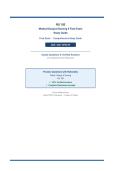
NU 185
Medical-Surgical Nursing II Final Exam
Study Guide
Final Exam • Comprehensive Study Guide
UPDATE
Actual Questions & Verified Answers
with Detailed Clinical Rationales
Practice Questions with Rationales
Galen College of Nursing
NU 185
✓ 100% Verified Answers
✓ Complete Rationales Included
Exam (elaborations)
Instant PDF Download • Ready for Study
,NU 185 Medical-Surgical Nursing II Final Exam Study Guide 2026/2027 UPDATE – Galen
1. A patient with acute respiratory distress syndrome (ARDS) is receiving mechanical
ventilation. Which setting is most critical to prevent alveolar collapse at the end of
expiration?
A. Positive End-Expiratory Pressure (PEEP)
B. Tidal Volume
C. Fraction of Inspired Oxygen (FiO2)
D. Inspiratory:Expiratory (I:E) Ratio
Answer: A
Rationale: PEEP maintains a set amount of pressure in the lungs at the end of expiration to
keep the alveoli open, improving gas exchange and preventing atelectasis.
2. Which of the following clinical manifestations is considered a late sign of increased
intracranial pressure (ICP)?
A. Restlessness and irritability
B. Constant headache
C. Cushing’s Triad
D. Pupillary sluggishness
, Answer: C
Rationale: Cushing’s Triad (bradycardia, hypertension with a widening pulse pressure,
and irregular respirations) is a late sign of increased ICP indicating brainstem compression.
3. A patient is admitted with a diagnosis of Pheochromocytoma. Which assessment finding
should the nurse prioritize?
A. Severe Hypertension
B. Weight gain
C. Hypoglycemia
D. Bradycardia
Answer: A
Rationale: Pheochromocytoma is a catecholamine-secreting tumor that causes severe,
episodic hypertension which can lead to stroke or organ damage if untreated.
4. When caring for a patient in the oliguric phase of Acute Kidney Injury (AKI), which
electrolyte imbalance is most likely to occur?
A. Hypokalemia
B. Hyperkalemia
C. Hypernatremia
D. Hypophosphatemia
Answer: B
Medical-Surgical Nursing II Final Exam
Study Guide
Final Exam • Comprehensive Study Guide
UPDATE
Actual Questions & Verified Answers
with Detailed Clinical Rationales
Practice Questions with Rationales
Galen College of Nursing
NU 185
✓ 100% Verified Answers
✓ Complete Rationales Included
Exam (elaborations)
Instant PDF Download • Ready for Study
,NU 185 Medical-Surgical Nursing II Final Exam Study Guide 2026/2027 UPDATE – Galen
1. A patient with acute respiratory distress syndrome (ARDS) is receiving mechanical
ventilation. Which setting is most critical to prevent alveolar collapse at the end of
expiration?
A. Positive End-Expiratory Pressure (PEEP)
B. Tidal Volume
C. Fraction of Inspired Oxygen (FiO2)
D. Inspiratory:Expiratory (I:E) Ratio
Answer: A
Rationale: PEEP maintains a set amount of pressure in the lungs at the end of expiration to
keep the alveoli open, improving gas exchange and preventing atelectasis.
2. Which of the following clinical manifestations is considered a late sign of increased
intracranial pressure (ICP)?
A. Restlessness and irritability
B. Constant headache
C. Cushing’s Triad
D. Pupillary sluggishness
, Answer: C
Rationale: Cushing’s Triad (bradycardia, hypertension with a widening pulse pressure,
and irregular respirations) is a late sign of increased ICP indicating brainstem compression.
3. A patient is admitted with a diagnosis of Pheochromocytoma. Which assessment finding
should the nurse prioritize?
A. Severe Hypertension
B. Weight gain
C. Hypoglycemia
D. Bradycardia
Answer: A
Rationale: Pheochromocytoma is a catecholamine-secreting tumor that causes severe,
episodic hypertension which can lead to stroke or organ damage if untreated.
4. When caring for a patient in the oliguric phase of Acute Kidney Injury (AKI), which
electrolyte imbalance is most likely to occur?
A. Hypokalemia
B. Hyperkalemia
C. Hypernatremia
D. Hypophosphatemia
Answer: B


