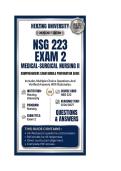
,NSG 223 Exam 2 Medical-Surgical Nursing II Questions And Answers
2026/2027 Herzing University
Q1. A client suddenly develops shortness of breath, tachycardia, chest pain,
and anxiety after several days of immobility. Which condition should the
nurse suspect?
A) Pulmonary embolism
B) Pleural effusion
C) Chronic bronchitis
D) Stable angina
Correct Answer: A) Pulmonary embolism
Rationale: A pulmonary embolism can cause sudden dyspnea, tachycardia,
chest pain, anxiety, and hypoxemia, particularly in clients with risk factors
for venous thromboembolism.
Q2. Which condition is the most common source of a pulmonary embolus?
A) Deep vein thrombosis
B) Pneumothorax
C) Pulmonary edema
D) Pneumonia
Correct Answer: A) Deep vein thrombosis
Rationale: Most pulmonary emboli occur when a thrombus from the deep
veins travels through the venous circulation to the pulmonary arteries.
Q3. Which client has the greatest risk for pulmonary embolism?
A) A client who ambulates several times each day
B) A client who recently underwent major orthopedic surgery and remains
immobile
C) A client with controlled hypertension
D) A client with seasonal allergies
Correct Answer: B) A client who recently underwent major orthopedic surgery
and remains immobile
Rationale: Surgery and prolonged immobility promote venous stasis and
increase the risk of deep vein thrombosis and pulmonary embolism.
Q4. Which finding is commonly associated with pulmonary embolism?
A) Tachypnea
B) Bradycardia
C) Hyperactive bowel sounds
D) Increased appetite
Correct Answer: A) Tachypnea
, Rationale: Rapid respirations are a common response to impaired
pulmonary perfusion and hypoxemia.
Q5. A client with suspected pulmonary embolism reports severe difficulty
breathing. Which position should the nurse use initially?
A) Flat supine
B) Upright
C) Trendelenburg
D) Prone
Correct Answer: B) Upright
Rationale: Upright positioning promotes lung expansion and can decrease
the work of breathing.
Q6. Which diagnostic study evaluates both ventilation and perfusion of the
lungs?
A) V/Q scan
B) Echocardiogram
C) Colonoscopy
D) EEG
Correct Answer: A) V/Q scan
Rationale: A ventilation-perfusion scan compares airflow and pulmonary
blood flow to identify areas of mismatch that may indicate pulmonary
embolism.
Q7. Which laboratory test may support evaluation for pulmonary embolism
by identifying evidence of clot formation and breakdown?
A) D-dimer
B) Troponin
C) Hemoglobin A1c
D) Amylase
Correct Answer: A) D-dimer
Rationale: D-dimer can be elevated when significant clot formation and
fibrinolysis are occurring, although it is not specific for pulmonary embolism.
Q8. A client receiving IV unfractionated heparin for pulmonary embolism
requires monitoring of which laboratory value?
A) INR
B) aPTT
C) Hemoglobin A1c
D) Troponin
Correct Answer: B) aPTT
2026/2027 Herzing University
Q1. A client suddenly develops shortness of breath, tachycardia, chest pain,
and anxiety after several days of immobility. Which condition should the
nurse suspect?
A) Pulmonary embolism
B) Pleural effusion
C) Chronic bronchitis
D) Stable angina
Correct Answer: A) Pulmonary embolism
Rationale: A pulmonary embolism can cause sudden dyspnea, tachycardia,
chest pain, anxiety, and hypoxemia, particularly in clients with risk factors
for venous thromboembolism.
Q2. Which condition is the most common source of a pulmonary embolus?
A) Deep vein thrombosis
B) Pneumothorax
C) Pulmonary edema
D) Pneumonia
Correct Answer: A) Deep vein thrombosis
Rationale: Most pulmonary emboli occur when a thrombus from the deep
veins travels through the venous circulation to the pulmonary arteries.
Q3. Which client has the greatest risk for pulmonary embolism?
A) A client who ambulates several times each day
B) A client who recently underwent major orthopedic surgery and remains
immobile
C) A client with controlled hypertension
D) A client with seasonal allergies
Correct Answer: B) A client who recently underwent major orthopedic surgery
and remains immobile
Rationale: Surgery and prolonged immobility promote venous stasis and
increase the risk of deep vein thrombosis and pulmonary embolism.
Q4. Which finding is commonly associated with pulmonary embolism?
A) Tachypnea
B) Bradycardia
C) Hyperactive bowel sounds
D) Increased appetite
Correct Answer: A) Tachypnea
, Rationale: Rapid respirations are a common response to impaired
pulmonary perfusion and hypoxemia.
Q5. A client with suspected pulmonary embolism reports severe difficulty
breathing. Which position should the nurse use initially?
A) Flat supine
B) Upright
C) Trendelenburg
D) Prone
Correct Answer: B) Upright
Rationale: Upright positioning promotes lung expansion and can decrease
the work of breathing.
Q6. Which diagnostic study evaluates both ventilation and perfusion of the
lungs?
A) V/Q scan
B) Echocardiogram
C) Colonoscopy
D) EEG
Correct Answer: A) V/Q scan
Rationale: A ventilation-perfusion scan compares airflow and pulmonary
blood flow to identify areas of mismatch that may indicate pulmonary
embolism.
Q7. Which laboratory test may support evaluation for pulmonary embolism
by identifying evidence of clot formation and breakdown?
A) D-dimer
B) Troponin
C) Hemoglobin A1c
D) Amylase
Correct Answer: A) D-dimer
Rationale: D-dimer can be elevated when significant clot formation and
fibrinolysis are occurring, although it is not specific for pulmonary embolism.
Q8. A client receiving IV unfractionated heparin for pulmonary embolism
requires monitoring of which laboratory value?
A) INR
B) aPTT
C) Hemoglobin A1c
D) Troponin
Correct Answer: B) aPTT