
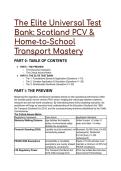
The Elite Universal Test
Bank: Scotland PCV &
Home-to-School
Transport Mastery
PART 0: TABLE OF CONTENTS
● PART I: THE PREVIEW
○ The Executive Imperative
○ The Critical Axioms Matrix
● PART II: THE ELITE TEST BANK
○ Tier 1: Foundational Syntax & Application (Questions 1–10)
○ Tier 2: Complex Application & Simulation (Questions 11–20)
○ Tier 3: Grandmaster Synthesis (Questions 21–30)
PART I: THE PREVIEW
Mastering this regulatory architecture translates directly to elite operational performance within
the Scottish public service vehicle (PSV) sector, bridging the critical gap between academic
transport law and real-world compliance. By internalizing these thirty escalating scenarios, the
practitioner will forge an executive-level understanding of the Education (Scotland) Act 1980,
the Transport (Scotland) Act 2019, and the uncompromising directives established by the Traffic
Commissioner.
The Critical Axioms Matrix
Regulatory Framework Core Axiom Application Standard
Statutory Walking Distance Age dictates the baseline Under 8 years: >2 miles. 8
radius; environmental safety years and older: >3 miles.
dictates the exceptions.
Financial Standing (2026) Liquidity must be sustained, not Standard: £8,000 (first), £4,500
momentarily peaked. (subsequent). Restricted:
£3,100 (first), £1,700
(subsequent).
PSVAR 2000 Exemptions Accessibility is inevitable; Fleets of 10-29 vehicles must
exemptions are merely phased maintain a minimum of 25% full
compliance countdowns. PSVAR compliance.
LTA Regulatory Power The Transport (Scotland) Act LTAs may initiate Bus Services
2019 shifts leverage from Improvement Partnerships
,Regulatory Framework Core Axiom Application Standard
private operators to public (BSIPs), Franchises, or run
authorities. municipal fleets.
Driver CPC Mandate Commercial operation is strictly 35 hours of approved periodic
tethered to continuous training every 5 years for hire or
professional development. reward operations.
PART II: THE ELITE TEST BANK
Tier 1: Foundational Syntax & Application
Q1: A local council is assessing the transport eligibility of a 7-year-old pupil who lives exactly 2.4
miles from their designated catchment primary school. The route is entirely paved, lit, and
deemed safe by a transportation engineer. Based on the principles of the Education (Scotland)
Act 1980, which action is the MOST ACCURATE? A) The council is not required to provide free
transport because the route is engineered to safe pedestrian standards. B) The council must
provide free transport because the pupil is under 8 years old and lives more than 2 miles from
the school. C) The council is not required to provide free transport because the pupil lives under
the 3-mile absolute statutory walking distance. D) The council must charge the parents a
subsidized fare for the journey since the distance is between 2 and 3 miles.
● Answer: B (The council must provide free transport because the pupil is under 8 years
old and lives more than 2 miles from the school.)
● Distractor Analysis:
○ A is incorrect: While safety is a critical factor that can trigger transport requirements
below the statutory distance, a safe route does not negate the statutory distance
mandate itself.
○ C is incorrect: The 3-mile threshold applies strictly and exclusively to children aged
8 and over.
○ D is incorrect: Transport provided under these specific statutory distance conditions
must be entirely free of charge to the user.
The Mentor's Analysis: The absolute baseline of Scottish home-to-school transport law rests
on age-dependent distance thresholds set forth in Sections 42 and 51 of the Education
(Scotland) Act 1980. When facing a statutory assessment, the immediate priority is calculating
the shortest safe walking route against the pupil's exact age. By utilizing the Age-Graduated
Statutory Walking Distance metric, you bypass the common trap of confusing primary versus
secondary school policies with the strict under-8/over-8 legal definitions.
Professional/Academic Intuition: Age dictates the radius; safety dictates the exceptions.
Q2: An operator intends to expand their fleet and applies for a new Standard Public Service
Vehicle (PSV) Operator Licence in 2026 for a total of four coaches. Based on the principles of
Traffic Commissioner Financial Standing, what is the EXACT minimum capital they must
continuously evidence? A) £21,500 B) £32,000 C) £18,000 D) £8,200
● Answer: A (£21,500)
● Distractor Analysis:
○ B is incorrect: This calculation multiplies the base £8,000 by four, which is a
common novice error that ignores the sliding scale intended for additional vehicles.
○ C is incorrect: This calculates £4,500 multiplied by four, completely ignoring the
higher capital requirement for the primary vehicle.
○ D is incorrect: This perfectly calculates the Restricted Licence rates (£3,100 +
, [£1,700 x 3] = £8,200), which is legally insufficient for a Standard Licence.
The Mentor's Analysis: Financial standing is the lifeblood of an operator's repute and
operational safety, ensuring maintenance schedules are not compromised by cash-flow deficits.
When facing fleet expansion, the immediate priority is securing capital at the current statutory
rates. By utilizing the formula of £8,000 (First Vehicle) + [N x £4,500] (Subsequent Vehicles),
you bypass the common trap of miscalculating reserve requirements and triggering an
unexpected Public Inquiry. Professional/Academic Intuition: Financial standing is not a
one-off fee; it is a continuous, mathematically rigid state of liquidity.
Q3: A Scottish Local Transport Authority (LTA) wishes to entirely replace the deregulated bus
market in its region, taking total control over network planning, vehicle standards, and maximum
fare structures, while contracting out the actual driving to private operators. Based on the
principles of the Transport (Scotland) Act 2019, which framework is the MOST APPROPRIATE
to implement? A) A Bus Services Improvement Partnership (BSIP) B) A Quality Partnership
(QP) C) A Local Services Franchise D) A Section 19 Permit Scheme
● Answer: C (A Local Services Franchise)
● Distractor Analysis:
○ A is incorrect: A BSIP requires collaboration and agreement with operators who still
maintain a degree of commercial control and financial risk, rather than the LTA
taking total, unilateral control of the network.
○ B is incorrect: Quality Partnerships were definitively replaced by the 2019 Act and
historically never offered this level of absolute market monopolization.
○ D is incorrect: Section 19 permits are designed exclusively for non-profit community
transport, entirely unrelated to commercial network restructuring.
The Mentor's Analysis: The 2019 Act provides LTAs with unprecedented regulatory teeth,
effectively reversing decades of full deregulation. When facing profound market failure or a
desire for total network integration, the immediate priority is evaluating the feasibility of a
franchise model. By utilizing a Local Services Franchise, you bypass the common trap of relying
on the voluntary operator compliance that inherently limits partnership models.
Professional/Academic Intuition: Partnerships negotiate; Franchises dictate.
Q4: A professional coach driver operates a dedicated, closed-door home-to-school transport
service in rural Scotland. Based on the principles of Driver CPC Regulations, which statement
regarding their periodic training is MOST ACCURATE? A) They are exempt from Driver CPC
requirements because home-to-school transport is classified strictly as a community service. B)
They must complete 35 hours of approved periodic training every 5 years to maintain their
Driver Qualification Card (DQC). C) They are required to complete only 7 hours of annual
training explicitly focused on child safeguarding and behavioral management. D) They are
exempt from Driver CPC if the vehicle is driven under a Restricted PSV Operator Licence.
● Answer: B (They must complete 35 hours of approved periodic training every 5 years to
maintain their Driver Qualification Card (DQC).)
● Distractor Analysis:
○ A is incorrect: Home-to-school transport conducted for hire or reward is a
commercial operation; it does not meet the strict legal exemptions reserved for
emergency, military, or non-commercial driving.
○ C is incorrect: While safeguarding is operationally vital, the legal framework rigidly
dictates 35 hours over 5 years across various approved modules, forbidding a
narrow, single-topic annual constraint.
○ D is incorrect: The tier of Operator Licence (Standard versus Restricted) has
absolutely no bearing on the individual driver's statutory requirement to hold
Bank: Scotland PCV &
Home-to-School
Transport Mastery
PART 0: TABLE OF CONTENTS
● PART I: THE PREVIEW
○ The Executive Imperative
○ The Critical Axioms Matrix
● PART II: THE ELITE TEST BANK
○ Tier 1: Foundational Syntax & Application (Questions 1–10)
○ Tier 2: Complex Application & Simulation (Questions 11–20)
○ Tier 3: Grandmaster Synthesis (Questions 21–30)
PART I: THE PREVIEW
Mastering this regulatory architecture translates directly to elite operational performance within
the Scottish public service vehicle (PSV) sector, bridging the critical gap between academic
transport law and real-world compliance. By internalizing these thirty escalating scenarios, the
practitioner will forge an executive-level understanding of the Education (Scotland) Act 1980,
the Transport (Scotland) Act 2019, and the uncompromising directives established by the Traffic
Commissioner.
The Critical Axioms Matrix
Regulatory Framework Core Axiom Application Standard
Statutory Walking Distance Age dictates the baseline Under 8 years: >2 miles. 8
radius; environmental safety years and older: >3 miles.
dictates the exceptions.
Financial Standing (2026) Liquidity must be sustained, not Standard: £8,000 (first), £4,500
momentarily peaked. (subsequent). Restricted:
£3,100 (first), £1,700
(subsequent).
PSVAR 2000 Exemptions Accessibility is inevitable; Fleets of 10-29 vehicles must
exemptions are merely phased maintain a minimum of 25% full
compliance countdowns. PSVAR compliance.
LTA Regulatory Power The Transport (Scotland) Act LTAs may initiate Bus Services
2019 shifts leverage from Improvement Partnerships
,Regulatory Framework Core Axiom Application Standard
private operators to public (BSIPs), Franchises, or run
authorities. municipal fleets.
Driver CPC Mandate Commercial operation is strictly 35 hours of approved periodic
tethered to continuous training every 5 years for hire or
professional development. reward operations.
PART II: THE ELITE TEST BANK
Tier 1: Foundational Syntax & Application
Q1: A local council is assessing the transport eligibility of a 7-year-old pupil who lives exactly 2.4
miles from their designated catchment primary school. The route is entirely paved, lit, and
deemed safe by a transportation engineer. Based on the principles of the Education (Scotland)
Act 1980, which action is the MOST ACCURATE? A) The council is not required to provide free
transport because the route is engineered to safe pedestrian standards. B) The council must
provide free transport because the pupil is under 8 years old and lives more than 2 miles from
the school. C) The council is not required to provide free transport because the pupil lives under
the 3-mile absolute statutory walking distance. D) The council must charge the parents a
subsidized fare for the journey since the distance is between 2 and 3 miles.
● Answer: B (The council must provide free transport because the pupil is under 8 years
old and lives more than 2 miles from the school.)
● Distractor Analysis:
○ A is incorrect: While safety is a critical factor that can trigger transport requirements
below the statutory distance, a safe route does not negate the statutory distance
mandate itself.
○ C is incorrect: The 3-mile threshold applies strictly and exclusively to children aged
8 and over.
○ D is incorrect: Transport provided under these specific statutory distance conditions
must be entirely free of charge to the user.
The Mentor's Analysis: The absolute baseline of Scottish home-to-school transport law rests
on age-dependent distance thresholds set forth in Sections 42 and 51 of the Education
(Scotland) Act 1980. When facing a statutory assessment, the immediate priority is calculating
the shortest safe walking route against the pupil's exact age. By utilizing the Age-Graduated
Statutory Walking Distance metric, you bypass the common trap of confusing primary versus
secondary school policies with the strict under-8/over-8 legal definitions.
Professional/Academic Intuition: Age dictates the radius; safety dictates the exceptions.
Q2: An operator intends to expand their fleet and applies for a new Standard Public Service
Vehicle (PSV) Operator Licence in 2026 for a total of four coaches. Based on the principles of
Traffic Commissioner Financial Standing, what is the EXACT minimum capital they must
continuously evidence? A) £21,500 B) £32,000 C) £18,000 D) £8,200
● Answer: A (£21,500)
● Distractor Analysis:
○ B is incorrect: This calculation multiplies the base £8,000 by four, which is a
common novice error that ignores the sliding scale intended for additional vehicles.
○ C is incorrect: This calculates £4,500 multiplied by four, completely ignoring the
higher capital requirement for the primary vehicle.
○ D is incorrect: This perfectly calculates the Restricted Licence rates (£3,100 +
, [£1,700 x 3] = £8,200), which is legally insufficient for a Standard Licence.
The Mentor's Analysis: Financial standing is the lifeblood of an operator's repute and
operational safety, ensuring maintenance schedules are not compromised by cash-flow deficits.
When facing fleet expansion, the immediate priority is securing capital at the current statutory
rates. By utilizing the formula of £8,000 (First Vehicle) + [N x £4,500] (Subsequent Vehicles),
you bypass the common trap of miscalculating reserve requirements and triggering an
unexpected Public Inquiry. Professional/Academic Intuition: Financial standing is not a
one-off fee; it is a continuous, mathematically rigid state of liquidity.
Q3: A Scottish Local Transport Authority (LTA) wishes to entirely replace the deregulated bus
market in its region, taking total control over network planning, vehicle standards, and maximum
fare structures, while contracting out the actual driving to private operators. Based on the
principles of the Transport (Scotland) Act 2019, which framework is the MOST APPROPRIATE
to implement? A) A Bus Services Improvement Partnership (BSIP) B) A Quality Partnership
(QP) C) A Local Services Franchise D) A Section 19 Permit Scheme
● Answer: C (A Local Services Franchise)
● Distractor Analysis:
○ A is incorrect: A BSIP requires collaboration and agreement with operators who still
maintain a degree of commercial control and financial risk, rather than the LTA
taking total, unilateral control of the network.
○ B is incorrect: Quality Partnerships were definitively replaced by the 2019 Act and
historically never offered this level of absolute market monopolization.
○ D is incorrect: Section 19 permits are designed exclusively for non-profit community
transport, entirely unrelated to commercial network restructuring.
The Mentor's Analysis: The 2019 Act provides LTAs with unprecedented regulatory teeth,
effectively reversing decades of full deregulation. When facing profound market failure or a
desire for total network integration, the immediate priority is evaluating the feasibility of a
franchise model. By utilizing a Local Services Franchise, you bypass the common trap of relying
on the voluntary operator compliance that inherently limits partnership models.
Professional/Academic Intuition: Partnerships negotiate; Franchises dictate.
Q4: A professional coach driver operates a dedicated, closed-door home-to-school transport
service in rural Scotland. Based on the principles of Driver CPC Regulations, which statement
regarding their periodic training is MOST ACCURATE? A) They are exempt from Driver CPC
requirements because home-to-school transport is classified strictly as a community service. B)
They must complete 35 hours of approved periodic training every 5 years to maintain their
Driver Qualification Card (DQC). C) They are required to complete only 7 hours of annual
training explicitly focused on child safeguarding and behavioral management. D) They are
exempt from Driver CPC if the vehicle is driven under a Restricted PSV Operator Licence.
● Answer: B (They must complete 35 hours of approved periodic training every 5 years to
maintain their Driver Qualification Card (DQC).)
● Distractor Analysis:
○ A is incorrect: Home-to-school transport conducted for hire or reward is a
commercial operation; it does not meet the strict legal exemptions reserved for
emergency, military, or non-commercial driving.
○ C is incorrect: While safeguarding is operationally vital, the legal framework rigidly
dictates 35 hours over 5 years across various approved modules, forbidding a
narrow, single-topic annual constraint.
○ D is incorrect: The tier of Operator Licence (Standard versus Restricted) has
absolutely no bearing on the individual driver's statutory requirement to hold


