
The Elite Universal Test
Bank: Australian Capital
Territory Public Vehicle
Driver Authority Mastery
Table of Contents
● Part I: The Preview
○ The Intro
○ The "Critical Axioms" Cheat Sheet
● Part II: The Elite Test Bank
○ Tier 1: Foundational Syntax & Application (Questions 1–18)
○ Tier 2: Complex Application & Simulation (Questions 19–37)
○ Tier 3: Grandmaster Synthesis (Questions 38–55)
Part I: The Preview
Mastering this test bank ensures complete command over the regulatory, medical, and
operational frameworks governing public vehicle drivers in the Australian Capital Territory (ACT).
This rigorous cognitive conditioning translates directly into unshakeable clinical judgment, strict
legal compliance, and elite professional competence on the road.
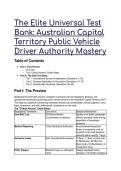
The "Critical Axioms" Cheat Sheet:
Regulatory Framework Core Axiom Statutory Mechanism
Zero BAC Law 0.00 Blood Alcohol Applies to all public passenger
Concentration is absolute. vehicle operators while driving,
regardless of passenger
presence.
Medical Reporting 7-Day Mandatory Notification. Any permanent/long-term
illness or incapacity must be
reported to the road transport
authority within exactly 7 days.
Authority Codes Strict Operational Boundaries. O (Bus), T (Taxi), H (Hire Car),
D (Rideshare), M (Hire Car
Motorcycle), W (Restricted), Q
(Temporary Visa).
HVNL Fatigue Standard Hours vs. Biological Fatigue-regulated heavy
Limits. vehicles (>12t GVM) mandate a
,Regulatory Framework Core Axiom Statutory Mechanism
strict 12-hour maximum work
cap and 7-hour minimum
continuous rest.
PVDAC Display Visible Credential Verification. The Public Vehicle Driver
Authority Card must be visibly
displayed in the prescribed
location at all times during
operation.
Part II: The Elite Test Bank
Tier 1: Foundational Syntax & Application
Q1: An applicant has completed all requirements to operate an app-based transport service in
the ACT. Based on the Road Transport (Driver Licensing) Regulation, which public vehicle
condition code is the MOST APPROPRIATE? A) Code H B) Code T C) Code D D) Code W
● Answer: C (Code D)
● Distractor Analysis:
○ A is incorrect: Code H is reserved for traditional booked hire cars, not rideshare
platforms.
○ B is incorrect: Code T applies exclusively to licensed taxis.
○ D is incorrect: Code W designates restricted hire cars, which are severely limited in
scope.
The Mentor's Analysis: Licensing syntax establishes absolute legal boundaries. When
determining rideshare authority, the immediate priority is verifying the Code D endorsement. By
utilizing this specific classification, you bypass the common trap of operating illegally under a
legacy hire car designation. Professional Intuition: Never accept a passenger without
verifying your condition code explicitly matches your service model.
Q2: A public bus driver is diagnosed with a long-term cardiovascular condition. Based on the
Assessing Fitness to Drive guidelines, what is the FIRST legally mandated action? A) Cease
driving immediately and wait for the annual medical review. B) Surrender the public vehicle
driver authority card to the depot manager. C) Report the condition to the road transport
authority within 7 days. D) Request an occupational therapy driving assessment within 14 days.
● Answer: C (Report the condition to the road transport authority within 7 days.)
● Distractor Analysis:
○ A is incorrect: Waiting for an annual review violates immediate statutory reporting
requirements.
○ B is incorrect: The card is surrendered to the authority upon cancellation, not the
depot manager.
○ D is incorrect: An occupational therapy assessment may be a downstream
requirement, not the initial obligation.
The Mentor's Analysis: Medical fitness is a continuous legal requirement. When facing a new
long-term diagnosis, the immediate priority is notifying the authority within the 7-day statutory
window. By utilizing immediate disclosure, you bypass the common trap of driving while
medically invalidated. Professional Intuition: Statutory medical reporting operates on a strict
7-day countdown from the moment of awareness.
Q3: A taxi driver consumes a single standard alcoholic beverage before a shift. Based on ACT
, legislation, what is the MAXIMUM permitted blood alcohol concentration (BAC) while on duty?
A) 0.05 B) 0.02 C) 0.00 D) 0.08
● Answer: C (0.00)
● Distractor Analysis:
○ A is incorrect: 0.05 is the limit for unrestricted private vehicle drivers.
○ B is incorrect: 0.02 is a legacy heavy vehicle limit in other jurisdictions, but ACT
mandates zero.
○ D is incorrect: 0.08 is an outdated international metric.
The Mentor's Analysis: Public safety protocols mandate absolute sobriety. When facing BAC
limits for public vehicle drivers, the immediate priority is maintaining Zero BAC. By utilizing strict
abstinence, you bypass the trap of assuming a single drink falls under a "safe" threshold.
Professional Intuition: If you hold a public vehicle authority, your operational BAC limit is
mathematically zero.
Q4: A driver applies to operate a public bus carrying more than 12 adults. Based on ACT
regulations, which condition code is the ONLY valid endorsement? A) Code O B) Code B C)
Code T D) Code M
● Answer: A (Code O)
● Distractor Analysis:
○ B is incorrect: Code B is a novice assumption; ACT uses O for public bus
authorities.
○ C is incorrect: Code T is explicitly restricted to taxi operations.
○ D is incorrect: Code M is strictly for hire car motorcycles.
The Mentor's Analysis: Endorsement codes are non-negotiable identifiers. When verifying
authority for a public bus, the immediate priority is checking for Code O. By utilizing correct
regulatory terminology, you bypass the trap of misinterpreting generalized terms. Professional
Intuition: In the ACT, the letter 'O' represents the apex of heavy passenger vehicle
authorization.
Q5: A driver holding a temporary visa is issued a Public Vehicle Driver Licence. Which condition
code is ADDED to denote temporary residency status? A) Code V B) Code T C) Code Q D)
Code X
● Answer: C (Code Q)
● Distractor Analysis:
○ A is incorrect: Code V is associated with vehicle modifications.
○ B is incorrect: Code T is for Taxi authorization.
○ D is incorrect: Code X is a specialized medical condition code.
The Mentor's Analysis: Administrative transparency is essential for regulatory tracking. When
processing an applicant without permanent residency, the immediate priority is applying the
Code Q condition. By utilizing this flag, you bypass the trap of granting permanent privileges to
temporary visa holders. Professional Intuition: Code Q serves as an administrative tether,
removable only once permanent residency is proven.
Q6: A public passenger vehicle driver's authority is cancelled. What is the MAXIMUM timeframe
allowed to return the Public Vehicle Driver Authority Card (PVDAC)? A) 24 hours B) 7 days C)
14 days D) 28 days
● Answer: B (7 days)
● Distractor Analysis:
○ A is incorrect: 24 hours is operationally impractical.
○ C is incorrect: 14 days applies to complaint responses, not card returns.
○ D is incorrect: 28 days is a standard administrative update timeframe.
Bank: Australian Capital
Territory Public Vehicle
Driver Authority Mastery
Table of Contents
● Part I: The Preview
○ The Intro
○ The "Critical Axioms" Cheat Sheet
● Part II: The Elite Test Bank
○ Tier 1: Foundational Syntax & Application (Questions 1–18)
○ Tier 2: Complex Application & Simulation (Questions 19–37)
○ Tier 3: Grandmaster Synthesis (Questions 38–55)
Part I: The Preview
Mastering this test bank ensures complete command over the regulatory, medical, and
operational frameworks governing public vehicle drivers in the Australian Capital Territory (ACT).
This rigorous cognitive conditioning translates directly into unshakeable clinical judgment, strict
legal compliance, and elite professional competence on the road.
The "Critical Axioms" Cheat Sheet:
Regulatory Framework Core Axiom Statutory Mechanism
Zero BAC Law 0.00 Blood Alcohol Applies to all public passenger
Concentration is absolute. vehicle operators while driving,
regardless of passenger
presence.
Medical Reporting 7-Day Mandatory Notification. Any permanent/long-term
illness or incapacity must be
reported to the road transport
authority within exactly 7 days.
Authority Codes Strict Operational Boundaries. O (Bus), T (Taxi), H (Hire Car),
D (Rideshare), M (Hire Car
Motorcycle), W (Restricted), Q
(Temporary Visa).
HVNL Fatigue Standard Hours vs. Biological Fatigue-regulated heavy
Limits. vehicles (>12t GVM) mandate a
,Regulatory Framework Core Axiom Statutory Mechanism
strict 12-hour maximum work
cap and 7-hour minimum
continuous rest.
PVDAC Display Visible Credential Verification. The Public Vehicle Driver
Authority Card must be visibly
displayed in the prescribed
location at all times during
operation.
Part II: The Elite Test Bank
Tier 1: Foundational Syntax & Application
Q1: An applicant has completed all requirements to operate an app-based transport service in
the ACT. Based on the Road Transport (Driver Licensing) Regulation, which public vehicle
condition code is the MOST APPROPRIATE? A) Code H B) Code T C) Code D D) Code W
● Answer: C (Code D)
● Distractor Analysis:
○ A is incorrect: Code H is reserved for traditional booked hire cars, not rideshare
platforms.
○ B is incorrect: Code T applies exclusively to licensed taxis.
○ D is incorrect: Code W designates restricted hire cars, which are severely limited in
scope.
The Mentor's Analysis: Licensing syntax establishes absolute legal boundaries. When
determining rideshare authority, the immediate priority is verifying the Code D endorsement. By
utilizing this specific classification, you bypass the common trap of operating illegally under a
legacy hire car designation. Professional Intuition: Never accept a passenger without
verifying your condition code explicitly matches your service model.
Q2: A public bus driver is diagnosed with a long-term cardiovascular condition. Based on the
Assessing Fitness to Drive guidelines, what is the FIRST legally mandated action? A) Cease
driving immediately and wait for the annual medical review. B) Surrender the public vehicle
driver authority card to the depot manager. C) Report the condition to the road transport
authority within 7 days. D) Request an occupational therapy driving assessment within 14 days.
● Answer: C (Report the condition to the road transport authority within 7 days.)
● Distractor Analysis:
○ A is incorrect: Waiting for an annual review violates immediate statutory reporting
requirements.
○ B is incorrect: The card is surrendered to the authority upon cancellation, not the
depot manager.
○ D is incorrect: An occupational therapy assessment may be a downstream
requirement, not the initial obligation.
The Mentor's Analysis: Medical fitness is a continuous legal requirement. When facing a new
long-term diagnosis, the immediate priority is notifying the authority within the 7-day statutory
window. By utilizing immediate disclosure, you bypass the common trap of driving while
medically invalidated. Professional Intuition: Statutory medical reporting operates on a strict
7-day countdown from the moment of awareness.
Q3: A taxi driver consumes a single standard alcoholic beverage before a shift. Based on ACT
, legislation, what is the MAXIMUM permitted blood alcohol concentration (BAC) while on duty?
A) 0.05 B) 0.02 C) 0.00 D) 0.08
● Answer: C (0.00)
● Distractor Analysis:
○ A is incorrect: 0.05 is the limit for unrestricted private vehicle drivers.
○ B is incorrect: 0.02 is a legacy heavy vehicle limit in other jurisdictions, but ACT
mandates zero.
○ D is incorrect: 0.08 is an outdated international metric.
The Mentor's Analysis: Public safety protocols mandate absolute sobriety. When facing BAC
limits for public vehicle drivers, the immediate priority is maintaining Zero BAC. By utilizing strict
abstinence, you bypass the trap of assuming a single drink falls under a "safe" threshold.
Professional Intuition: If you hold a public vehicle authority, your operational BAC limit is
mathematically zero.
Q4: A driver applies to operate a public bus carrying more than 12 adults. Based on ACT
regulations, which condition code is the ONLY valid endorsement? A) Code O B) Code B C)
Code T D) Code M
● Answer: A (Code O)
● Distractor Analysis:
○ B is incorrect: Code B is a novice assumption; ACT uses O for public bus
authorities.
○ C is incorrect: Code T is explicitly restricted to taxi operations.
○ D is incorrect: Code M is strictly for hire car motorcycles.
The Mentor's Analysis: Endorsement codes are non-negotiable identifiers. When verifying
authority for a public bus, the immediate priority is checking for Code O. By utilizing correct
regulatory terminology, you bypass the trap of misinterpreting generalized terms. Professional
Intuition: In the ACT, the letter 'O' represents the apex of heavy passenger vehicle
authorization.
Q5: A driver holding a temporary visa is issued a Public Vehicle Driver Licence. Which condition
code is ADDED to denote temporary residency status? A) Code V B) Code T C) Code Q D)
Code X
● Answer: C (Code Q)
● Distractor Analysis:
○ A is incorrect: Code V is associated with vehicle modifications.
○ B is incorrect: Code T is for Taxi authorization.
○ D is incorrect: Code X is a specialized medical condition code.
The Mentor's Analysis: Administrative transparency is essential for regulatory tracking. When
processing an applicant without permanent residency, the immediate priority is applying the
Code Q condition. By utilizing this flag, you bypass the trap of granting permanent privileges to
temporary visa holders. Professional Intuition: Code Q serves as an administrative tether,
removable only once permanent residency is proven.
Q6: A public passenger vehicle driver's authority is cancelled. What is the MAXIMUM timeframe
allowed to return the Public Vehicle Driver Authority Card (PVDAC)? A) 24 hours B) 7 days C)
14 days D) 28 days
● Answer: B (7 days)
● Distractor Analysis:
○ A is incorrect: 24 hours is operationally impractical.
○ C is incorrect: 14 days applies to complaint responses, not card returns.
○ D is incorrect: 28 days is a standard administrative update timeframe.


