

Biochemistry Module Exam 1 Mock Exam 2026 |
Trusted Questions & Answers
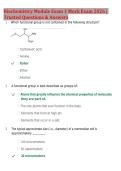
1. Which functional group is not contained in the following structure?
Carboxylic acid
Amine
Ester
Ether
Alcohol
2. A functional group is best described as groups of:
Atoms that greatly influence the chemical properties of molecules
they are part of.
The only atoms that ever function in the body.
Elements that form at high pH.
Elements that occur in a salt.
3. The typical approximate size (i.e., diameter) of a mammalian cell is
approximately _.
100 micrometers
30 nanometers
20 micrometers
, 1 cm
50 nanometers
4. Describe the role of functional groups in organic molecules and how they
influence the properties of biomolecules.
Functional groups are solely responsible for the molecular weight of
compounds.
Functional groups are irrelevant to the structure of biomolecules.
Functional groups only affect the physical state of molecules.
Functional groups determine the chemical reactivity and properties
of organic molecules.
5. The molecular formula of a compound does not show any bonds
F
T
6. If a eukaryotic cell's cytoskeleton were to be disrupted, what immediate
effect might this have on the cell?
Improved nutrient absorption
Increased energy production
Enhanced cell division
Loss of structural integrity
7. Describe the role of glucose in cellular energy storage and metabolism.
Glucose is involved in the synthesis of proteins.
Glucose serves as a primary energy source for cells and is stored as
glycogen in animals.
, Glucose is a structural component of cell membranes.
Glucose is a type of lipid that stores energy.
8. Describe why compounds with a molecular mass of 1,000 g/mol or more are
classified as macromolecules.
Compounds with a molecular mass of 1,000 g/mol or more are
classified as macromolecules because they are always proteins.
Compounds with a molecular mass of 1,000 g/mol or more are
classified as macromolecules due to their high solubility in water.
Compounds with a molecular mass of 1,000 g/mol or more are
classified as macromolecules since they are always found in living
organisms.
Compounds with a molecular mass of 1,000 g/mol or more are
classified as macromolecules because they consist of large
numbers of atoms and exhibit complex structures, which are
essential for biological functions.
9. What term describes a group of two or more macromolecules that come
together?
Mixture
Compound
Aggregate
Complex
10. Which of the following is true about the functional groups in
macromolecules?
Functional groups do not affect the properties and functions of
macromolecules
, Functional groups can change the shape and function of
macromolecules
Functional groups are interchangeable between different types of
macromolecules.
Functional groups are only found in proteins and not in other
macromolecules
11. What is the primary molecule associated with the medical condition of gout?
Glucose
Cholesterol
Lactic acid
Uric acid
12. In relation to functional groups, what is an R-group?
An R-group indicates that the functional group was formed through
dehydration synthesis
An R-group is an abbreviation for an acetyl group in inorganic
chemistry
An R-group is an abbreviation used to show any group to which the
functional group is attached, usually at a carbon or hydrogen atom
An R-group is an abbreviation that denotes the addition of a
phosphate to any functional group
13. If a scientist were to study the differences in cell structure between marigold
flower cells and animal cells, what key feature would they focus on?
The presence of mitochondria in animal cells.
The type of ribosomes in animal cells.
Trusted Questions & Answers
1. Which functional group is not contained in the following structure?
Carboxylic acid
Amine
Ester
Ether
Alcohol
2. A functional group is best described as groups of:
Atoms that greatly influence the chemical properties of molecules
they are part of.
The only atoms that ever function in the body.
Elements that form at high pH.
Elements that occur in a salt.
3. The typical approximate size (i.e., diameter) of a mammalian cell is
approximately _.
100 micrometers
30 nanometers
20 micrometers
, 1 cm
50 nanometers
4. Describe the role of functional groups in organic molecules and how they
influence the properties of biomolecules.
Functional groups are solely responsible for the molecular weight of
compounds.
Functional groups are irrelevant to the structure of biomolecules.
Functional groups only affect the physical state of molecules.
Functional groups determine the chemical reactivity and properties
of organic molecules.
5. The molecular formula of a compound does not show any bonds
F
T
6. If a eukaryotic cell's cytoskeleton were to be disrupted, what immediate
effect might this have on the cell?
Improved nutrient absorption
Increased energy production
Enhanced cell division
Loss of structural integrity
7. Describe the role of glucose in cellular energy storage and metabolism.
Glucose is involved in the synthesis of proteins.
Glucose serves as a primary energy source for cells and is stored as
glycogen in animals.
, Glucose is a structural component of cell membranes.
Glucose is a type of lipid that stores energy.
8. Describe why compounds with a molecular mass of 1,000 g/mol or more are
classified as macromolecules.
Compounds with a molecular mass of 1,000 g/mol or more are
classified as macromolecules because they are always proteins.
Compounds with a molecular mass of 1,000 g/mol or more are
classified as macromolecules due to their high solubility in water.
Compounds with a molecular mass of 1,000 g/mol or more are
classified as macromolecules since they are always found in living
organisms.
Compounds with a molecular mass of 1,000 g/mol or more are
classified as macromolecules because they consist of large
numbers of atoms and exhibit complex structures, which are
essential for biological functions.
9. What term describes a group of two or more macromolecules that come
together?
Mixture
Compound
Aggregate
Complex
10. Which of the following is true about the functional groups in
macromolecules?
Functional groups do not affect the properties and functions of
macromolecules
, Functional groups can change the shape and function of
macromolecules
Functional groups are interchangeable between different types of
macromolecules.
Functional groups are only found in proteins and not in other
macromolecules
11. What is the primary molecule associated with the medical condition of gout?
Glucose
Cholesterol
Lactic acid
Uric acid
12. In relation to functional groups, what is an R-group?
An R-group indicates that the functional group was formed through
dehydration synthesis
An R-group is an abbreviation for an acetyl group in inorganic
chemistry
An R-group is an abbreviation used to show any group to which the
functional group is attached, usually at a carbon or hydrogen atom
An R-group is an abbreviation that denotes the addition of a
phosphate to any functional group
13. If a scientist were to study the differences in cell structure between marigold
flower cells and animal cells, what key feature would they focus on?
The presence of mitochondria in animal cells.
The type of ribosomes in animal cells.


