Advanced Adult Health Assessment Neurological Assessment answer keys
Advanced Adult Health Assessment Neurological Assessment.pdf
Study online at https://quizlet.com/_bn7d90
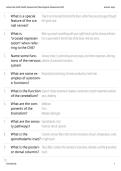
1. What is a special They're all connected directly to the brain, rather than pass messages through
feature of the cra- the spinal cord
nial nerves?
2. What is When you touch something with your right hand, but that sensory informa-
"crossed represen- tion is perceived in the left side of the brain. And vice versa
tation" when refer-
ring to the CNS?
3. Name some func- Sensory input, in, perceiving sensory input, and motor responses. And reg-
tions of the nervous ulations of autonomic functions
system
4. What are some ex- Respiratory functioning, hormone production, heart rate
amples of autonom-
ic functions?
5. What is the function Doesn't initiate movement, however coordinates smooth movement and bal-
of the cerebellum? ance, dexterity.
6. What are the com- Midbrain
ponents of the Pons
brainstem? Medulla oblongata
7. What are the senso- Spinothalamic tract
ry pathways? Posterior dorsal columns
8. What is the Contains sensory fibers that transmit sensations of pain, temperature, crude
spinothalamic tract? or light touch
9. What is the posteri- These fibers conduct the sensations of position, vibration, and finely localized
or dorsal columns? touch
10.
Actualstudy 1
, Advanced Adult Health Assessment Neurological Assessment answer keys
Advanced Adult Health Assessment Neurological Assessment.pdf
Study online at https://quizlet.com/_bn7d90
What is the spinal The highway for ascending and descending fiber tracts that connect brain to
cord and what does the spinal nerves
it do? Mediates reflexes
11. What are the motor Corticospinal/ pyramidal tract
pathways? Extrapyramidal tracts
Cerebellar system
12. What does the pyra- Mediates purposeful voluntary movement
midal tract do? Ex: Writing
13. What does the ex- Controls gross automatic movements, muscle tone
trapyramidal tract Ex: Walking
do?
14. What does the cere- Coordinates movement
bellar system do? Maintains equilibrium Maintains posture
15. Sensory neurons Afferent neurons
are also known as
____________________
16. Motor neurons are Efferent neurons
also known as
____________________
17. What is a reflex arc? Involuntary response to an external stimulus.
Direct connection between sensory and motor neuron without connection to
brain
Ex: Touching a hot stove
18. What are the types Deep tendon (myostatic) - patellar or knee jerk
of reflexes? Superficial - such as corneal reflex
Actualstudy 2
, Advanced Adult Health Assessment Neurological Assessment answer keys
Advanced Adult Health Assessment Neurological Assessment.pdf
Study online at https://quizlet.com/_bn7d90
Visceral (organic) - such as pupillary response to light and accommodation
Pathological (abnormal) - such as Babinskis reflex beyond 2-2.5yrs
19. What are they 2 Somatic - innervate skeletal voluntary muscle
functional compo- Autonomic - fibers innervate smooth, involuntary muscle (cardiac muscle,
nents of PNS nerve glands)
fibers?
20. What are changes General atrophy/loss of neurons in brain and spinal cord
associated with the Decrease in weight/volume of brain
nervous system Decrease in muscle strength + impaired fine coordination
seen with aging? Slowed reaction time
Dizziness and loss of balance
21. What are pieces of Experience headache, dizziness/vertigo, tremors, seizures, weakness, incoor-
subjective data we dination, numbness/tingling, difficulty swallowing or speaking
would collect when History of: head/spinal cord injuries, stroke, diabetes (think neuropathy),
doing a neurologi- concussions, alcoholism (encephalopathy), meningitis, encephalitis
cal exam?
22. What are some Cognitive functioning declines, decreased memory, changes to mental func-
abnormal changes tioning, confusion
with aging affect- Senile tremor of commonly hand or face
ing the neurological Sudden vision changes, sudden weakness (may indicate CVA)
system?
23. What is a senile A tremor commonly seen in older adults with no underlying pathological
tremor? cause
24. What are the 3 ap- Screening
proaches to neuro- Complete examination
logical assessment? Neurological recheck examination
Actualstudy 3
Advanced Adult Health Assessment Neurological Assessment.pdf
Study online at https://quizlet.com/_bn7d90
1. What is a special They're all connected directly to the brain, rather than pass messages through
feature of the cra- the spinal cord
nial nerves?
2. What is When you touch something with your right hand, but that sensory informa-
"crossed represen- tion is perceived in the left side of the brain. And vice versa
tation" when refer-
ring to the CNS?
3. Name some func- Sensory input, in, perceiving sensory input, and motor responses. And reg-
tions of the nervous ulations of autonomic functions
system
4. What are some ex- Respiratory functioning, hormone production, heart rate
amples of autonom-
ic functions?
5. What is the function Doesn't initiate movement, however coordinates smooth movement and bal-
of the cerebellum? ance, dexterity.
6. What are the com- Midbrain
ponents of the Pons
brainstem? Medulla oblongata
7. What are the senso- Spinothalamic tract
ry pathways? Posterior dorsal columns
8. What is the Contains sensory fibers that transmit sensations of pain, temperature, crude
spinothalamic tract? or light touch
9. What is the posteri- These fibers conduct the sensations of position, vibration, and finely localized
or dorsal columns? touch
10.
Actualstudy 1
, Advanced Adult Health Assessment Neurological Assessment answer keys
Advanced Adult Health Assessment Neurological Assessment.pdf
Study online at https://quizlet.com/_bn7d90
What is the spinal The highway for ascending and descending fiber tracts that connect brain to
cord and what does the spinal nerves
it do? Mediates reflexes
11. What are the motor Corticospinal/ pyramidal tract
pathways? Extrapyramidal tracts
Cerebellar system
12. What does the pyra- Mediates purposeful voluntary movement
midal tract do? Ex: Writing
13. What does the ex- Controls gross automatic movements, muscle tone
trapyramidal tract Ex: Walking
do?
14. What does the cere- Coordinates movement
bellar system do? Maintains equilibrium Maintains posture
15. Sensory neurons Afferent neurons
are also known as
____________________
16. Motor neurons are Efferent neurons
also known as
____________________
17. What is a reflex arc? Involuntary response to an external stimulus.
Direct connection between sensory and motor neuron without connection to
brain
Ex: Touching a hot stove
18. What are the types Deep tendon (myostatic) - patellar or knee jerk
of reflexes? Superficial - such as corneal reflex
Actualstudy 2
, Advanced Adult Health Assessment Neurological Assessment answer keys
Advanced Adult Health Assessment Neurological Assessment.pdf
Study online at https://quizlet.com/_bn7d90
Visceral (organic) - such as pupillary response to light and accommodation
Pathological (abnormal) - such as Babinskis reflex beyond 2-2.5yrs
19. What are they 2 Somatic - innervate skeletal voluntary muscle
functional compo- Autonomic - fibers innervate smooth, involuntary muscle (cardiac muscle,
nents of PNS nerve glands)
fibers?
20. What are changes General atrophy/loss of neurons in brain and spinal cord
associated with the Decrease in weight/volume of brain
nervous system Decrease in muscle strength + impaired fine coordination
seen with aging? Slowed reaction time
Dizziness and loss of balance
21. What are pieces of Experience headache, dizziness/vertigo, tremors, seizures, weakness, incoor-
subjective data we dination, numbness/tingling, difficulty swallowing or speaking
would collect when History of: head/spinal cord injuries, stroke, diabetes (think neuropathy),
doing a neurologi- concussions, alcoholism (encephalopathy), meningitis, encephalitis
cal exam?
22. What are some Cognitive functioning declines, decreased memory, changes to mental func-
abnormal changes tioning, confusion
with aging affect- Senile tremor of commonly hand or face
ing the neurological Sudden vision changes, sudden weakness (may indicate CVA)
system?
23. What is a senile A tremor commonly seen in older adults with no underlying pathological
tremor? cause
24. What are the 3 ap- Screening
proaches to neuro- Complete examination
logical assessment? Neurological recheck examination
Actualstudy 3