
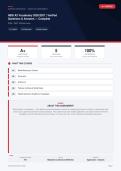
A+ VERIFIED
NURSING ADMISSIONS · OBJECTIVE ASSESSMENT
HESI A2 Vocabulary 2026/2027 | Verified
Questions & Answers — Complete
Official Exam
A+ Verified Full Rationales Verified Answers
A+ 5 100%
QUESTIONS SECTIONS RATIONALES
Complete coverage Core exam domains Every answer explained
WHAT THIS COVERS
01 Word Meaning in Context
02 Synonyms
03 Antonyms
04 Prefixes, Suffixes & Word Roots
05 Health-Science & Academic Vocabulary
ABOUT THIS ASSESSMENT
Build mastery in vocabulary — from determining word meaning in context to recognizing synonyms, antonyms, and precise word
choice across general and health-science passages. This original study bank targets application and analysis skills for HESI A2
Vocabulary, with full rationales for every answer. For review use only; not an institutional proctored assessment.
PASSING SCORE LEVEL FORMAT
75% Moderate to Advanced (HESI A2) Application / Analysis
STUVIA ACTUAL EXAM Page 1
, SECTION 1: Word Meaning in Context
Q1. During morning rounds, the charge nurse noted that the patient’s condition appeared to be deteriorating rapidly after
the medication change. In this clinical context, the word “deteriorating” most nearly means:
A. Becoming worse or declining in quality
B. Improving steadily over several hours
C. Remaining completely unchanged
D. Stabilizing after a temporary setback
Correct Answer: A
Rationale: In medical and everyday usage, “deteriorating” means becoming progressively worse. The surrounding phrase “rapidly after
the medication change” confirms a negative shift rather than improvement, stability, or recovery.
Q2. The physician explained that the new protocol would supersede the previous guidelines for post-operative care. Based
on the sentence, the word “supersede” most closely means:
A. To support or reinforce an existing rule
B. To delay implementation indefinitely
C. To take the place of something previously in force
D. To copy the language of an older document
Correct Answer: C
Rationale: “Supersede” means to replace or take the place of something that came before. In policy language, a new protocol that
supersedes prior guidelines becomes the controlling standard.
Q3. After reviewing the lab results, the nurse practitioner concluded that the findings were inconclusive and ordered
additional tests. In this context, “inconclusive” most nearly means:
A. Clearly proving a single diagnosis
B. Not decisive or not settling the question
C. Leading to an immediate discharge order
D. Identical to results from the previous week
Correct Answer: B
Rationale: “Inconclusive” describes evidence that does not allow a firm conclusion. Ordering further tests is the logical response when
current findings fail to settle the clinical question.
Q4. The discharge planner emphasized that the patient’s adherence to the home medication schedule would be critical for
recovery. The word “adherence” in this sentence is best defined as:
A. Occasional, irregular use of the prescribed drugs
B. Complete refusal to take any medication
C. Preference for alternative herbal remedies
D. Consistent following of the recommended plan
Correct Answer: D
Rationale: “Adherence” means steady compliance with a prescribed regimen. In patient education, it refers to reliably following the
medication schedule rather than sporadic or absent use.
STUVIA ACTUAL EXAM · Page 2
, Q5. Although the initial assessment suggested a simple soft-tissue injury, further imaging revealed a more ominous
underlying fracture. The word “ominous” most nearly means:
A. Encouraging and reassuring
B. Suggesting future difficulty or threat
C. Completely irrelevant to the case
D. Mild and expected for the age group
Correct Answer: B
Rationale: “Ominous” describes something that indicates a threatening or unfavorable outcome. The contrast with the initially “simple”
impression highlights the more serious implication of the fracture.
Q6. The infection-control nurse reported that the pathogen was ubiquitous in the intensive-care environment and required
heightened precautions. In this context, “ubiquitous” means:
A. Present or appearing everywhere
B. Extremely rare and confined to one room
C. Newly discovered and poorly understood
D. Sensitive only to a single antibiotic
Correct Answer: A
Rationale: “Ubiquitous” means existing or being present everywhere. The call for heightened precautions follows logically from a
pathogen that is widespread throughout the unit.
Q7. The attending physician described the patient’s response to therapy as paradoxical because the expected
improvement did not occur. The word “paradoxical” most nearly means:
A. Exactly matching the predicted outcome
B. Milder than the average response
C. Seemingly contradictory or contrary to expectation
D. Delayed by only a few minutes
Correct Answer: C
Rationale: A paradoxical response is one that is contrary to what is expected. The sentence itself states that the expected improvement
failed to appear, confirming the meaning.
Q8. Before the procedure, the nurse obtained informed consent and verified that the patient understood the potential
sequelae of the surgery. The word “sequelae” refers to:
A. The preparatory steps taken the night before
B. The list of medications the patient currently takes
C. The name of the operating surgeon
D. Conditions or complications that follow a disease or treatment
Correct Answer: D
Rationale: “Sequelae” are the after-effects or secondary conditions that result from a disease, injury, or treatment. Informed consent
discussions routinely address possible sequelae of surgery.
Q9. The research abstract stated that the study’s findings should be interpreted with caution because the sample size was
limited and the results were not generalizable. In this sentence, “generalizable” means:
A. Capable of being extended to a broader population
B. Applicable only to the exact participants studied
C. Written in language that non-scientists cannot understand
D. Based solely on laboratory animal data
Correct Answer: A
Rationale: Results that are generalizable can be applied beyond the specific sample to a wider group. A limited sample size is a classic
reason that findings may lack generalizability.
STUVIA ACTUAL EXAM · Page 3
NURSING ADMISSIONS · OBJECTIVE ASSESSMENT
HESI A2 Vocabulary 2026/2027 | Verified
Questions & Answers — Complete
Official Exam
A+ Verified Full Rationales Verified Answers
A+ 5 100%
QUESTIONS SECTIONS RATIONALES
Complete coverage Core exam domains Every answer explained
WHAT THIS COVERS
01 Word Meaning in Context
02 Synonyms
03 Antonyms
04 Prefixes, Suffixes & Word Roots
05 Health-Science & Academic Vocabulary
ABOUT THIS ASSESSMENT
Build mastery in vocabulary — from determining word meaning in context to recognizing synonyms, antonyms, and precise word
choice across general and health-science passages. This original study bank targets application and analysis skills for HESI A2
Vocabulary, with full rationales for every answer. For review use only; not an institutional proctored assessment.
PASSING SCORE LEVEL FORMAT
75% Moderate to Advanced (HESI A2) Application / Analysis
STUVIA ACTUAL EXAM Page 1
, SECTION 1: Word Meaning in Context
Q1. During morning rounds, the charge nurse noted that the patient’s condition appeared to be deteriorating rapidly after
the medication change. In this clinical context, the word “deteriorating” most nearly means:
A. Becoming worse or declining in quality
B. Improving steadily over several hours
C. Remaining completely unchanged
D. Stabilizing after a temporary setback
Correct Answer: A
Rationale: In medical and everyday usage, “deteriorating” means becoming progressively worse. The surrounding phrase “rapidly after
the medication change” confirms a negative shift rather than improvement, stability, or recovery.
Q2. The physician explained that the new protocol would supersede the previous guidelines for post-operative care. Based
on the sentence, the word “supersede” most closely means:
A. To support or reinforce an existing rule
B. To delay implementation indefinitely
C. To take the place of something previously in force
D. To copy the language of an older document
Correct Answer: C
Rationale: “Supersede” means to replace or take the place of something that came before. In policy language, a new protocol that
supersedes prior guidelines becomes the controlling standard.
Q3. After reviewing the lab results, the nurse practitioner concluded that the findings were inconclusive and ordered
additional tests. In this context, “inconclusive” most nearly means:
A. Clearly proving a single diagnosis
B. Not decisive or not settling the question
C. Leading to an immediate discharge order
D. Identical to results from the previous week
Correct Answer: B
Rationale: “Inconclusive” describes evidence that does not allow a firm conclusion. Ordering further tests is the logical response when
current findings fail to settle the clinical question.
Q4. The discharge planner emphasized that the patient’s adherence to the home medication schedule would be critical for
recovery. The word “adherence” in this sentence is best defined as:
A. Occasional, irregular use of the prescribed drugs
B. Complete refusal to take any medication
C. Preference for alternative herbal remedies
D. Consistent following of the recommended plan
Correct Answer: D
Rationale: “Adherence” means steady compliance with a prescribed regimen. In patient education, it refers to reliably following the
medication schedule rather than sporadic or absent use.
STUVIA ACTUAL EXAM · Page 2
, Q5. Although the initial assessment suggested a simple soft-tissue injury, further imaging revealed a more ominous
underlying fracture. The word “ominous” most nearly means:
A. Encouraging and reassuring
B. Suggesting future difficulty or threat
C. Completely irrelevant to the case
D. Mild and expected for the age group
Correct Answer: B
Rationale: “Ominous” describes something that indicates a threatening or unfavorable outcome. The contrast with the initially “simple”
impression highlights the more serious implication of the fracture.
Q6. The infection-control nurse reported that the pathogen was ubiquitous in the intensive-care environment and required
heightened precautions. In this context, “ubiquitous” means:
A. Present or appearing everywhere
B. Extremely rare and confined to one room
C. Newly discovered and poorly understood
D. Sensitive only to a single antibiotic
Correct Answer: A
Rationale: “Ubiquitous” means existing or being present everywhere. The call for heightened precautions follows logically from a
pathogen that is widespread throughout the unit.
Q7. The attending physician described the patient’s response to therapy as paradoxical because the expected
improvement did not occur. The word “paradoxical” most nearly means:
A. Exactly matching the predicted outcome
B. Milder than the average response
C. Seemingly contradictory or contrary to expectation
D. Delayed by only a few minutes
Correct Answer: C
Rationale: A paradoxical response is one that is contrary to what is expected. The sentence itself states that the expected improvement
failed to appear, confirming the meaning.
Q8. Before the procedure, the nurse obtained informed consent and verified that the patient understood the potential
sequelae of the surgery. The word “sequelae” refers to:
A. The preparatory steps taken the night before
B. The list of medications the patient currently takes
C. The name of the operating surgeon
D. Conditions or complications that follow a disease or treatment
Correct Answer: D
Rationale: “Sequelae” are the after-effects or secondary conditions that result from a disease, injury, or treatment. Informed consent
discussions routinely address possible sequelae of surgery.
Q9. The research abstract stated that the study’s findings should be interpreted with caution because the sample size was
limited and the results were not generalizable. In this sentence, “generalizable” means:
A. Capable of being extended to a broader population
B. Applicable only to the exact participants studied
C. Written in language that non-scientists cannot understand
D. Based solely on laboratory animal data
Correct Answer: A
Rationale: Results that are generalizable can be applied beyond the specific sample to a wider group. A limited sample size is a classic
reason that findings may lack generalizability.
STUVIA ACTUAL EXAM · Page 3


