
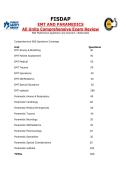
FISDAP
EMT AND PARAMEDICS
All Units Comprehensive Exam Review
600 Multichoice Questions and Answers +Rationales
Comprehensive 600-Questions Coverage
Unit Questions
EMT Airway & Breathing 40
EMT Patient Assessment 40
EMT Medical 50
EMT Trauma 50
EMT Operations 40
EMT OB/Pediatrics 40
EMT Special Situations 20
EMT subtotal 280
Paramedic Airway & Respiratory 40
Paramedic Cardiology 60
Paramedic Medical Emergencies 60
Paramedic Trauma 40
Paramedic Neurology 20
Paramedic OB/Pediatrics 30
Paramedic Pharmacology 30
Paramedic Operations 20
Paramedic Special Considerations 20
Paramedic subtotal 320
TOTAL 600
,EMT: Airway, Breathing & Assessment
1. An unresponsive adult has abnormal gasping respirations. What should the EMT
do first?
Answer: Begin high-quality CPR and activate the appropriate emergency response.
Rationale: Agonal gasps are not considered normal breathing. An unresponsive
patient with abnormal breathing should be treated as being in cardiac arrest until
proven otherwise. Early CPR and rapid defibrillation are critical to survival.
2. A conscious patient has a suspected upper-airway obstruction but is still
coughing forcefully. What is the appropriate action?
Answer: Encourage the patient to continue coughing.
Rationale: A strong cough indicates that air is still moving through the airway.
Unnecessary abdominal thrusts or back blows can worsen the obstruction. The EMT
should closely monitor the patient and intervene if the cough becomes ineffective.
3. A patient with severe respiratory distress has a respiratory rate of 34/min,
cyanosis, and decreasing level of consciousness. What is the greatest concern?
Answer: Impending respiratory failure.
Rationale: Tachypnea combined with cyanosis and altered mental status suggests
inadequate oxygenation or ventilation. Altered consciousness can indicate that
respiratory compensation is failing. Immediate airway and ventilatory support are
necessary.
4. Which finding most strongly suggests inadequate ventilation?
Answer: Increasing carbon dioxide with altered mental status.
Rationale: Ventilation refers to the movement of air into and out of the lungs and
removal of carbon dioxide. Hypoventilation can cause carbon dioxide retention and
respiratory acidosis. Mental-status changes may occur as respiratory failure
progresses.
5. An adult patient is breathing 6 times/min with shallow respirations after an
opioid overdose. What intervention is most appropriate?
Answer: Provide assisted ventilations and administer naloxone according to
protocol.
Rationale: Severe opioid toxicity can cause respiratory depression and hypoxia.
Assisted ventilation is the immediate priority when spontaneous breathing is
inadequate. Naloxone can reverse opioid-induced respiratory depression but should
not delay ventilation.
6. What is the primary purpose of a pulse oximeter?
Answer: To estimate peripheral blood oxygen saturation.
Rationale: Pulse oximetry provides an estimate of hemoglobin oxygen saturation. It
does not directly measure ventilation or carbon dioxide levels. Clinical assessment
remains essential because oxygen saturation may initially appear normal in some
serious conditions.
,7. A patient with asthma is becoming exhausted after prolonged wheezing. What
does the sudden disappearance of wheezing potentially indicate?
Answer: Severely reduced airflow and impending respiratory failure.
Rationale: Wheezing results from narrowed airways with air movement. In a
severely deteriorating patient, airflow may become so limited that wheezing
decreases or disappears. A “quiet chest” in this setting is a dangerous finding.
8. Which patient should receive the highest priority during initial triage?
Answer: A patient with severe respiratory distress and altered mental status.
Rationale: Airway and breathing problems can become rapidly fatal. Altered mental
status suggests inadequate oxygenation, ventilation, or cerebral perfusion. Patients
with immediately life-threatening conditions receive priority.
9. What is the most reliable initial indicator that an airway is patent in a conscious
patient?
Answer: The patient can speak clearly.
Rationale: Speaking requires sufficient airflow through the airway. A patient who
can speak in complete sentences generally has at least a partially patent airway.
However, ongoing monitoring is still required because airway status can
deteriorate.
10. An unconscious trauma patient requires airway management and has no
evidence of spinal injury. Which maneuver is generally preferred?
Answer: Head-tilt/chin-lift.
Rationale: The head-tilt/chin-lift opens the airway by moving the tongue away from
the posterior pharynx. In suspected spinal trauma, a jaw-thrust maneuver is
generally preferred when feasible. Airway management always takes priority over
concerns about potential spinal injury.
EMT Patient Assessment
11. What is the primary purpose of the primary assessment?
Answer: Identify and immediately manage life threats.
Rationale: The primary assessment rapidly evaluates airway, breathing, circulation,
disability, and other immediate threats. It is not intended to establish a complete
diagnosis. Life-threatening problems must be addressed before a detailed
secondary assessment.
12. A patient has severe bleeding from an extremity. What should the EMT do first?
Answer: Control the life-threatening hemorrhage.
Rationale: Massive external bleeding can cause death within minutes. Direct
pressure, appropriate wound packing, or a tourniquet may be required depending
on the injury. Hemorrhage control should not be unnecessarily delayed for a
complete history.
13. Which finding is most concerning in a patient with suspected shock?
Answer: Altered mental status with weak peripheral pulses.
Rationale: Altered mental status may indicate inadequate cerebral perfusion. Weak
, peripheral pulses can occur as the body constricts peripheral circulation to preserve
blood flow to vital organs. Together, these findings suggest significant circulatory
compromise.
14. Why is a patient's mental status assessed early during the primary survey?
Answer: It provides important information about oxygenation, perfusion, and
neurologic function.
Rationale: Mental status can deteriorate when the brain is not receiving adequate
oxygen or blood flow. It can also change because of metabolic, toxicologic, or
neurologic problems. A rapid mental-status assessment therefore helps identify
serious illness.
15. Which question is most appropriate when assessing the onset of a patient's
chest pain?
Answer: “What were you doing when the pain started?”
Rationale: Determining onset and circumstances can help identify possible causes.
Chest discomfort associated with exertion may suggest myocardial ischemia, while
sudden onset can suggest other conditions. The history should follow a structured
assessment approach.
16. A patient reports abdominal pain. Which finding should raise the greatest
concern?
Answer: Rigid, distended abdomen with signs of shock.
Rationale: Abdominal rigidity and distention may indicate significant internal
pathology or bleeding. Associated shock suggests compromised circulation. Such a
patient requires rapid recognition, supportive care, and prompt transport.
17. What does the “P” in the SAMPLE history represent?
Answer: Pertinent past medical history.
Rationale: SAMPLE is a structured method for obtaining important patient
information. The components include signs/symptoms, allergies, medications,
pertinent past history, last oral intake, and events leading to the illness or injury.
Using a consistent structure reduces the chance of missing important information.
18. What is the purpose of reassessment during EMS care?
Answer: To identify changes in the patient's condition and evaluate treatment
effectiveness.
Rationale: A patient's condition can change during transport or after treatment.
Reassessment allows the EMT or paramedic to recognize deterioration early. It also
determines whether interventions are producing the expected response.
19. Which vital-sign trend is most concerning?
Answer: Increasing respiratory rate followed by decreasing respiratory effort and
altered consciousness.
Rationale: Increasing respiratory effort may initially represent compensation. A
subsequent decrease in effort combined with altered consciousness can indicate
fatigue and impending respiratory failure. Trends are often more informative than a
single isolated measurement.
EMT AND PARAMEDICS
All Units Comprehensive Exam Review
600 Multichoice Questions and Answers +Rationales
Comprehensive 600-Questions Coverage
Unit Questions
EMT Airway & Breathing 40
EMT Patient Assessment 40
EMT Medical 50
EMT Trauma 50
EMT Operations 40
EMT OB/Pediatrics 40
EMT Special Situations 20
EMT subtotal 280
Paramedic Airway & Respiratory 40
Paramedic Cardiology 60
Paramedic Medical Emergencies 60
Paramedic Trauma 40
Paramedic Neurology 20
Paramedic OB/Pediatrics 30
Paramedic Pharmacology 30
Paramedic Operations 20
Paramedic Special Considerations 20
Paramedic subtotal 320
TOTAL 600
,EMT: Airway, Breathing & Assessment
1. An unresponsive adult has abnormal gasping respirations. What should the EMT
do first?
Answer: Begin high-quality CPR and activate the appropriate emergency response.
Rationale: Agonal gasps are not considered normal breathing. An unresponsive
patient with abnormal breathing should be treated as being in cardiac arrest until
proven otherwise. Early CPR and rapid defibrillation are critical to survival.
2. A conscious patient has a suspected upper-airway obstruction but is still
coughing forcefully. What is the appropriate action?
Answer: Encourage the patient to continue coughing.
Rationale: A strong cough indicates that air is still moving through the airway.
Unnecessary abdominal thrusts or back blows can worsen the obstruction. The EMT
should closely monitor the patient and intervene if the cough becomes ineffective.
3. A patient with severe respiratory distress has a respiratory rate of 34/min,
cyanosis, and decreasing level of consciousness. What is the greatest concern?
Answer: Impending respiratory failure.
Rationale: Tachypnea combined with cyanosis and altered mental status suggests
inadequate oxygenation or ventilation. Altered consciousness can indicate that
respiratory compensation is failing. Immediate airway and ventilatory support are
necessary.
4. Which finding most strongly suggests inadequate ventilation?
Answer: Increasing carbon dioxide with altered mental status.
Rationale: Ventilation refers to the movement of air into and out of the lungs and
removal of carbon dioxide. Hypoventilation can cause carbon dioxide retention and
respiratory acidosis. Mental-status changes may occur as respiratory failure
progresses.
5. An adult patient is breathing 6 times/min with shallow respirations after an
opioid overdose. What intervention is most appropriate?
Answer: Provide assisted ventilations and administer naloxone according to
protocol.
Rationale: Severe opioid toxicity can cause respiratory depression and hypoxia.
Assisted ventilation is the immediate priority when spontaneous breathing is
inadequate. Naloxone can reverse opioid-induced respiratory depression but should
not delay ventilation.
6. What is the primary purpose of a pulse oximeter?
Answer: To estimate peripheral blood oxygen saturation.
Rationale: Pulse oximetry provides an estimate of hemoglobin oxygen saturation. It
does not directly measure ventilation or carbon dioxide levels. Clinical assessment
remains essential because oxygen saturation may initially appear normal in some
serious conditions.
,7. A patient with asthma is becoming exhausted after prolonged wheezing. What
does the sudden disappearance of wheezing potentially indicate?
Answer: Severely reduced airflow and impending respiratory failure.
Rationale: Wheezing results from narrowed airways with air movement. In a
severely deteriorating patient, airflow may become so limited that wheezing
decreases or disappears. A “quiet chest” in this setting is a dangerous finding.
8. Which patient should receive the highest priority during initial triage?
Answer: A patient with severe respiratory distress and altered mental status.
Rationale: Airway and breathing problems can become rapidly fatal. Altered mental
status suggests inadequate oxygenation, ventilation, or cerebral perfusion. Patients
with immediately life-threatening conditions receive priority.
9. What is the most reliable initial indicator that an airway is patent in a conscious
patient?
Answer: The patient can speak clearly.
Rationale: Speaking requires sufficient airflow through the airway. A patient who
can speak in complete sentences generally has at least a partially patent airway.
However, ongoing monitoring is still required because airway status can
deteriorate.
10. An unconscious trauma patient requires airway management and has no
evidence of spinal injury. Which maneuver is generally preferred?
Answer: Head-tilt/chin-lift.
Rationale: The head-tilt/chin-lift opens the airway by moving the tongue away from
the posterior pharynx. In suspected spinal trauma, a jaw-thrust maneuver is
generally preferred when feasible. Airway management always takes priority over
concerns about potential spinal injury.
EMT Patient Assessment
11. What is the primary purpose of the primary assessment?
Answer: Identify and immediately manage life threats.
Rationale: The primary assessment rapidly evaluates airway, breathing, circulation,
disability, and other immediate threats. It is not intended to establish a complete
diagnosis. Life-threatening problems must be addressed before a detailed
secondary assessment.
12. A patient has severe bleeding from an extremity. What should the EMT do first?
Answer: Control the life-threatening hemorrhage.
Rationale: Massive external bleeding can cause death within minutes. Direct
pressure, appropriate wound packing, or a tourniquet may be required depending
on the injury. Hemorrhage control should not be unnecessarily delayed for a
complete history.
13. Which finding is most concerning in a patient with suspected shock?
Answer: Altered mental status with weak peripheral pulses.
Rationale: Altered mental status may indicate inadequate cerebral perfusion. Weak
, peripheral pulses can occur as the body constricts peripheral circulation to preserve
blood flow to vital organs. Together, these findings suggest significant circulatory
compromise.
14. Why is a patient's mental status assessed early during the primary survey?
Answer: It provides important information about oxygenation, perfusion, and
neurologic function.
Rationale: Mental status can deteriorate when the brain is not receiving adequate
oxygen or blood flow. It can also change because of metabolic, toxicologic, or
neurologic problems. A rapid mental-status assessment therefore helps identify
serious illness.
15. Which question is most appropriate when assessing the onset of a patient's
chest pain?
Answer: “What were you doing when the pain started?”
Rationale: Determining onset and circumstances can help identify possible causes.
Chest discomfort associated with exertion may suggest myocardial ischemia, while
sudden onset can suggest other conditions. The history should follow a structured
assessment approach.
16. A patient reports abdominal pain. Which finding should raise the greatest
concern?
Answer: Rigid, distended abdomen with signs of shock.
Rationale: Abdominal rigidity and distention may indicate significant internal
pathology or bleeding. Associated shock suggests compromised circulation. Such a
patient requires rapid recognition, supportive care, and prompt transport.
17. What does the “P” in the SAMPLE history represent?
Answer: Pertinent past medical history.
Rationale: SAMPLE is a structured method for obtaining important patient
information. The components include signs/symptoms, allergies, medications,
pertinent past history, last oral intake, and events leading to the illness or injury.
Using a consistent structure reduces the chance of missing important information.
18. What is the purpose of reassessment during EMS care?
Answer: To identify changes in the patient's condition and evaluate treatment
effectiveness.
Rationale: A patient's condition can change during transport or after treatment.
Reassessment allows the EMT or paramedic to recognize deterioration early. It also
determines whether interventions are producing the expected response.
19. Which vital-sign trend is most concerning?
Answer: Increasing respiratory rate followed by decreasing respiratory effort and
altered consciousness.
Rationale: Increasing respiratory effort may initially represent compensation. A
subsequent decrease in effort combined with altered consciousness can indicate
fatigue and impending respiratory failure. Trends are often more informative than a
single isolated measurement.


