

Written by students who passed Immediately available after payment Read online or as PDF Wrong document? Swap it for free 4.6 TrustPilot
logo-home
Document preview thumbnail
Preview 2 out of 12 pages
Exam (elaborations)

NSG 1400 Becoming a Nurse Questions & Answers 2026/2027 | Nursing History, ADPIE, Ethics, Theories, Scope of Practice & Canadian Healthcare

Document preview thumbnail
Preview 2 out of 12 pages

This NSG 1400 Becoming a Nurse 2026/2027 study document provides a comprehensive 12-page question-and-answer review covering the history and development of nursing, professional nursing organizations, regulation and scope of practice, nursing theories, the nursing process, ethics, critical thinking, Canadian healthcare, legal responsibilities, documentation, consent, and professional accountability. It is structured for exam preparation with concise definitions and answers that help students review foundational concepts associated with becoming a professional nurse. The document begins with important figures and developments in nursing history and professionalization, including Florence Nightingale and Mary Agnes Snively, hospital-based nursing schools, St. Catherine’s Training School, and the development of university nursing education in Canada. It also introduces Carper’s Ways of Knowing—empirical, personal, ethical, and aesthetic knowledge—and the nursing metaparadigm of person, environment, health, and nursing. These concepts establish the historical, theoretical, and professional foundations of nursing practice presented throughout the document. A major section focuses on professional regulation, scope of practice, standards, competency, and nursing organizations. Students review the roles described in the material for the Canadian Nurses Association (CNA), Canadian Association of Schools of Nursing (CASN), College and Association of Registered Nurses of Alberta (CARNA), professional colleges, regulatory bodies, and the Health Professions Act. Other key concepts include jurisprudence, continuing competence, fitness to practice, self-regulation, standards of practice, and the clinical, administration, education, and research domains of nursing scope of practice. The study material also reviews nine entry-level nursing competencies, including clinician, professional, communicator, collaborator, coordinator, leader, advocate, educator, and scholar. Nursing practice standards are organized around responsibility and accountability, knowledge, ethical practice, provision of service to the public, and self-regulation. These topics are particularly useful for understanding professional expectations and the responsibilities associated with entry into nursing practice. Another substantial section covers the nursing process and major nursing theories. Students review ADPIE—Assessment, Diagnosis, Planning, Implementation, and Evaluation—alongside concepts, theory, signs versus symptoms, reflection, and critical thinking. The document introduces Hildegard Peplau’s Theory of Interpersonal Relations, Virginia Henderson’s Definition of Nursing, Sister Callista Roy’s Adaptation Model, Jean Watson’s Theory of Human Caring, and Margaret Campbell’s UBC Model of Nursing. Together, these frameworks demonstrate different approaches to therapeutic relationships, independence, adaptation, holistic caring, and human needs. The ethics section provides targeted review of autonomy, beneficence, nonmaleficence, justice, fidelity, veracity, morality, ethical dilemmas, moral distress, utilitarianism, deontology, and principlism. It connects ethical decision-making with professional nursing practice and patient rights while emphasizing reflection and critical thinking as important elements of clinical judgment. The document further addresses the organization of Canadian healthcare and health policy, including healthcare reform, Alberta Health, Alberta Health Services, the Health Quality Council of Alberta, and primary healthcare. It reviews the five pillars of the Canadian healthcare system identified in the material: public administration, comprehensiveness, universality, portability, and accessibility. Primary healthcare is additionally organized around team, access, information, and healthy living. The final portion focuses on legal and professional nursing responsibilities, including standards of care, torts, negligence, malpractice, delegation and supervision, documentation, vicarious liability, informed and implied consent, conscientious objection, and unions. Documentation methods reviewed include narrative charting, SOAP, SOAPIE, PIE, and focus charting, giving students a broad overview of legal accountability and professional record-keeping concepts relevant to nursing practice. Relevant Students: NSG 1400 students, first-year nursing students, BSN students, BScN students, RN students, Canadian nursing students, Alberta nursing students, nursing fundamentals students, students studying professional nursing practice, nursing ethics students, nursing theory students, and students preparing for examinations on nursing history, regulation, scope of practice, ADPIE, professional accountability, Canadian healthcare, and nursing law. Keywords: NSG 1400 Becoming a Nurse, NSG , NSG , NSG 1400 questions and answers, NSG 1400 exam questions, NSG 1400 study guide, Becoming a Nurse exam, nursing fundamentals questions, nursing history exam questions, Florence Nightingale nursing, Mary Agnes Snively, Carpers Ways of Knowing, empirical personal ethical aesthetic knowing, Canadian nursing organizations, CNA nursing, CASN nursing, CARNA nursing, Health Professions Act nursing, nursing scope of practice, nursing standards of practice, entry level nursing competencies, nursing metaparadigm, ADPIE nursing process, nursing theories exam, Hildegard Peplau theory, Virginia Henderson nursing theory, Roy Adaptation Model, Jean Watson Theory of Human Caring, UBC Model of Nursing, nursing ethics questions, autonomy beneficence nonmaleficence justice, moral distress nursing, critical thinking nursing, Canadian healthcare system, five pillars Canadian healthcare, nursing negligence and malpractice, nursing legal responsibilities, nursing documentation, SOAPIE nursing, informed consent nursing, professional nursing practice

Content preview

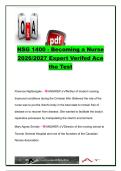
NSG 1400 - Becoming a Nurse
2026/2027 Expert Verifed Ace
the Test


Florence Nightengale - ANSWER ✔✔Mother of modern nursing,

Improved conditions during the Crimean War. Believed the role of the

nurse was to put the client's body in the best state to remain free of

disease or to recover from disease. She wanted to facilitate the body's

reparative processes by manipulating the client's environment.


Mary Agnes Snively - ANSWER ✔✔Director of the nursing school at

Toronto General Hospital and one of the founders of the Canadian

Nurses Association

, Carper's Way of Knowing - ANSWER ✔✔Empirical, Personal, Ethical

& Aesthetic


Empirical - ANSWER ✔✔factual, from basic and human science


Personal - ANSWER ✔✔through reflection and reflective practice;

empathy


Ethical - ANSWER ✔✔what is right and ought to be done; moral

compass


Aesthetic - ANSWER ✔✔caring, relational, bein with the other;

enables a profound understanding


CNA - ANSWER ✔✔Canadian Nurses Association


Professional issues, health policy and advocacy. Lead regulation of the

public interest, Not for Profit


CASN - ANSWER ✔✔Canadian Association of Schools of Nursing


Offers legal advice and support, risk management, professional liability

protection


CARNA - ANSWER ✔✔College & Association of Registered Nurses

of Alberta

Serve to protect the public by regulating the profession

Document information

Uploaded on
September 14, 2026
Number of pages
12
Written in
2026/2027
Type
Exam (elaborations)
Contains
Questions & answers
$21.99

Wrong document? Swap it for free Within 14 days of purchase and before downloading, you can choose a different document. You can simply spend the amount again.
Written by students who passed
Immediately available after payment
Read online or as PDF

Seller avatar
Reputation scores are based on the amount of documents a seller has sold for a fee and the reviews they have received for those documents. There are three levels: Bronze, Silver and Gold. The better the reputation, the more your can rely on the quality of the sellers work.
JOSHCLAY
3.6
(87)
Sold
405
Followers
16
Items
20795
Last sold
23 hours ago


Why students choose Stuvia

Created by fellow students, verified by reviews

Quality you can trust: written by students who passed their tests and reviewed by others who've used these notes.

Didn't get what you expected? Choose another document

No worries! You can instantly pick a different document that better fits what you're looking for.

Pay as you like, start learning right away

No subscription, no commitments. Pay the way you're used to via credit card and download your PDF document instantly.

Student with book image

“Bought, downloaded, and aced it. It really can be that simple.”

Alisha Student

Working on your references?

Create accurate citations in APA, MLA and Harvard with our free citation generator.

Working on your references?

Frequently asked questions

