
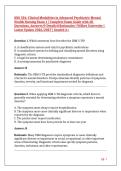
NSG 526: Clinical Modalities in Advanced Psychiatric Mental
Health Nursing Exam 1 | Complete Exam Guide with All
Questions, Answers & Detailed Rationales | Wilkes University |
Latest Update 2026/2027 | Graded A+
Question 1. Which statement best describes the DSM-5-TR?
A. A classification system used only for psychiatric medications
B. A standardized system for defining and classifying mental disorders using
diagnostic criteria
C. A legal document determining involuntary commitment
D. A nursing taxonomy for psychiatric diagnoses
Answer: B
Rationale: The DSM-5-TR provides standardized diagnostic definitions and
criteria for mental disorders. It helps clinicians identify patterns of symptoms,
duration, severity, and functional impairment needed for diagnosis.
Question 2. When applying DSM-5-TR diagnostic criteria, which factor is
generally essential for determining whether a symptom represents a mental
disorder?
A. The symptom must always require hospitalization
B. The symptom must cause clinically significant distress or impairment when
required by the diagnosis
C. The patient must request medication
D. The symptom must have been present for at least one year
Answer: B
Rationale: Many DSM diagnoses require symptoms to cause clinically
significant distress or impairment in social, occupational, or other important
areas of functioning. Diagnostic criteria also specify symptom patterns,
duration, exclusions, and other requirements.
pg. 1
,Question 3. A patient reports depressed mood, loss of interest, fatigue, sleep
disturbance, and feelings of worthlessness. What should the PMHNP do first
when considering a depressive disorder?
A. Diagnose major depressive disorder immediately
B. Determine whether the complete diagnostic criteria are met and rule out
relevant medical, substance-related, and other causes
C. Begin an antidepressant without further assessment
D. Assume the symptoms are caused by personality traits
Answer: B
Rationale: Psychiatric diagnosis requires systematic assessment. Symptoms
alone do not establish a DSM diagnosis; duration, severity, functional
impairment, exclusion criteria, and possible medical or substance-related
causes must be considered.
Question 4. Which ICD-10-CM code is commonly associated with major
depressive disorder, single episode, unspecified?
A. F32.9
B. F20.9
C. F41.1
D. F31.9
Answer: A
Rationale: F32.9 corresponds to major depressive disorder, single episode,
unspecified. ICD-10-CM codes provide standardized diagnostic coding for
clinical documentation and billing.
Question 5. Which ICD-10-CM code is commonly associated with
schizophrenia, unspecified?
A. F32.9
B. F20.9
pg. 2
,C. F41.9
D. F43.10
Answer: B
Rationale: F20.9 is used for schizophrenia, unspecified. Accurate coding
should correspond to the documented diagnosis and the applicable ICD-10-
CM coding requirements.
Question 6. A patient who is extremely angry toward a parent behaves
unusually politely and affectionately toward that parent. Which defense
mechanism is most consistent with this behavior?
A. Projection
B. Reaction formation
C. Sublimation
D. Regression
Answer: B
Rationale: Reaction formation involves expressing thoughts, feelings, or
behaviors that are opposite to unacceptable or anxiety-provoking impulses.
The patient's exaggerated affection may mask underlying anger.
Question 7. A patient with clear evidence of alcohol dependence states, “I
don't have a drinking problem. I can stop whenever I want.” Which defense
mechanism is most evident?
A. Denial
B. Displacement
C. Intellectualization
D. Sublimation
Answer: A
pg. 3
, Rationale: Denial involves refusing to acknowledge an uncomfortable reality
despite available evidence. The patient minimizes or rejects the existence of
the substance-use problem.
Question 8. Which finding is most characteristic of a positive symptom of
psychosis?
A. Avolition
B. Flat affect
C. Auditory hallucination
D. Social withdrawal
Answer: C
Rationale: Positive symptoms represent an addition or distortion of normal
functioning and include hallucinations, delusions, and disorganized speech or
behavior. Avolition, flat affect, and social withdrawal are commonly
considered negative symptoms.
Question 9. During a psychosis assessment, which question is most
appropriate for evaluating auditory hallucinations?
A. “Why are you hearing voices?”
B. “Do you hear things that other people do not hear?”
C. “You don't really hear voices, do you?”
D. “Are the voices caused by schizophrenia?”
Answer: B
Rationale: The question is direct, neutral, and nonjudgmental. The clinician
should determine the sensory modality, content, frequency, distress, and
whether hallucinations contain commands or instructions.
Question 10. A patient reports hearing a voice commanding them to kill
another person. What is the priority assessment?
pg. 4
Health Nursing Exam 1 | Complete Exam Guide with All
Questions, Answers & Detailed Rationales | Wilkes University |
Latest Update 2026/2027 | Graded A+
Question 1. Which statement best describes the DSM-5-TR?
A. A classification system used only for psychiatric medications
B. A standardized system for defining and classifying mental disorders using
diagnostic criteria
C. A legal document determining involuntary commitment
D. A nursing taxonomy for psychiatric diagnoses
Answer: B
Rationale: The DSM-5-TR provides standardized diagnostic definitions and
criteria for mental disorders. It helps clinicians identify patterns of symptoms,
duration, severity, and functional impairment needed for diagnosis.
Question 2. When applying DSM-5-TR diagnostic criteria, which factor is
generally essential for determining whether a symptom represents a mental
disorder?
A. The symptom must always require hospitalization
B. The symptom must cause clinically significant distress or impairment when
required by the diagnosis
C. The patient must request medication
D. The symptom must have been present for at least one year
Answer: B
Rationale: Many DSM diagnoses require symptoms to cause clinically
significant distress or impairment in social, occupational, or other important
areas of functioning. Diagnostic criteria also specify symptom patterns,
duration, exclusions, and other requirements.
pg. 1
,Question 3. A patient reports depressed mood, loss of interest, fatigue, sleep
disturbance, and feelings of worthlessness. What should the PMHNP do first
when considering a depressive disorder?
A. Diagnose major depressive disorder immediately
B. Determine whether the complete diagnostic criteria are met and rule out
relevant medical, substance-related, and other causes
C. Begin an antidepressant without further assessment
D. Assume the symptoms are caused by personality traits
Answer: B
Rationale: Psychiatric diagnosis requires systematic assessment. Symptoms
alone do not establish a DSM diagnosis; duration, severity, functional
impairment, exclusion criteria, and possible medical or substance-related
causes must be considered.
Question 4. Which ICD-10-CM code is commonly associated with major
depressive disorder, single episode, unspecified?
A. F32.9
B. F20.9
C. F41.1
D. F31.9
Answer: A
Rationale: F32.9 corresponds to major depressive disorder, single episode,
unspecified. ICD-10-CM codes provide standardized diagnostic coding for
clinical documentation and billing.
Question 5. Which ICD-10-CM code is commonly associated with
schizophrenia, unspecified?
A. F32.9
B. F20.9
pg. 2
,C. F41.9
D. F43.10
Answer: B
Rationale: F20.9 is used for schizophrenia, unspecified. Accurate coding
should correspond to the documented diagnosis and the applicable ICD-10-
CM coding requirements.
Question 6. A patient who is extremely angry toward a parent behaves
unusually politely and affectionately toward that parent. Which defense
mechanism is most consistent with this behavior?
A. Projection
B. Reaction formation
C. Sublimation
D. Regression
Answer: B
Rationale: Reaction formation involves expressing thoughts, feelings, or
behaviors that are opposite to unacceptable or anxiety-provoking impulses.
The patient's exaggerated affection may mask underlying anger.
Question 7. A patient with clear evidence of alcohol dependence states, “I
don't have a drinking problem. I can stop whenever I want.” Which defense
mechanism is most evident?
A. Denial
B. Displacement
C. Intellectualization
D. Sublimation
Answer: A
pg. 3
, Rationale: Denial involves refusing to acknowledge an uncomfortable reality
despite available evidence. The patient minimizes or rejects the existence of
the substance-use problem.
Question 8. Which finding is most characteristic of a positive symptom of
psychosis?
A. Avolition
B. Flat affect
C. Auditory hallucination
D. Social withdrawal
Answer: C
Rationale: Positive symptoms represent an addition or distortion of normal
functioning and include hallucinations, delusions, and disorganized speech or
behavior. Avolition, flat affect, and social withdrawal are commonly
considered negative symptoms.
Question 9. During a psychosis assessment, which question is most
appropriate for evaluating auditory hallucinations?
A. “Why are you hearing voices?”
B. “Do you hear things that other people do not hear?”
C. “You don't really hear voices, do you?”
D. “Are the voices caused by schizophrenia?”
Answer: B
Rationale: The question is direct, neutral, and nonjudgmental. The clinician
should determine the sensory modality, content, frequency, distress, and
whether hallucinations contain commands or instructions.
Question 10. A patient reports hearing a voice commanding them to kill
another person. What is the priority assessment?
pg. 4


