
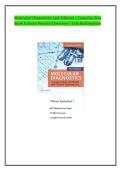
Molecular Diagnostics (4th Edition) – Complete Test
Bank & Exam Practice Questions | Lela Buckingham
,
,Core Domains
• Nucleic Acid Biochemistry and Protein Structure
• DNA Replication, Transcription, and Translation
• Nucleic Acid Extraction and Quantitation Methods
• Molecular Biology Techniques and Instrumentation
• PCR, Real-Time PCR, and Amplification Technologies
• DNA Sequencing and Fragment Analysis
• Genetics, Mutations, and Genetic Disorders
• Molecular Oncology and Cancer Biomarkers
• Molecular Microbiology and Infectious Disease Testing
• Clinical Applications, Quality Control, and Regulatory
Compliance
Introduction
This examination evaluates comprehensive knowledge of molecular
diagnostics principles, techniques, and clinical applications essential
for laboratory science practice. It assesses understanding of nucleic
acid biochemistry, molecular biology methods, and their application
in genetic testing, oncology, and infectious disease diagnostics. The
test employs multiple-choice and scenario-based questions that
mirror the style of national certification examinations. Emphasis is
placed on critical thinking, troubleshooting, quality control, and
interpretation of molecular test results. This assessment serves as a
benchmark for verifying readiness for professional practice in
molecular diagnostics.
, Section One: Questions 1–400
1. A medical technologist is explaining the central dogma of
molecular biology to a new laboratory trainee. According to
the textbook's foundational concepts, which of the following
best describes the flow of genetic information in a eukaryotic
cell?
A. Protein → RNA → DNA
B. DNA → Protein → RNA
C. DNA → RNA → Protein
D. RNA → DNA → Protein
C. DNA → RNA → Protein
RATIONALE: The central dogma of molecular biology describes
the flow of genetic information as DNA being transcribed into RNA,
which is then translated into protein. This process involves
transcription (DNA to mRNA) and translation (mRNA to protein).
Retroviruses are an exception, using reverse transcriptase to convert
RNA to DNA.
2. A researcher is analyzing a DNA sequence and needs to
identify the directionality of the strand. The 5' carbon
connects to which functional group on the adjacent
nucleotide?
A. The 1' carbon
B. The 3' hydroxyl group
C. The 5' phosphate group
D. The nitrogenous base
B. The 3' hydroxyl group
Bank & Exam Practice Questions | Lela Buckingham
,
,Core Domains
• Nucleic Acid Biochemistry and Protein Structure
• DNA Replication, Transcription, and Translation
• Nucleic Acid Extraction and Quantitation Methods
• Molecular Biology Techniques and Instrumentation
• PCR, Real-Time PCR, and Amplification Technologies
• DNA Sequencing and Fragment Analysis
• Genetics, Mutations, and Genetic Disorders
• Molecular Oncology and Cancer Biomarkers
• Molecular Microbiology and Infectious Disease Testing
• Clinical Applications, Quality Control, and Regulatory
Compliance
Introduction
This examination evaluates comprehensive knowledge of molecular
diagnostics principles, techniques, and clinical applications essential
for laboratory science practice. It assesses understanding of nucleic
acid biochemistry, molecular biology methods, and their application
in genetic testing, oncology, and infectious disease diagnostics. The
test employs multiple-choice and scenario-based questions that
mirror the style of national certification examinations. Emphasis is
placed on critical thinking, troubleshooting, quality control, and
interpretation of molecular test results. This assessment serves as a
benchmark for verifying readiness for professional practice in
molecular diagnostics.
, Section One: Questions 1–400
1. A medical technologist is explaining the central dogma of
molecular biology to a new laboratory trainee. According to
the textbook's foundational concepts, which of the following
best describes the flow of genetic information in a eukaryotic
cell?
A. Protein → RNA → DNA
B. DNA → Protein → RNA
C. DNA → RNA → Protein
D. RNA → DNA → Protein
C. DNA → RNA → Protein
RATIONALE: The central dogma of molecular biology describes
the flow of genetic information as DNA being transcribed into RNA,
which is then translated into protein. This process involves
transcription (DNA to mRNA) and translation (mRNA to protein).
Retroviruses are an exception, using reverse transcriptase to convert
RNA to DNA.
2. A researcher is analyzing a DNA sequence and needs to
identify the directionality of the strand. The 5' carbon
connects to which functional group on the adjacent
nucleotide?
A. The 1' carbon
B. The 3' hydroxyl group
C. The 5' phosphate group
D. The nitrogenous base
B. The 3' hydroxyl group


