

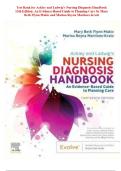
Test Bank for Nursing Diagnosis Handbook, 13th Edition: An Evidence-Based Guide to Planning Care by Mary Beth Flynn Makic and Marina Reyna Martinez Kratz
Test Bank for Nursing Diagnosis Handbook, 13th Edition: An Evidence-Based Guide to Planning Care by Mary Beth Flynn Makic and Marina Reyna Martinez Kratz is a useful study resource for nursing students and healthcare learners preparing for nursing examinations, coursework, clinical practice, quizzes, and assignments. This resource is designed to support students in reviewing important concepts related to nursing diagnoses, patient assessment, care planning, nursing interventions, expected outcomes, and evidence-based nursing practice. It can be used alongside the official textbook, lecture notes, classroom materials, and other approved study resources to reinforce learning and improve examination preparation. Nursing diagnosis and care planning are essential components of professional nursing practice. Nurses need to collect relevant patient information, identify actual or potential health problems, establish appropriate nursing priorities, develop individualized care plans, implement suitable interventions, and evaluate patient outcomes. Developing a strong understanding of these processes can help nursing students become more confident in both academic and clinical settings. The Nursing Diagnosis Handbook provides a foundation for understanding how assessment findings can be connected to nursing diagnoses and individualized care planning. Students can use this study resource to review concepts related to identifying patient needs, selecting appropriate nursing diagnoses, establishing measurable outcomes, and choosing relevant nursing interventions. A major benefit of practice-based revision is the opportunity to apply theoretical knowledge to patient scenarios. Nursing examinations frequently present clinical situations in which students must interpret assessment information, identify the most appropriate nursing diagnosis, determine priorities, or select an appropriate intervention. Practicing these concepts can help learners improve their clinical reasoning and decision-making skills. This resource can also help students review the relationship between assessment and nursing diagnosis. Accurate assessment is an important first step in developing an effective nursing care plan. Students need to recognize significant patient findings, distinguish relevant information from less important details, and use assessment data to support appropriate nursing decisions. Care planning is another important area covered by nursing education. Students can review how nursing diagnoses can be used to establish patient-centered goals and expected outcomes. They can also strengthen their understanding of selecting interventions that address identified patient needs and evaluating whether those interventions have been effective. Evidence-based practice is an important part of modern nursing. Nurses are expected to use current evidence, professional knowledge, patient preferences, and clinical judgment when planning and delivering care. Reviewing evidence-based approaches can help students understand why nursing interventions should be appropriate, individualized, and supported by reliable information. The resource may also be useful when preparing for questions involving prioritization. Nursing examinations often require students to determine which patient problem should receive immediate attention or which intervention should be performed first. Developing a structured approach to prioritization can help learners approach these questions more effectively. Students can use this resource to reinforce their understanding of nursing interventions and expected outcomes. An appropriate nursing intervention should relate directly to the identified patient problem and contribute toward achieving the desired outcome. Reviewing these relationships can help students develop more logical and organized care plans. Another important area of nursing education is evaluation. Developing a care plan does not end with selecting interventions. Nurses must evaluate patient responses and determine whether goals have been achieved, partially achieved, or require modification. Students can review these principles as part of their preparation for care-planning and clinical judgment questions. This resource can be particularly useful for students who are learning how to connect assessment findings, nursing diagnoses, outcomes, and interventions. Understanding these connections can make nursing care plans more organized and help students approach clinical scenarios with greater confidence. The study resource may be suitable for students enrolled in Bachelor of Science in Nursing programs, Associate Degree Nursing programs, practical nursing programs, and other nursing and healthcare education programs. It can be incorporated into study sessions throughout a nursing course or used for focused revision before examinations. For examination preparation, students can use practice questions to identify areas of strength and weakness. A useful strategy is to attempt questions independently first, review incorrect responses, and then return to the relevant textbook or lecture material to strengthen understanding. This approach encourages active learning rather than relying only on memorization. Students can also organize their revision around major nursing concepts, including nursing assessment, nursing diagnoses, care planning, expected outcomes, nursing interventions, patient safety, clinical judgment, prioritization, documentation, and evaluation of care. The resource can support preparation for different types of nursing assessments. Whether students are preparing for classroom quizzes, midterm examinations, final examinations, clinical evaluations, or comprehensive nursing assessments, additional practice can help reinforce important concepts. Nursing diagnosis questions may require careful interpretation of patient information. Students may need to distinguish between related concepts, identify the most appropriate nursing diagnosis, determine the priority problem, or select an intervention that addresses the patient's specific needs. Regular practice can help learners become more comfortable with these question formats. The resource can also be useful for students who want to strengthen their understanding of individualized patient care. Effective nursing care should consider the patient's condition, needs, preferences, circumstances, and responses to treatment. Reviewing care-planning concepts can help students appreciate the importance of individualized approaches to nursing practice. Test Bank for Nursing Diagnosis Handbook, 13th Edition: An Evidence-Based Guide to Planning Care by Mary Beth Flynn Makic and Marina Reyna Martinez Kratz can therefore serve as a supplementary study resource for nursing students looking to improve their preparation and understanding of nursing diagnosis and care planning concepts. Whether you are studying nursing diagnoses for the first time, preparing for an upcoming examination, reviewing care-planning concepts, or looking for additional practice questions, this resource can be incorporated into a broader nursing study strategy. Students should use this resource together with their official textbook, instructor guidance, current evidence-based resources, and applicable professional standards. It should be considered a supplementary study aid and not a replacement for current clinical guidelines or professional judgment. Overall, this resource provides an additional way for nursing students to review nursing diagnosis and care-planning concepts, practice applying knowledge to clinical situations, identify areas requiring further study, and prepare more effectively for nursing assessments.
Document information
- Uploaded on
- September 13, 2026
- Number of pages
- 100
- Written in
- 2026/2027
- Type
- Exam (elaborations)
- Contains
- Questions & answers


