

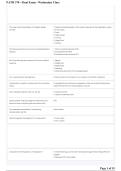
PATH 370 - Final Exam - Wednesday Class
The usual clinical presentation of Hodgkin disease 1. Painless lymphadenopathy of the lymph nodes above the diaphragm, usually
includes cervical nodes
2. Fever
3. Night sweats
4. Pruritus
5. Weight loss
6. Malaise
The following are the most common myeloproliferative 1. Chronic myeloid leukemia (CML)
diseases 2. Polycythemia vera (PV)
3. Essential thrombocythemia (ET)
All of the following are symptoms of Chronic Myeloid 1. Fatigue
Leukemia 2. Weight loss
3. Diaphoresis
4. Bleeding
5. Abdominal discomfort from enlarged spleen
Iron is transported in the plasma by Protein transferrin to transferrin iron receptors on the RBC membrane
The transferrin-receptor complex enters the red blood It's engulfed by the cell into an invagination of the cell surface that becomes
cell by sealed off and forms an intracytoplasmic vacuole
Once released inside the cell, iron can be 1. Stored as ferritin
2. Used to synthesize heme
Approximately what percentage of total body iron is 67%
bound to heme in erythrocytes and muscle cells?
The organelles responsible for synthesizing Mitochondria
protoporphyrin are the
Fetal hemoglobin (hemoglobin F) is composed of 1. Two α chains
2. Two γ chains
Compared with hemoglobin A, hemoglobin F 1. More efficient gas carrier under decreased oxygen tension (high affinity for
oxygen)
2. Releases CO2 more readily
Page 1 of 15
, PATH 370 - Final Exam - Wednesday Class
Adult hemoglobin (hemoglobin A) constitutes 97%
approximately what percentage of hemoglobin in
adults?
For erythropoiesis to proceed, the following vitamins 1. B12 (Cobalamin)
are needed 2. Folate
3. B6
4. Riboflavin
5. Pantothenic acid
6. Niacin
7. Ascorbic acid
8. Vitamin E
These drugs may facilitate the passage of stones, α1-adrenergic antagonists (tamsulosin)
decrease ureteral muscle tone, and decrease the
frequency of peristalsis, relaxing the ureteral wall.
Urethral Valves 1. Mucosal folds that resemble thin membranes and cause obstruction when a
child attempts to void
2. Majority are posterior in location and occur in the distal prostatic urethra;
rarely located anteriorly in the penile urethra
3. Most common cause of urinary obstruction in male newborns and infants,
but are a rare congenital anomaly
4. Unclear development
5. Commonly may result from abnormal insertion and persistence of distal
wolffian in embryogenesis; less frequently, a persistent urogenital membrane
6. Severe cases, intrauterine renal failure may cause oligohydramnios
(decreased amniotic fluid), pulmonary hypoplasia (incomplete lung
development), and either stillbirth or extreme distress at the time of delivery
7. Frequently, inability to void is noted shortly after birth or the infant has
abdominal masses representing a thickened palpable bladder or
hydronephrotic kidneys, with azotemia and renal failure
8. Urinary ascites (extravasated urine in the peritoneum) may result from a hard-
to-localize urinary leak
9. Diagnosis for distention: abdominal radiograph showing the bowel "floating"
in the center of the abdomen
10. Prenatal ultrasounds used for diagnosis before birth, so immediate
evaluation and treatment can take place upon delivery
11. Older infants uncommonly have palpable kidney/ascites and instead have
UTIs, poor stream with straining to void, or hematuria, but due to less
obstruction, the diagnosis is more difficult
12. Treatments: management of metabolic abnormalities with appropriate fluid
and electrolyte replacement; urine drainage with urethral/suprapubic catheter
(UTI); valve ablation with endoscopic resection that has risk of traumatizing
infant urethra and create urethral stricture disease, may be delayed and
cutaneous vesicostomy done temporarily to divert/drain urine
The _________ is a common congenital condition in which Hypospadias
the urethral meatus is located on the ventral
undersurface of the penis or on the perineum.
The ________ occurs when a foreskin that has been Paraphimosis
retracted over the glans up onto the shaft of the penis
cannot be replaced in its normal position.
Page 2 of 15
The usual clinical presentation of Hodgkin disease 1. Painless lymphadenopathy of the lymph nodes above the diaphragm, usually
includes cervical nodes
2. Fever
3. Night sweats
4. Pruritus
5. Weight loss
6. Malaise
The following are the most common myeloproliferative 1. Chronic myeloid leukemia (CML)
diseases 2. Polycythemia vera (PV)
3. Essential thrombocythemia (ET)
All of the following are symptoms of Chronic Myeloid 1. Fatigue
Leukemia 2. Weight loss
3. Diaphoresis
4. Bleeding
5. Abdominal discomfort from enlarged spleen
Iron is transported in the plasma by Protein transferrin to transferrin iron receptors on the RBC membrane
The transferrin-receptor complex enters the red blood It's engulfed by the cell into an invagination of the cell surface that becomes
cell by sealed off and forms an intracytoplasmic vacuole
Once released inside the cell, iron can be 1. Stored as ferritin
2. Used to synthesize heme
Approximately what percentage of total body iron is 67%
bound to heme in erythrocytes and muscle cells?
The organelles responsible for synthesizing Mitochondria
protoporphyrin are the
Fetal hemoglobin (hemoglobin F) is composed of 1. Two α chains
2. Two γ chains
Compared with hemoglobin A, hemoglobin F 1. More efficient gas carrier under decreased oxygen tension (high affinity for
oxygen)
2. Releases CO2 more readily
Page 1 of 15
, PATH 370 - Final Exam - Wednesday Class
Adult hemoglobin (hemoglobin A) constitutes 97%
approximately what percentage of hemoglobin in
adults?
For erythropoiesis to proceed, the following vitamins 1. B12 (Cobalamin)
are needed 2. Folate
3. B6
4. Riboflavin
5. Pantothenic acid
6. Niacin
7. Ascorbic acid
8. Vitamin E
These drugs may facilitate the passage of stones, α1-adrenergic antagonists (tamsulosin)
decrease ureteral muscle tone, and decrease the
frequency of peristalsis, relaxing the ureteral wall.
Urethral Valves 1. Mucosal folds that resemble thin membranes and cause obstruction when a
child attempts to void
2. Majority are posterior in location and occur in the distal prostatic urethra;
rarely located anteriorly in the penile urethra
3. Most common cause of urinary obstruction in male newborns and infants,
but are a rare congenital anomaly
4. Unclear development
5. Commonly may result from abnormal insertion and persistence of distal
wolffian in embryogenesis; less frequently, a persistent urogenital membrane
6. Severe cases, intrauterine renal failure may cause oligohydramnios
(decreased amniotic fluid), pulmonary hypoplasia (incomplete lung
development), and either stillbirth or extreme distress at the time of delivery
7. Frequently, inability to void is noted shortly after birth or the infant has
abdominal masses representing a thickened palpable bladder or
hydronephrotic kidneys, with azotemia and renal failure
8. Urinary ascites (extravasated urine in the peritoneum) may result from a hard-
to-localize urinary leak
9. Diagnosis for distention: abdominal radiograph showing the bowel "floating"
in the center of the abdomen
10. Prenatal ultrasounds used for diagnosis before birth, so immediate
evaluation and treatment can take place upon delivery
11. Older infants uncommonly have palpable kidney/ascites and instead have
UTIs, poor stream with straining to void, or hematuria, but due to less
obstruction, the diagnosis is more difficult
12. Treatments: management of metabolic abnormalities with appropriate fluid
and electrolyte replacement; urine drainage with urethral/suprapubic catheter
(UTI); valve ablation with endoscopic resection that has risk of traumatizing
infant urethra and create urethral stricture disease, may be delayed and
cutaneous vesicostomy done temporarily to divert/drain urine
The _________ is a common congenital condition in which Hypospadias
the urethral meatus is located on the ventral
undersurface of the penis or on the perineum.
The ________ occurs when a foreskin that has been Paraphimosis
retracted over the glans up onto the shaft of the penis
cannot be replaced in its normal position.
Page 2 of 15


