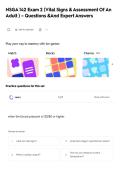
NSGA 142 Exam 2 (Vital Signs & Assessment Of An
Adult ) – Questions &And Expert Answers
Add to calendar
Play your way to mastery with fun games
Match Blocks Charms NEW
Practice questions for this set
Learn 1 /7 Study with Learn
when the blood pressure is 130/80 or higher.
Choose an answer
1 what are vital signs? 2 what does stage 1 hypertension mean?
How do you measure surface
3 What is cardiac output? 4
temperature?
, Don't know?
Terms in this set (104)
what are vital signs? Vital signs are indicators of physiologic functioning
and reflect the health status of a person. They reflect a
person's state of health. It is crucial that vital signs are
accurate.
what are the two types of core and surface
temperature?
what is core temperature? the temperature of internal organs, like the heart,
brain, and liver. This is the key indicator for the body
maintaining homeostasis.
what is surface temperature? temperature of the skin.
How do you measure surface oral and axillary.
temperature? 3 multiple choice options
what is thermoregulation? This is the process of maintaining a stable internal
body temperature.
what is pyrexia? high fever, higher than 100 degrees Fahrenheit.
what is hyperpyrexia? abnormally high body temperature, above 106
degrees Fahrenheit.
what is febrile? a patient with a fever.
What is hypothermia? When body temperature is below normal. Normal is
around 95-96
Adult ) – Questions &And Expert Answers
Add to calendar
Play your way to mastery with fun games
Match Blocks Charms NEW
Practice questions for this set
Learn 1 /7 Study with Learn
when the blood pressure is 130/80 or higher.
Choose an answer
1 what are vital signs? 2 what does stage 1 hypertension mean?
How do you measure surface
3 What is cardiac output? 4
temperature?
, Don't know?
Terms in this set (104)
what are vital signs? Vital signs are indicators of physiologic functioning
and reflect the health status of a person. They reflect a
person's state of health. It is crucial that vital signs are
accurate.
what are the two types of core and surface
temperature?
what is core temperature? the temperature of internal organs, like the heart,
brain, and liver. This is the key indicator for the body
maintaining homeostasis.
what is surface temperature? temperature of the skin.
How do you measure surface oral and axillary.
temperature? 3 multiple choice options
what is thermoregulation? This is the process of maintaining a stable internal
body temperature.
what is pyrexia? high fever, higher than 100 degrees Fahrenheit.
what is hyperpyrexia? abnormally high body temperature, above 106
degrees Fahrenheit.
what is febrile? a patient with a fever.
What is hypothermia? When body temperature is below normal. Normal is
around 95-96