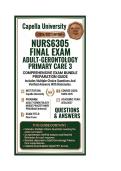
,NURS 6305 Final Exam Adult-Gerontology Primary Care 3 Questions
And Answers | 2026/2027 Capella University
Q1. Which approach best reflects the role of the adult-gerontology
primary care nurse practitioner when caring for an older adult with
multiple chronic conditions?
A) Treat each condition independently without considering treatment
interactions.
B) Focus only on the condition that produces the most symptoms.
C) Coordinate comprehensive care while considering function, comorbidities,
medications, prevention, and patient goals.
D) Refer all complex older adults to specialists without initiating
management.
Correct Answer: C) Coordinate comprehensive care while considering
function, comorbidities, medications, prevention, and patient goals.
Rationale: Multimorbidity requires integrated management. The clinician
should consider interactions among illnesses and treatments while
incorporating functional status, prevention, safety, treatment burden, and
the patient's priorities.
Q2. Which statement best distinguishes chronological age from
biological age?
A) Chronological age always accurately predicts physiologic function.
B) Biological age reflects the person's physiologic condition, which may differ
substantially from chronological age.
C) Biological age is determined exclusively by genetics.
D) Chronological age has no relationship to health outcomes.
Correct Answer: B) Biological age reflects the person's physiologic condition,
which may differ substantially from chronological age.
Rationale: Individuals of the same chronological age may have very
different physical, cognitive, and functional status. Biological aging is
influenced by genetics, disease, lifestyle, environment, and cumulative
exposures.
Q3. Which statement best reflects healthy aging?
A) Healthy aging means avoiding every disease.
B) Healthy aging requires maintaining the same physical capacity throughout
life.
,C) Healthy aging involves optimizing function and well-being while adapting
to age-related changes.
D) Healthy aging occurs only in adults without chronic illness.
Correct Answer: C) Healthy aging involves optimizing function and well-being
while adapting to age-related changes.
Rationale: Healthy aging is not defined by complete absence of disease. It
emphasizes maintaining function, adapting to changes, minimizing
preventable disability, supporting well-being, and preserving meaningful
participation.
Q4. Which situation best illustrates continuity theory?
A) An older adult abandons all previous roles after retirement.
B) An older adult maintains familiar values and activities while adapting
them to changed physical abilities.
C) An older adult progressively withdraws from all social relationships.
D) An older adult's behavior changes solely because of genetic
programming.
Correct Answer: B) An older adult maintains familiar values and activities
while adapting them to changed physical abilities.
Rationale: Continuity theory emphasizes maintaining patterns, values,
relationships, and activities while modifying them as circumstances change.
Adaptation allows the individual to preserve a sense of identity and meaning.
Q5. Which intervention best supports the concept described by
activity theory?
A) Encouraging an older adult to discontinue meaningful social roles
B) Supporting participation in activities that remain meaningful and feasible
C) Limiting physical activity after retirement
D) Encouraging isolation to conserve energy
Correct Answer: B) Supporting participation in activities that remain
meaningful and feasible
Rationale: Activity theory proposes that continued meaningful engagement
can contribute to life satisfaction. Activities should be adapted to the
person's health, preferences, function, and available resources.
Q6. Which statement about disengagement theory is most accurate?
, A) It describes withdrawal as an inevitable outcome for every older adult.
B) It is one historical theory suggesting that aging may involve reciprocal
withdrawal from social roles.
C) It establishes that social participation harms older adults.
D) It requires older adults to stop working.
Correct Answer: B) It is one historical theory suggesting that aging may
involve reciprocal withdrawal from social roles.
Rationale: Disengagement theory proposed reciprocal withdrawal between
older adults and society. Contemporary care should not assume that
withdrawal is inevitable or desirable for every individual.
Q7. Which factor best explains heterogeneity among older adults?
A) All organ systems age at an identical rate.
B) Individuals experience different combinations of genetics, disease,
environment, behaviors, and life experiences.
C) Chronological age completely determines functional status.
D) Functional capacity declines at a fixed rate after age 65.
Correct Answer: B) Individuals experience different combinations of genetics,
disease, environment, behaviors, and life experiences.
Rationale: Aging trajectories vary considerably. Genetic factors, chronic
illnesses, physical activity, nutrition, social conditions, exposures, and
cumulative experiences contribute to individual differences in health and
function.
Q8. Which clinician statement demonstrates ageism?
A) "Let's assess your functional status before choosing the treatment."
B) "Tell me what outcomes matter most to you."
C) "Because you're 82, this treatment would never be appropriate."
D) "Let's review the risks and benefits of each option."
Correct Answer: C) "Because you're 82, this treatment would never be
appropriate."
Rationale: Ageism involves stereotypes or assumptions based on age.
Chronological age alone should not determine whether a treatment is
appropriate; function, health status, prognosis, risks, benefits, and patient
preferences should be considered.
Q9. Which normal physiologic change is associated with aging?
And Answers | 2026/2027 Capella University
Q1. Which approach best reflects the role of the adult-gerontology
primary care nurse practitioner when caring for an older adult with
multiple chronic conditions?
A) Treat each condition independently without considering treatment
interactions.
B) Focus only on the condition that produces the most symptoms.
C) Coordinate comprehensive care while considering function, comorbidities,
medications, prevention, and patient goals.
D) Refer all complex older adults to specialists without initiating
management.
Correct Answer: C) Coordinate comprehensive care while considering
function, comorbidities, medications, prevention, and patient goals.
Rationale: Multimorbidity requires integrated management. The clinician
should consider interactions among illnesses and treatments while
incorporating functional status, prevention, safety, treatment burden, and
the patient's priorities.
Q2. Which statement best distinguishes chronological age from
biological age?
A) Chronological age always accurately predicts physiologic function.
B) Biological age reflects the person's physiologic condition, which may differ
substantially from chronological age.
C) Biological age is determined exclusively by genetics.
D) Chronological age has no relationship to health outcomes.
Correct Answer: B) Biological age reflects the person's physiologic condition,
which may differ substantially from chronological age.
Rationale: Individuals of the same chronological age may have very
different physical, cognitive, and functional status. Biological aging is
influenced by genetics, disease, lifestyle, environment, and cumulative
exposures.
Q3. Which statement best reflects healthy aging?
A) Healthy aging means avoiding every disease.
B) Healthy aging requires maintaining the same physical capacity throughout
life.
,C) Healthy aging involves optimizing function and well-being while adapting
to age-related changes.
D) Healthy aging occurs only in adults without chronic illness.
Correct Answer: C) Healthy aging involves optimizing function and well-being
while adapting to age-related changes.
Rationale: Healthy aging is not defined by complete absence of disease. It
emphasizes maintaining function, adapting to changes, minimizing
preventable disability, supporting well-being, and preserving meaningful
participation.
Q4. Which situation best illustrates continuity theory?
A) An older adult abandons all previous roles after retirement.
B) An older adult maintains familiar values and activities while adapting
them to changed physical abilities.
C) An older adult progressively withdraws from all social relationships.
D) An older adult's behavior changes solely because of genetic
programming.
Correct Answer: B) An older adult maintains familiar values and activities
while adapting them to changed physical abilities.
Rationale: Continuity theory emphasizes maintaining patterns, values,
relationships, and activities while modifying them as circumstances change.
Adaptation allows the individual to preserve a sense of identity and meaning.
Q5. Which intervention best supports the concept described by
activity theory?
A) Encouraging an older adult to discontinue meaningful social roles
B) Supporting participation in activities that remain meaningful and feasible
C) Limiting physical activity after retirement
D) Encouraging isolation to conserve energy
Correct Answer: B) Supporting participation in activities that remain
meaningful and feasible
Rationale: Activity theory proposes that continued meaningful engagement
can contribute to life satisfaction. Activities should be adapted to the
person's health, preferences, function, and available resources.
Q6. Which statement about disengagement theory is most accurate?
, A) It describes withdrawal as an inevitable outcome for every older adult.
B) It is one historical theory suggesting that aging may involve reciprocal
withdrawal from social roles.
C) It establishes that social participation harms older adults.
D) It requires older adults to stop working.
Correct Answer: B) It is one historical theory suggesting that aging may
involve reciprocal withdrawal from social roles.
Rationale: Disengagement theory proposed reciprocal withdrawal between
older adults and society. Contemporary care should not assume that
withdrawal is inevitable or desirable for every individual.
Q7. Which factor best explains heterogeneity among older adults?
A) All organ systems age at an identical rate.
B) Individuals experience different combinations of genetics, disease,
environment, behaviors, and life experiences.
C) Chronological age completely determines functional status.
D) Functional capacity declines at a fixed rate after age 65.
Correct Answer: B) Individuals experience different combinations of genetics,
disease, environment, behaviors, and life experiences.
Rationale: Aging trajectories vary considerably. Genetic factors, chronic
illnesses, physical activity, nutrition, social conditions, exposures, and
cumulative experiences contribute to individual differences in health and
function.
Q8. Which clinician statement demonstrates ageism?
A) "Let's assess your functional status before choosing the treatment."
B) "Tell me what outcomes matter most to you."
C) "Because you're 82, this treatment would never be appropriate."
D) "Let's review the risks and benefits of each option."
Correct Answer: C) "Because you're 82, this treatment would never be
appropriate."
Rationale: Ageism involves stereotypes or assumptions based on age.
Chronological age alone should not determine whether a treatment is
appropriate; function, health status, prognosis, risks, benefits, and patient
preferences should be considered.
Q9. Which normal physiologic change is associated with aging?