
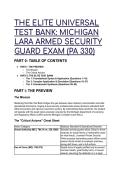
THE ELITE UNIVERSAL
TEST BANK: MICHIGAN
LARA ARMED SECURITY
GUARD EXAM (PA 330)
PART 0: TABLE OF CONTENTS
● PART I: THE PREVIEW
○ The Mission
○ The Critical Axioms
● PART II: THE ELITE TEST BANK
○ Tier 1: Foundational Syntax & Application (Questions 1–18)
○ Tier 2: Complex Application & Simulation (Questions 19–37)
○ Tier 3: Grandmaster Synthesis (Questions 38–55)
PART I: THE PREVIEW
The Mission
Mastering this Elite Test Bank bridges the gap between basic statutory memorization and elite
operational dominance, forging A-level security professionals whose decisions withstand both
lethal encounters and rigorous courtroom scrutiny. By internalizing these doctrines, the student
will operate with the exact native precision required by the Michigan Department of Licensing
and Regulatory Affairs (LARA) and the Michigan Compiled Laws (MCL).
The "Critical Axioms" Cheat Sheet
Axiom Category Statutory Standard & Operational Directive
Arrest Authority (MCL 764.16 vs. 338.1080) Standard private guards utilize Citizen’s Arrest
(requires an actual felony or reasonable cause
for retail fraud). Licensed Private Security
Police possess warrantless peace officer arrest
powers strictly limited to employer premises,
during shift hours, and in full uniform.
Use of Force (MCL 780.972) Deadly force is legally justified only to prevent
imminent death, great bodily harm, or sexual
assault, assuming the defender is in a legal
,Axiom Category Statutory Standard & Operational Directive
location without criminal intent. Deadly force is
strictly forbidden for the protection of property
alone.
Chemical & Electronic Assets Oleoresin Capsicum (OC/Pepper Spray) is
capped at 18% concentration; CS Gas is
capped at 35 grams. Electro-Muscular
Disruption Technology (Tasers) strictly requires
the user to possess a valid Concealed Pistol
License (CPL).
Felony-Firearm Rule (MCL 750.227b) Committing a felony while possessing a firearm
results in a mandatory, consecutive two-year
prison sentence. An unjustified use of a firearm
instantly triggers this enhancement.
PART II: THE ELITE TEST BANK
Tier 1: Foundational Syntax & Application
Q1: Under the Michigan Private Security Business and Security Alarm Act (PA 330), a licensed
private security guard agency hires a new armed guard. Based on the principles of MCL
338.1068 regarding employee qualifications, which action is the FIRST legal requirement before
the employee can begin working as a direct provider of security? A) The agency must issue the
employee a badge and tactical baton. B) The agency must conduct a 40-hour MCOLES certified
training academy. C) The agency must submit the employee's fingerprints to the Michigan State
Police for a state and national background check. D) The agency must assign the license to the
employee via the LARA portal.
● Answer: C (The agency must submit the employee's fingerprints to the Michigan State
Police for a state and national background check.)
● Distractor Analysis:
○ A is incorrect: Standard security guards are expressly forbidden from displaying or
carrying a badge or shield.
○ B is incorrect: PA 330 does not mandate a 40-hour MCOLES academy for standard
private security guards, though internal training is standard.
○ D is incorrect: A security agency license is strictly nonassignable and personal to
the licensee under MCL 338.1065.
The Mentor's Analysis: LARA mandates absolute verification of an employee's criminal history
before deployment. Fingerprinting acts as the fundamental requirement to ensure felons are not
placed in positions of authority. Professional/Academic Intuition: Verification precedes
deployment; fingerprint submissions form the foundational barrier against negligent
hiring.
Q2: An agency employer conducts a name-based background check on a prospective guard
through the Michigan State Police. Based on the principles of MCL 338.1068, which conclusion
is the MOST ACCURATE regarding provisional employment? A) The applicant may work
indefinitely if the name check is clear. B) The applicant may be employed provisionally for up to
90 days pending final fingerprint clearance. C) The applicant may not be deployed on a site until
the FBI national check is returned. D) The applicant is restricted to unarmed posts only for the
first six months.
, ● Answer: B (The applicant may be employed provisionally for up to 90 days pending final
fingerprint clearance.)
● Distractor Analysis:
○ A is incorrect: Name checks provide provisional, not indefinite, clearance under the
statute.
○ C is incorrect: The statute explicitly allows provisional deployment pending the
fingerprint results based on a clear name check.
○ D is incorrect: PA 330 does not outline a six-month unarmed probationary mandate
based on background check timelines.
The Mentor's Analysis: Provisional clearance balances business operational needs with public
safety mandates. The 90-day window allows immediate staffing while the comprehensive FBI
biometric data is processed. Professional/Academic Intuition: Name checks grant 90-day
provisional status; fingerprint returns grant permanence.
Q3: A private security guard desires to project a highly authoritative presence to deter
trespassers at a commercial facility. Based on the principles of MCL 338.1069 regarding uniform
and insignia, which action is MOST ACCURATE? A) The guard may wear a gold star shield on
the left breast of the uniform. B) The guard may wear shoulder identification patches that
measure 2 inches by 4 inches. C) The guard may carry a commercially available tactical baton if
authorized by the employer. D) The guard may design a uniform identical to the local county
sheriff's department.
● Answer: C (The guard may carry a commercially available tactical baton if authorized by
the employer.)
● Distractor Analysis:
○ A is incorrect: Standard security guards are expressly forbidden from displaying
badges or shields under penalty of a misdemeanor.
○ B is incorrect: Shoulder patches must be at least 3 inches by 5 inches and include
the agency name.
○ D is incorrect: Uniforms must not deceive the public or be identical to actual law
enforcement agencies.
The Mentor's Analysis: The state strictly controls the visual demarcation between private
security and sworn public peace officers to prevent public deception. Non-lethal tools like batons
are permitted, but deceptive insignia are criminalized. Professional/Academic Intuition: Private
security must remain visually distinct from public law enforcement; badges are
absolutely forbidden.
Q4: A private security guard observes a patron shoplifting a $50 item from the client's store.
Based on the principles of Michigan's Citizen's Arrest statute (MCL 764.16), which action is the
MOST ACCURATE? A) The guard may arrest the suspect because any crime committed in the
guard's presence warrants an arrest. B) The guard may arrest the suspect under the merchant
exception for reasonable cause of retail fraud. C) The guard cannot make an arrest because the
item is valued under $1,000, making it a misdemeanor. D) The guard may only issue a civil
demand letter and must allow the suspect to leave.
● Answer: B (The guard may arrest the suspect under the merchant exception for
reasonable cause of retail fraud.)
● Distractor Analysis:
○ A is incorrect: Private citizens generally cannot arrest for misdemeanors committed
in their presence; the power is limited to felonies.
○ C is incorrect: While theft under $1,000 is a misdemeanor, the specific "merchant
exception" grants arrest authority for retail fraud regardless of felony or
TEST BANK: MICHIGAN
LARA ARMED SECURITY
GUARD EXAM (PA 330)
PART 0: TABLE OF CONTENTS
● PART I: THE PREVIEW
○ The Mission
○ The Critical Axioms
● PART II: THE ELITE TEST BANK
○ Tier 1: Foundational Syntax & Application (Questions 1–18)
○ Tier 2: Complex Application & Simulation (Questions 19–37)
○ Tier 3: Grandmaster Synthesis (Questions 38–55)
PART I: THE PREVIEW
The Mission
Mastering this Elite Test Bank bridges the gap between basic statutory memorization and elite
operational dominance, forging A-level security professionals whose decisions withstand both
lethal encounters and rigorous courtroom scrutiny. By internalizing these doctrines, the student
will operate with the exact native precision required by the Michigan Department of Licensing
and Regulatory Affairs (LARA) and the Michigan Compiled Laws (MCL).
The "Critical Axioms" Cheat Sheet
Axiom Category Statutory Standard & Operational Directive
Arrest Authority (MCL 764.16 vs. 338.1080) Standard private guards utilize Citizen’s Arrest
(requires an actual felony or reasonable cause
for retail fraud). Licensed Private Security
Police possess warrantless peace officer arrest
powers strictly limited to employer premises,
during shift hours, and in full uniform.
Use of Force (MCL 780.972) Deadly force is legally justified only to prevent
imminent death, great bodily harm, or sexual
assault, assuming the defender is in a legal
,Axiom Category Statutory Standard & Operational Directive
location without criminal intent. Deadly force is
strictly forbidden for the protection of property
alone.
Chemical & Electronic Assets Oleoresin Capsicum (OC/Pepper Spray) is
capped at 18% concentration; CS Gas is
capped at 35 grams. Electro-Muscular
Disruption Technology (Tasers) strictly requires
the user to possess a valid Concealed Pistol
License (CPL).
Felony-Firearm Rule (MCL 750.227b) Committing a felony while possessing a firearm
results in a mandatory, consecutive two-year
prison sentence. An unjustified use of a firearm
instantly triggers this enhancement.
PART II: THE ELITE TEST BANK
Tier 1: Foundational Syntax & Application
Q1: Under the Michigan Private Security Business and Security Alarm Act (PA 330), a licensed
private security guard agency hires a new armed guard. Based on the principles of MCL
338.1068 regarding employee qualifications, which action is the FIRST legal requirement before
the employee can begin working as a direct provider of security? A) The agency must issue the
employee a badge and tactical baton. B) The agency must conduct a 40-hour MCOLES certified
training academy. C) The agency must submit the employee's fingerprints to the Michigan State
Police for a state and national background check. D) The agency must assign the license to the
employee via the LARA portal.
● Answer: C (The agency must submit the employee's fingerprints to the Michigan State
Police for a state and national background check.)
● Distractor Analysis:
○ A is incorrect: Standard security guards are expressly forbidden from displaying or
carrying a badge or shield.
○ B is incorrect: PA 330 does not mandate a 40-hour MCOLES academy for standard
private security guards, though internal training is standard.
○ D is incorrect: A security agency license is strictly nonassignable and personal to
the licensee under MCL 338.1065.
The Mentor's Analysis: LARA mandates absolute verification of an employee's criminal history
before deployment. Fingerprinting acts as the fundamental requirement to ensure felons are not
placed in positions of authority. Professional/Academic Intuition: Verification precedes
deployment; fingerprint submissions form the foundational barrier against negligent
hiring.
Q2: An agency employer conducts a name-based background check on a prospective guard
through the Michigan State Police. Based on the principles of MCL 338.1068, which conclusion
is the MOST ACCURATE regarding provisional employment? A) The applicant may work
indefinitely if the name check is clear. B) The applicant may be employed provisionally for up to
90 days pending final fingerprint clearance. C) The applicant may not be deployed on a site until
the FBI national check is returned. D) The applicant is restricted to unarmed posts only for the
first six months.
, ● Answer: B (The applicant may be employed provisionally for up to 90 days pending final
fingerprint clearance.)
● Distractor Analysis:
○ A is incorrect: Name checks provide provisional, not indefinite, clearance under the
statute.
○ C is incorrect: The statute explicitly allows provisional deployment pending the
fingerprint results based on a clear name check.
○ D is incorrect: PA 330 does not outline a six-month unarmed probationary mandate
based on background check timelines.
The Mentor's Analysis: Provisional clearance balances business operational needs with public
safety mandates. The 90-day window allows immediate staffing while the comprehensive FBI
biometric data is processed. Professional/Academic Intuition: Name checks grant 90-day
provisional status; fingerprint returns grant permanence.
Q3: A private security guard desires to project a highly authoritative presence to deter
trespassers at a commercial facility. Based on the principles of MCL 338.1069 regarding uniform
and insignia, which action is MOST ACCURATE? A) The guard may wear a gold star shield on
the left breast of the uniform. B) The guard may wear shoulder identification patches that
measure 2 inches by 4 inches. C) The guard may carry a commercially available tactical baton if
authorized by the employer. D) The guard may design a uniform identical to the local county
sheriff's department.
● Answer: C (The guard may carry a commercially available tactical baton if authorized by
the employer.)
● Distractor Analysis:
○ A is incorrect: Standard security guards are expressly forbidden from displaying
badges or shields under penalty of a misdemeanor.
○ B is incorrect: Shoulder patches must be at least 3 inches by 5 inches and include
the agency name.
○ D is incorrect: Uniforms must not deceive the public or be identical to actual law
enforcement agencies.
The Mentor's Analysis: The state strictly controls the visual demarcation between private
security and sworn public peace officers to prevent public deception. Non-lethal tools like batons
are permitted, but deceptive insignia are criminalized. Professional/Academic Intuition: Private
security must remain visually distinct from public law enforcement; badges are
absolutely forbidden.
Q4: A private security guard observes a patron shoplifting a $50 item from the client's store.
Based on the principles of Michigan's Citizen's Arrest statute (MCL 764.16), which action is the
MOST ACCURATE? A) The guard may arrest the suspect because any crime committed in the
guard's presence warrants an arrest. B) The guard may arrest the suspect under the merchant
exception for reasonable cause of retail fraud. C) The guard cannot make an arrest because the
item is valued under $1,000, making it a misdemeanor. D) The guard may only issue a civil
demand letter and must allow the suspect to leave.
● Answer: B (The guard may arrest the suspect under the merchant exception for
reasonable cause of retail fraud.)
● Distractor Analysis:
○ A is incorrect: Private citizens generally cannot arrest for misdemeanors committed
in their presence; the power is limited to felonies.
○ C is incorrect: While theft under $1,000 is a misdemeanor, the specific "merchant
exception" grants arrest authority for retail fraud regardless of felony or


