
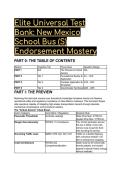
Elite Universal Test
Bank: New Mexico
School Bus (S)
Endorsement Mastery
PART 0: THE TABLE OF CONTENTS
Section Cognitive Tier Focus Area Question Range
PART I N/A The Preview & Critical N/A
Axioms
PART II Tier 1 Foundational Syntax & Q1 – Q18
Application
PART II Tier 2 Complex Application & Q19 – Q37
Simulation
PART II Tier 3 Grandmaster Synthesis Q38 – Q55
PART I: THE PREVIEW
Mastering this test bank ensures your theoretical knowledge translates directly into flawless
operational safety and regulatory compliance on New Mexico roadways. This document forges
elite operators capable of mitigating high-stakes transportation hazards through absolute
mechanical, physiological, and procedural mastery.
The "Critical Axioms" Cheat Sheet:
Axiom Category Core Metric / Regulation Absolute Rule
Pneumatic Thresholds Air Brake Leakage Static Drop Max: 2 PSI/min.
Applied Drop Max: 3 PSI/min.
Danger Zone Geometry FMVSS 111 Compliance The 10-foot perimeter around
the bus is lethal; cross-view
mirrors must reveal the front
tires touching the tarmac.
Oncoming Traffic Laws NMSA 1978, Sec. 66-7-347 Traffic on a divided highway
with a physical median ≥ 20
feet is exempt from stopping.
Crash Architecture FMVSS 222 Seats must be 24 inches high,
Compartmentalization heavily padded, and closely
spaced to absorb kinetic energy
without seatbelts.
,Axiom Category Core Metric / Regulation Absolute Rule
Illegal Passing Data NASDPTS Metrics Right-side passing accounts for
nearly 20% of stop-arm
violations; secure the right-side
blind spot before egress.
PART II: THE ELITE TEST BANK
TIER 1: Foundational Syntax & Application
Q1: You are operating a Type C school bus on a four-lane divided highway with a physical
median. You activate your 8-light warning system to unload students. Based on the principles of
NMSA 1978, Section 66-7-347, which action regarding oncoming traffic is MOST ACCURATE?
A) All lanes of traffic in both directions must come to a complete stop. B) Only vehicles in the
lane immediately adjacent to the bus must stop. C) Vehicles traveling in the opposite direction
across the median are not required to stop. D) Vehicles in the opposite direction must slow to 15
mph and proceed with caution.
● Answer: C (Vehicles traveling in the opposite direction across the median are not required
to stop)
● Distractor Analysis:
○ A is incorrect: This applies exclusively to undivided two-lane or multi-lane roads
lacking physical separation.
○ B is incorrect: All traffic following the bus must stop, regardless of their specific lane
positioning.
○ D is incorrect: There is no 15 mph slow-down exception within New Mexico state
law; oncoming median-separated traffic may proceed normally.
The Mentor's Analysis: Physical barriers sever the shared roadway dynamic, isolating the kinetic
risk. When facing divided highways, the immediate priority is protecting the loading zone on
your side without creating false expectations of oncoming traffic behavior. By utilizing the NMSA
1978 median exemption framework, you bypass the common trap of expecting all oncoming
traffic to halt, allowing you to correctly anticipate hazards. Professional Intuition: A physical
median breaks the stop mandate for oncoming traffic; a center turn lane does not.
Q2: During a pre-trip inspection, you are calibrating your mirror system. Based on the principles
of FMVSS 111, what is the FIRST requirement for the flat mirrors (System A)? A) They must
provide a view of the front tires touching the ground. B) They must provide a rearward view of at
least 200 feet behind the bus. C) They must show the entire area from the front bumper to the
service door. D) They must reflect the interior passenger compartment entirely.
● Answer: B (They must provide a rearward view of at least 200 feet behind the bus)
● Distractor Analysis:
○ A is incorrect: This is the specific function of the cross-view (System B) mirrors.
○ C is incorrect: This represents the combined operational function of the convex and
cross-view mirrors.
○ D is incorrect: Interior monitoring is the function of the interior rearview mirror, not
the exterior flat mirrors.
The Mentor's Analysis: Mirror arrays are mathematically defined survival tools designed to
eliminate specific blind spots. When facing rearward visibility assessments, the immediate
priority is establishing the baseline depth of field. By utilizing System A flat mirror geometry, you
bypass the common trap of confusing lateral blind-spot monitoring with essential longitudinal
, rear tracking. Professional Intuition: Flat mirrors look deep (200 feet); convex mirrors look
wide (12 feet); cross-view mirrors look front/down.
Q3: You are conducting the applied pressure leak-down test on a Class B single-unit school
bus. Based on the principles of the CDL Air Brake Test, which pressure loss threshold is the
ABSOLUTE MAXIMUM allowed over one minute? A) 2 PSI B) 3 PSI C) 4 PSI D) 5 PSI
● Answer: B (3 PSI)
● Distractor Analysis:
○ A is incorrect: 2 PSI is the maximum allowable loss for a static test (foot off the
service brake), not the applied test.
○ C is incorrect: 4 PSI is the maximum allowable loss for a combination vehicle (Class
A), not a single-unit Class B bus.
○ D is incorrect: 5 PSI represents a massive systemic pneumatic failure requiring
immediate out-of-service designation.
The Mentor's Analysis: Pneumatic integrity is the foundation of heavy-vehicle deceleration
control. When facing the applied pressure test, the immediate priority is holding the service
brake firmly and timing exactly one minute to expose microscopic leaks under load. By utilizing
Class B pneumatic standard thresholds, you bypass the common trap of confusing combination
vehicle limits with single-unit limits. Professional Intuition: Static equals 2 PSI; Applied equals
3 PSI for a school bus. Memorize the hard deck.
Q4: A school bus is struck from the rear by a passenger vehicle. Based on the principles of
FMVSS 222 (Compartmentalization), which seating specification provides the PRIMARY
passive crash protection for unbelted students? A) 20-inch seat backs spaced 30 inches apart.
B) 24-inch seat backs that yield to absorb kinetic energy. C) Rigid, non-yielding steel seat
frames designed to deflect impact. D) Lap belts installed loosely across all seating rows.
● Answer: B (24-inch seat backs that yield to absorb kinetic energy)
● Distractor Analysis:
○ A is incorrect: The NHTSA raised the required minimum seat back height from 20
inches to 24 inches to prevent occupant override.
○ C is incorrect: Rigid frames cause severe blunt-force trauma; compartmentalization
relies strictly on energy-absorbing, yielding seat backs.
○ D is incorrect: While some buses utilize lap/shoulder belts, compartmentalization
relies entirely on passive foam and frame architecture, not lap belts which can
cause abdominal injuries if used alone.
The Mentor's Analysis: Passive safety systems must function flawlessly without student
intervention. When facing a frontal or rear collision, the immediate priority is managing and
dispersing occupant kinetic energy evenly. By utilizing yielding 24-inch seat backs, you bypass
the common trap of relying on active restraints or unyielding metal to protect fragile anatomies.
Professional Intuition: Compartmentalization turns the seating area into an
energy-absorbing egg carton; the seats must yield to protect.
Q5: You are approaching a railroad-highway grade crossing. Based on New Mexico CDL
guidelines, at what distance MUST you activate your hazard lights to warn following traffic of
your impending stop? A) 50 feet B) 100 feet C) 200 feet D) 500 feet
● Answer: C (200 feet)
● Distractor Analysis:
○ A is incorrect: 50 feet is the maximum permitted stopping distance from the nearest
rail, not the warning activation distance.
○ B is incorrect: 100 feet is too late to provide adequate deceleration warning for
commercial vehicles trailing the bus.
Bank: New Mexico
School Bus (S)
Endorsement Mastery
PART 0: THE TABLE OF CONTENTS
Section Cognitive Tier Focus Area Question Range
PART I N/A The Preview & Critical N/A
Axioms
PART II Tier 1 Foundational Syntax & Q1 – Q18
Application
PART II Tier 2 Complex Application & Q19 – Q37
Simulation
PART II Tier 3 Grandmaster Synthesis Q38 – Q55
PART I: THE PREVIEW
Mastering this test bank ensures your theoretical knowledge translates directly into flawless
operational safety and regulatory compliance on New Mexico roadways. This document forges
elite operators capable of mitigating high-stakes transportation hazards through absolute
mechanical, physiological, and procedural mastery.
The "Critical Axioms" Cheat Sheet:
Axiom Category Core Metric / Regulation Absolute Rule
Pneumatic Thresholds Air Brake Leakage Static Drop Max: 2 PSI/min.
Applied Drop Max: 3 PSI/min.
Danger Zone Geometry FMVSS 111 Compliance The 10-foot perimeter around
the bus is lethal; cross-view
mirrors must reveal the front
tires touching the tarmac.
Oncoming Traffic Laws NMSA 1978, Sec. 66-7-347 Traffic on a divided highway
with a physical median ≥ 20
feet is exempt from stopping.
Crash Architecture FMVSS 222 Seats must be 24 inches high,
Compartmentalization heavily padded, and closely
spaced to absorb kinetic energy
without seatbelts.
,Axiom Category Core Metric / Regulation Absolute Rule
Illegal Passing Data NASDPTS Metrics Right-side passing accounts for
nearly 20% of stop-arm
violations; secure the right-side
blind spot before egress.
PART II: THE ELITE TEST BANK
TIER 1: Foundational Syntax & Application
Q1: You are operating a Type C school bus on a four-lane divided highway with a physical
median. You activate your 8-light warning system to unload students. Based on the principles of
NMSA 1978, Section 66-7-347, which action regarding oncoming traffic is MOST ACCURATE?
A) All lanes of traffic in both directions must come to a complete stop. B) Only vehicles in the
lane immediately adjacent to the bus must stop. C) Vehicles traveling in the opposite direction
across the median are not required to stop. D) Vehicles in the opposite direction must slow to 15
mph and proceed with caution.
● Answer: C (Vehicles traveling in the opposite direction across the median are not required
to stop)
● Distractor Analysis:
○ A is incorrect: This applies exclusively to undivided two-lane or multi-lane roads
lacking physical separation.
○ B is incorrect: All traffic following the bus must stop, regardless of their specific lane
positioning.
○ D is incorrect: There is no 15 mph slow-down exception within New Mexico state
law; oncoming median-separated traffic may proceed normally.
The Mentor's Analysis: Physical barriers sever the shared roadway dynamic, isolating the kinetic
risk. When facing divided highways, the immediate priority is protecting the loading zone on
your side without creating false expectations of oncoming traffic behavior. By utilizing the NMSA
1978 median exemption framework, you bypass the common trap of expecting all oncoming
traffic to halt, allowing you to correctly anticipate hazards. Professional Intuition: A physical
median breaks the stop mandate for oncoming traffic; a center turn lane does not.
Q2: During a pre-trip inspection, you are calibrating your mirror system. Based on the principles
of FMVSS 111, what is the FIRST requirement for the flat mirrors (System A)? A) They must
provide a view of the front tires touching the ground. B) They must provide a rearward view of at
least 200 feet behind the bus. C) They must show the entire area from the front bumper to the
service door. D) They must reflect the interior passenger compartment entirely.
● Answer: B (They must provide a rearward view of at least 200 feet behind the bus)
● Distractor Analysis:
○ A is incorrect: This is the specific function of the cross-view (System B) mirrors.
○ C is incorrect: This represents the combined operational function of the convex and
cross-view mirrors.
○ D is incorrect: Interior monitoring is the function of the interior rearview mirror, not
the exterior flat mirrors.
The Mentor's Analysis: Mirror arrays are mathematically defined survival tools designed to
eliminate specific blind spots. When facing rearward visibility assessments, the immediate
priority is establishing the baseline depth of field. By utilizing System A flat mirror geometry, you
bypass the common trap of confusing lateral blind-spot monitoring with essential longitudinal
, rear tracking. Professional Intuition: Flat mirrors look deep (200 feet); convex mirrors look
wide (12 feet); cross-view mirrors look front/down.
Q3: You are conducting the applied pressure leak-down test on a Class B single-unit school
bus. Based on the principles of the CDL Air Brake Test, which pressure loss threshold is the
ABSOLUTE MAXIMUM allowed over one minute? A) 2 PSI B) 3 PSI C) 4 PSI D) 5 PSI
● Answer: B (3 PSI)
● Distractor Analysis:
○ A is incorrect: 2 PSI is the maximum allowable loss for a static test (foot off the
service brake), not the applied test.
○ C is incorrect: 4 PSI is the maximum allowable loss for a combination vehicle (Class
A), not a single-unit Class B bus.
○ D is incorrect: 5 PSI represents a massive systemic pneumatic failure requiring
immediate out-of-service designation.
The Mentor's Analysis: Pneumatic integrity is the foundation of heavy-vehicle deceleration
control. When facing the applied pressure test, the immediate priority is holding the service
brake firmly and timing exactly one minute to expose microscopic leaks under load. By utilizing
Class B pneumatic standard thresholds, you bypass the common trap of confusing combination
vehicle limits with single-unit limits. Professional Intuition: Static equals 2 PSI; Applied equals
3 PSI for a school bus. Memorize the hard deck.
Q4: A school bus is struck from the rear by a passenger vehicle. Based on the principles of
FMVSS 222 (Compartmentalization), which seating specification provides the PRIMARY
passive crash protection for unbelted students? A) 20-inch seat backs spaced 30 inches apart.
B) 24-inch seat backs that yield to absorb kinetic energy. C) Rigid, non-yielding steel seat
frames designed to deflect impact. D) Lap belts installed loosely across all seating rows.
● Answer: B (24-inch seat backs that yield to absorb kinetic energy)
● Distractor Analysis:
○ A is incorrect: The NHTSA raised the required minimum seat back height from 20
inches to 24 inches to prevent occupant override.
○ C is incorrect: Rigid frames cause severe blunt-force trauma; compartmentalization
relies strictly on energy-absorbing, yielding seat backs.
○ D is incorrect: While some buses utilize lap/shoulder belts, compartmentalization
relies entirely on passive foam and frame architecture, not lap belts which can
cause abdominal injuries if used alone.
The Mentor's Analysis: Passive safety systems must function flawlessly without student
intervention. When facing a frontal or rear collision, the immediate priority is managing and
dispersing occupant kinetic energy evenly. By utilizing yielding 24-inch seat backs, you bypass
the common trap of relying on active restraints or unyielding metal to protect fragile anatomies.
Professional Intuition: Compartmentalization turns the seating area into an
energy-absorbing egg carton; the seats must yield to protect.
Q5: You are approaching a railroad-highway grade crossing. Based on New Mexico CDL
guidelines, at what distance MUST you activate your hazard lights to warn following traffic of
your impending stop? A) 50 feet B) 100 feet C) 200 feet D) 500 feet
● Answer: C (200 feet)
● Distractor Analysis:
○ A is incorrect: 50 feet is the maximum permitted stopping distance from the nearest
rail, not the warning activation distance.
○ B is incorrect: 100 feet is too late to provide adequate deceleration warning for
commercial vehicles trailing the bus.


