

NSG 3113 Nervous System Disorders Patho –
Questions With Fully Explained Solutions
Add to calendar
Play your way to mastery with fun games
Match Blocks Charms NEW
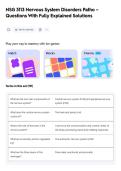
Terms in this set (191)
What are the two main components of Central nervous system (CNS) and peripheral nervous
the nervous system? system (PNS)
What does the central nervous system The brain and spinal cord
consist of?
What is the role of the brain in the It serves as the communication and control center of
nervous system? the body, processing inputs and initiating responses.
What are involuntary actions regulated The autonomic nervous system (ANS)
by?
What are the three layers of the Dura mater, arachnoid, and pia mater
meninges?
,What is the function of cerebrospinal It provides a cushion for the brain and spinal cord and
fluid (CSF)? helps maintain intracranial pressure.
What is the blood-brain barrier? A barrier at capillaries in the brain that limits the
passage of materials into the brain.
What is the dominant hemisphere in The left hemisphere, which controls language.
most people?
What is the function of the thalamus? It acts as a relay station for incoming sensory
impulses.
What does the hypothalamus Homeostasis, including body temperature, fluid intake,
regulate? and sleep cycles.
What are the three parts of the brain Midbrain, pons, and medulla oblongata
stem?
What is the primary function of the Coordination of movements, maintenance of posture,
cerebellum? and equilibrium.
What arteries supply blood to the Internal carotid and vertebral arteries
brain?
What is the Circle of Willis? An arrangement formed by anastomoses between
major arteries supplying the brain.
How many pairs of cranial nerves are 12 pairs
there?
What is the function of the spinal cord? It conducts impulses between the brain and the body
and is protected by the vertebral column.
What are reflexes? Automatic, rapid, involuntary responses to a stimulus.
, What are the two types of nerve fibers Afferent (sensory) and efferent (motor) fibers
in the spinal cord?
What is the role of glial cells? They support neurons in the central nervous system.
What happens to a neuron if its cell The neuron dies, but axons in the PNS may
body is damaged? regenerate.
What is the function of Schwann cells? They form the myelin sheath around axons in the
peripheral nervous system.
What is the role of the reticular It determines the degree of awareness of the cerebral
formation? cortex.
What is the function of the basal Control and coordination of skeletal muscle activity.
nuclei?
What is the function of the limbic It is responsible for emotional reactions or feelings.
system?
What are the two types of tracts in the Ascending tracts (spinal cord to brain) and
spinal cord? descending tracts (brain to spinal cord).
What is the role of interneurons? They transmit sensory information to the brain.
What is the significance of nodes of They are gaps between the myelin sheath that
Ranvier? facilitate faster impulse conduction.
What is the primary source of energy Glucose and oxygen
for neurons?
What causes depolarization in a Sodium influx
neuron?
Questions With Fully Explained Solutions
Add to calendar
Play your way to mastery with fun games
Match Blocks Charms NEW
Terms in this set (191)
What are the two main components of Central nervous system (CNS) and peripheral nervous
the nervous system? system (PNS)
What does the central nervous system The brain and spinal cord
consist of?
What is the role of the brain in the It serves as the communication and control center of
nervous system? the body, processing inputs and initiating responses.
What are involuntary actions regulated The autonomic nervous system (ANS)
by?
What are the three layers of the Dura mater, arachnoid, and pia mater
meninges?
,What is the function of cerebrospinal It provides a cushion for the brain and spinal cord and
fluid (CSF)? helps maintain intracranial pressure.
What is the blood-brain barrier? A barrier at capillaries in the brain that limits the
passage of materials into the brain.
What is the dominant hemisphere in The left hemisphere, which controls language.
most people?
What is the function of the thalamus? It acts as a relay station for incoming sensory
impulses.
What does the hypothalamus Homeostasis, including body temperature, fluid intake,
regulate? and sleep cycles.
What are the three parts of the brain Midbrain, pons, and medulla oblongata
stem?
What is the primary function of the Coordination of movements, maintenance of posture,
cerebellum? and equilibrium.
What arteries supply blood to the Internal carotid and vertebral arteries
brain?
What is the Circle of Willis? An arrangement formed by anastomoses between
major arteries supplying the brain.
How many pairs of cranial nerves are 12 pairs
there?
What is the function of the spinal cord? It conducts impulses between the brain and the body
and is protected by the vertebral column.
What are reflexes? Automatic, rapid, involuntary responses to a stimulus.
, What are the two types of nerve fibers Afferent (sensory) and efferent (motor) fibers
in the spinal cord?
What is the role of glial cells? They support neurons in the central nervous system.
What happens to a neuron if its cell The neuron dies, but axons in the PNS may
body is damaged? regenerate.
What is the function of Schwann cells? They form the myelin sheath around axons in the
peripheral nervous system.
What is the role of the reticular It determines the degree of awareness of the cerebral
formation? cortex.
What is the function of the basal Control and coordination of skeletal muscle activity.
nuclei?
What is the function of the limbic It is responsible for emotional reactions or feelings.
system?
What are the two types of tracts in the Ascending tracts (spinal cord to brain) and
spinal cord? descending tracts (brain to spinal cord).
What is the role of interneurons? They transmit sensory information to the brain.
What is the significance of nodes of They are gaps between the myelin sheath that
Ranvier? facilitate faster impulse conduction.
What is the primary source of energy Glucose and oxygen
for neurons?
What causes depolarization in a Sodium influx
neuron?


