
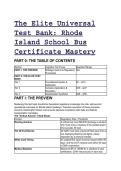
The Elite Universal
Test Bank: Rhode
Island School Bus
Certificate Mastery
PART 0: THE TABLE OF CONTENTS
Section Cognitive Tier Focus Question Range
PART I: THE PREVIEW Strategic Axioms & Regulatory N/A
Thresholds
PART II: THE ELITE TEST
BANK
Tier 1 Foundational Syntax & Q1 – Q18
Application
Tier 2 Complex Application & Q19 – Q37
Simulation
Tier 3 Grandmaster Synthesis Q38 – Q55
PART I: THE PREVIEW
Mastering this test bank transforms theoretical regulatory knowledge into elite, split-second
operational command on Rhode Island roadways. Precision execution of these principles
prevents catastrophic failures and ensures absolute compliance with state and federal
transportation mandates.
The "Critical Axioms" Cheat Sheet:
Domain Regulatory Rule / Threshold
Routing stricture A school bus must NEVER discharge a student
who must cross a roadway if the posted speed
limit exceeds 35 mph.
The 20-Foot Barrier All traffic must stop at least 20 feet away from a
bus displaying flashing red lights, unless
separated by a physical median.
White Card Timing An original BCI report must be issued within 60
days, and the DOT medical card within 90 days
of DMV submission.
Medical Baseline Maximum BP of 139/89 for a standard 2-year
certification, 20/40 visual acuity in each eye,
,Domain Regulatory Rule / Threshold
and hearing a forced whisper at 5 feet.
Equipment Triad Every RI pupil vehicle requires an emergency
airway kit, a bodily fluid spill kit, and a
potassium bicarbonate dry chemical fire
extinguisher.
PART II: THE ELITE TEST BANK
Tier 1: Foundational Syntax & Application
Q1: An applicant submits their RI School Bus Certificate application package to the DMV. The
package includes a BCI report dated 75 days prior to submission and a DOT medical card dated
80 days prior. Based on the principles of Rhode Island certification rules, what is the MOST
LIKELY outcome? A) The application is accepted because both documents are within the
90-day validity window. B) The application is rejected because the BCI report exceeds the
60-day validity limit. C) The application is accepted pending a secondary background check by
the local school district. D) The application is rejected because the DOT medical card exceeds
the 60-day validity limit.
● Answer: B (The application is rejected because the BCI report exceeds the 60-day validity
limit.)
● Distractor Analysis:
○ A is incorrect: The BCI report requires a stricter timeline (60 days) than the medical
card.
○ C is incorrect: The DMV sets a hard numerical limit; secondary checks do not
override state application prerequisites.
○ D is incorrect: The DOT medical card is valid for 90 days prior to submission, so at
80 days, it is compliant.
The Mentor's Analysis: Establishing a pristine administrative baseline is the first step of
operational readiness. When facing certification submissions, the immediate priority is verifying
strict date compliance. By utilizing the 60/90-day rule, you bypass the common trap of assuming
all background documents share the same expiration parameters. Professional Intuition:
Always audit your BCI (60 days) and DOT Medical (90 days) independently before DMV
submission.
Q2: A school bus operator is approaching a designated bus stop in a municipality. Based on the
principles of RI student transportation loading procedures, at what distance MUST the driver
activate the amber flashing warning lights? A) At least 50 feet before the stop. B) At least 100
feet before the stop. C) At least 300 feet before the stop. D) At least 500 feet before the stop.
● Answer: B (At least 100 feet before the stop.)
● Distractor Analysis:
○ A is incorrect: 50 feet provides insufficient warning for following traffic to adjust
speed.
○ C is incorrect: 300 feet is the standard minimum for rural areas, not municipalities.
○ D is incorrect: While some states require 500 feet universally, RI specifically
designates 100 feet in municipalities.
The Mentor's Analysis: Warning light activation is a preemptive space-management strategy.
When facing an approaching stop in a municipality, the immediate priority is initiating the amber
light sequence at 100 feet. By utilizing exact geographic distinctions, you bypass the common
, trap of triggering lights too early, which causes traffic confusion in dense urban areas.
Professional Intuition: Anchor your warning sequence to the environment: 100 feet for city
blocks, 300 feet for open rural routes.
Q3: During a routine pre-trip inspection, a driver checks the internal emergency equipment.
Based on the principles of Rhode Island vehicle standards (280-RICR-30-15-10), which
combination of kits is MANDATORY for a pupil transportation vehicle? A) First-aid kit, standard
road flare kit, and a general sanitation kit. B) First-aid kit, bodily fluid spill kit, and an emergency
airway kit. C) First-aid kit, bloodborne pathogen kit, and an AED (Automated External
Defibrillator). D) Advanced trauma kit, bodily fluid spill kit, and an emergency airway kit.
● Answer: B (First-aid kit, bodily fluid spill kit, and an emergency airway kit.)
● Distractor Analysis:
○ A is incorrect: "General sanitation kit" is not the regulatory term, omitting the critical
airway requirement.
○ C is incorrect: AEDs are not universally mandated by RI school bus regulations.
○ D is incorrect: "Advanced trauma kit" exceeds the baseline first-aid kit requirement.
The Mentor's Analysis: Regulatory equipment requirements are explicit and non-negotiable.
When facing pre-trip interior inspections, the immediate priority is verifying the exact triad of
state-mandated medical kits. By utilizing the specific regulatory definitions, you bypass the
common trap of accepting inadequate substitute items provided by underfunded dispatchers.
Professional Intuition: Look for the triad: First-Aid, Bodily Fluid, and Emergency Airway. If
one is missing, the bus is out of service.
Q4: A driver is conducting a required emergency evacuation drill. Based on the principles of
Rhode Island school bus safety regulations, how often MUST these drills be conducted? A)
Once a month during the academic year. B) Once during the fall term and once during the
spring term. C) At the beginning of the school year only. D) Once a week for the first four weeks
of the school year.
● Answer: B (Once during the fall term and once during the spring term.)
● Distractor Analysis:
○ A is incorrect: This is the standard for school building egress drills, not school
buses.
○ C is incorrect: This violates the mandate for bi-annual training to reinforce muscle
memory.
○ D is incorrect: This is a legacy concept for initial familiarization, not the legal
requirement.
The Mentor's Analysis: Evacuation proficiency requires periodic mechanical reinforcement.
When facing seasonal route planning, the immediate priority is scheduling a fall and spring drill.
By utilizing this bi-annual standard, you bypass the common trap of treating evacuation training
as a one-time onboarding checklist. Professional Intuition: Execute and document emergency
egress drills twice annually: once in the fall, once in the spring.
Q5: A driver is measuring the clearance of the rear emergency door during a vehicle inspection.
Based on the principles of RIGL vehicle design requirements, what are the MINIMUM clearance
dimensions required for this door? A) 24 inches horizontal clearance, 43 inches vertical height.
B) 22 inches horizontal clearance, 45 inches vertical height. C) 30 inches horizontal clearance,
48 inches vertical height. D) 20 inches horizontal clearance, 40 inches vertical height.
● Answer: A (24 inches horizontal clearance, 43 inches vertical height.)
● Distractor Analysis:
○ B is incorrect: 22 inches refers to the minimum width of the front entrance door, not
the emergency door.
Test Bank: Rhode
Island School Bus
Certificate Mastery
PART 0: THE TABLE OF CONTENTS
Section Cognitive Tier Focus Question Range
PART I: THE PREVIEW Strategic Axioms & Regulatory N/A
Thresholds
PART II: THE ELITE TEST
BANK
Tier 1 Foundational Syntax & Q1 – Q18
Application
Tier 2 Complex Application & Q19 – Q37
Simulation
Tier 3 Grandmaster Synthesis Q38 – Q55
PART I: THE PREVIEW
Mastering this test bank transforms theoretical regulatory knowledge into elite, split-second
operational command on Rhode Island roadways. Precision execution of these principles
prevents catastrophic failures and ensures absolute compliance with state and federal
transportation mandates.
The "Critical Axioms" Cheat Sheet:
Domain Regulatory Rule / Threshold
Routing stricture A school bus must NEVER discharge a student
who must cross a roadway if the posted speed
limit exceeds 35 mph.
The 20-Foot Barrier All traffic must stop at least 20 feet away from a
bus displaying flashing red lights, unless
separated by a physical median.
White Card Timing An original BCI report must be issued within 60
days, and the DOT medical card within 90 days
of DMV submission.
Medical Baseline Maximum BP of 139/89 for a standard 2-year
certification, 20/40 visual acuity in each eye,
,Domain Regulatory Rule / Threshold
and hearing a forced whisper at 5 feet.
Equipment Triad Every RI pupil vehicle requires an emergency
airway kit, a bodily fluid spill kit, and a
potassium bicarbonate dry chemical fire
extinguisher.
PART II: THE ELITE TEST BANK
Tier 1: Foundational Syntax & Application
Q1: An applicant submits their RI School Bus Certificate application package to the DMV. The
package includes a BCI report dated 75 days prior to submission and a DOT medical card dated
80 days prior. Based on the principles of Rhode Island certification rules, what is the MOST
LIKELY outcome? A) The application is accepted because both documents are within the
90-day validity window. B) The application is rejected because the BCI report exceeds the
60-day validity limit. C) The application is accepted pending a secondary background check by
the local school district. D) The application is rejected because the DOT medical card exceeds
the 60-day validity limit.
● Answer: B (The application is rejected because the BCI report exceeds the 60-day validity
limit.)
● Distractor Analysis:
○ A is incorrect: The BCI report requires a stricter timeline (60 days) than the medical
card.
○ C is incorrect: The DMV sets a hard numerical limit; secondary checks do not
override state application prerequisites.
○ D is incorrect: The DOT medical card is valid for 90 days prior to submission, so at
80 days, it is compliant.
The Mentor's Analysis: Establishing a pristine administrative baseline is the first step of
operational readiness. When facing certification submissions, the immediate priority is verifying
strict date compliance. By utilizing the 60/90-day rule, you bypass the common trap of assuming
all background documents share the same expiration parameters. Professional Intuition:
Always audit your BCI (60 days) and DOT Medical (90 days) independently before DMV
submission.
Q2: A school bus operator is approaching a designated bus stop in a municipality. Based on the
principles of RI student transportation loading procedures, at what distance MUST the driver
activate the amber flashing warning lights? A) At least 50 feet before the stop. B) At least 100
feet before the stop. C) At least 300 feet before the stop. D) At least 500 feet before the stop.
● Answer: B (At least 100 feet before the stop.)
● Distractor Analysis:
○ A is incorrect: 50 feet provides insufficient warning for following traffic to adjust
speed.
○ C is incorrect: 300 feet is the standard minimum for rural areas, not municipalities.
○ D is incorrect: While some states require 500 feet universally, RI specifically
designates 100 feet in municipalities.
The Mentor's Analysis: Warning light activation is a preemptive space-management strategy.
When facing an approaching stop in a municipality, the immediate priority is initiating the amber
light sequence at 100 feet. By utilizing exact geographic distinctions, you bypass the common
, trap of triggering lights too early, which causes traffic confusion in dense urban areas.
Professional Intuition: Anchor your warning sequence to the environment: 100 feet for city
blocks, 300 feet for open rural routes.
Q3: During a routine pre-trip inspection, a driver checks the internal emergency equipment.
Based on the principles of Rhode Island vehicle standards (280-RICR-30-15-10), which
combination of kits is MANDATORY for a pupil transportation vehicle? A) First-aid kit, standard
road flare kit, and a general sanitation kit. B) First-aid kit, bodily fluid spill kit, and an emergency
airway kit. C) First-aid kit, bloodborne pathogen kit, and an AED (Automated External
Defibrillator). D) Advanced trauma kit, bodily fluid spill kit, and an emergency airway kit.
● Answer: B (First-aid kit, bodily fluid spill kit, and an emergency airway kit.)
● Distractor Analysis:
○ A is incorrect: "General sanitation kit" is not the regulatory term, omitting the critical
airway requirement.
○ C is incorrect: AEDs are not universally mandated by RI school bus regulations.
○ D is incorrect: "Advanced trauma kit" exceeds the baseline first-aid kit requirement.
The Mentor's Analysis: Regulatory equipment requirements are explicit and non-negotiable.
When facing pre-trip interior inspections, the immediate priority is verifying the exact triad of
state-mandated medical kits. By utilizing the specific regulatory definitions, you bypass the
common trap of accepting inadequate substitute items provided by underfunded dispatchers.
Professional Intuition: Look for the triad: First-Aid, Bodily Fluid, and Emergency Airway. If
one is missing, the bus is out of service.
Q4: A driver is conducting a required emergency evacuation drill. Based on the principles of
Rhode Island school bus safety regulations, how often MUST these drills be conducted? A)
Once a month during the academic year. B) Once during the fall term and once during the
spring term. C) At the beginning of the school year only. D) Once a week for the first four weeks
of the school year.
● Answer: B (Once during the fall term and once during the spring term.)
● Distractor Analysis:
○ A is incorrect: This is the standard for school building egress drills, not school
buses.
○ C is incorrect: This violates the mandate for bi-annual training to reinforce muscle
memory.
○ D is incorrect: This is a legacy concept for initial familiarization, not the legal
requirement.
The Mentor's Analysis: Evacuation proficiency requires periodic mechanical reinforcement.
When facing seasonal route planning, the immediate priority is scheduling a fall and spring drill.
By utilizing this bi-annual standard, you bypass the common trap of treating evacuation training
as a one-time onboarding checklist. Professional Intuition: Execute and document emergency
egress drills twice annually: once in the fall, once in the spring.
Q5: A driver is measuring the clearance of the rear emergency door during a vehicle inspection.
Based on the principles of RIGL vehicle design requirements, what are the MINIMUM clearance
dimensions required for this door? A) 24 inches horizontal clearance, 43 inches vertical height.
B) 22 inches horizontal clearance, 45 inches vertical height. C) 30 inches horizontal clearance,
48 inches vertical height. D) 20 inches horizontal clearance, 40 inches vertical height.
● Answer: A (24 inches horizontal clearance, 43 inches vertical height.)
● Distractor Analysis:
○ B is incorrect: 22 inches refers to the minimum width of the front entrance door, not
the emergency door.


