

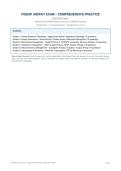
FISDAP AIRWAY EXAM – COMPREHENSIVE PRACTICE
2026/2027 Edition
Aligned with the FISDAP Airway Curriculum & NREMT Standards
68 Questions | 6 Content Domains | Multiple Choice (A–D)
Contents
Section 1: Airway Anatomy & Physiology – Upper/Lower Airway, Respiratory Physiology (12 questions)
Section 2: Airway Assessment – Scene Size-Up, Primary Survey, Obstruction Recognition (12 questions)
Section 3: Basic Airway Management – Head-Tilt/Chin-Lift, OPA/NPA, Suctioning, Recovery Position (15 questions)
Section 4: Ventilation & Oxygenation – BVM, Oxygen Devices, CPAP, Oxygen Therapy (15 questions)
Section 5: Advanced Airway Management – Supraglottic Airways, Intubation, Surgical Airway (10 questions)
Section 6: Capnography & Monitoring – Waveform Capnography, ETCO2 Monitoring (4 questions)
How to use this exam: Work through each section sequentially. One answer choice per question is correct; the correct answer
and a rationale follow each question. Use the rationales to reinforce airway management concepts. A reference answer key is
provided on the final page.
FISDAP Airway Exam – Comprehensive Practice (2026/2027 Edition) Page 1
, Section 1: Airway Anatomy & Physiology – Upper/Lower Airway, Respiratory
Section 1
Physiology (12 questions)
Q1: Which structure marks the division between the upper and lower airway?
A. The vocal cords (glottis) [CORRECT]
B. The carina
C. The epiglottis
D. The nasopharynx
Correct Answer: A
Rationale: The vocal cords mark the division between the upper and lower airway; structures above are upper airway
and those below are lower airway.
Q2: What is the primary function of the epiglottis?
A. To cover the trachea during swallowing and prevent aspiration [CORRECT]
B. To produce sound for speech
C. To warm and humidify inhaled air
D. To anchor the vocal cords
Correct Answer: A
Rationale: The epiglottis is a flap that covers the laryngeal inlet during swallowing, directing food away from the trachea.
Q3: Which structure is the narrowest part of the pediatric airway?
A. Cricoid cartilage [CORRECT]
B. Glottis
C. Epiglottis
D. Carina
Correct Answer: A
Rationale: In children the cricoid cartilage is the narrowest point, making the pediatric airway more prone to obstruction
from edema or foreign bodies.
Q4: Where does gas exchange between air and blood occur?
A. Alveoli [CORRECT]
B. Bronchi
C. Trachea
D. Bronchioles only
Correct Answer: A
Rationale: Gas exchange occurs across the alveolar-capillary membrane in the alveoli; larger airways only conduct air.
Q5: What keeps the trachea open and prevents it from collapsing?
A. C-shaped cartilage rings [CORRECT]
B. Smooth muscle alone
C. Bone
D. The thyroid gland
Correct Answer: A
Rationale: C-shaped cartilage rings provide rigid support to the trachea, preventing collapse during negative-pressure
inspiration.
FISDAP Airway Exam – Comprehensive Practice (2026/2027 Edition) Page 2
2026/2027 Edition
Aligned with the FISDAP Airway Curriculum & NREMT Standards
68 Questions | 6 Content Domains | Multiple Choice (A–D)
Contents
Section 1: Airway Anatomy & Physiology – Upper/Lower Airway, Respiratory Physiology (12 questions)
Section 2: Airway Assessment – Scene Size-Up, Primary Survey, Obstruction Recognition (12 questions)
Section 3: Basic Airway Management – Head-Tilt/Chin-Lift, OPA/NPA, Suctioning, Recovery Position (15 questions)
Section 4: Ventilation & Oxygenation – BVM, Oxygen Devices, CPAP, Oxygen Therapy (15 questions)
Section 5: Advanced Airway Management – Supraglottic Airways, Intubation, Surgical Airway (10 questions)
Section 6: Capnography & Monitoring – Waveform Capnography, ETCO2 Monitoring (4 questions)
How to use this exam: Work through each section sequentially. One answer choice per question is correct; the correct answer
and a rationale follow each question. Use the rationales to reinforce airway management concepts. A reference answer key is
provided on the final page.
FISDAP Airway Exam – Comprehensive Practice (2026/2027 Edition) Page 1
, Section 1: Airway Anatomy & Physiology – Upper/Lower Airway, Respiratory
Section 1
Physiology (12 questions)
Q1: Which structure marks the division between the upper and lower airway?
A. The vocal cords (glottis) [CORRECT]
B. The carina
C. The epiglottis
D. The nasopharynx
Correct Answer: A
Rationale: The vocal cords mark the division between the upper and lower airway; structures above are upper airway
and those below are lower airway.
Q2: What is the primary function of the epiglottis?
A. To cover the trachea during swallowing and prevent aspiration [CORRECT]
B. To produce sound for speech
C. To warm and humidify inhaled air
D. To anchor the vocal cords
Correct Answer: A
Rationale: The epiglottis is a flap that covers the laryngeal inlet during swallowing, directing food away from the trachea.
Q3: Which structure is the narrowest part of the pediatric airway?
A. Cricoid cartilage [CORRECT]
B. Glottis
C. Epiglottis
D. Carina
Correct Answer: A
Rationale: In children the cricoid cartilage is the narrowest point, making the pediatric airway more prone to obstruction
from edema or foreign bodies.
Q4: Where does gas exchange between air and blood occur?
A. Alveoli [CORRECT]
B. Bronchi
C. Trachea
D. Bronchioles only
Correct Answer: A
Rationale: Gas exchange occurs across the alveolar-capillary membrane in the alveoli; larger airways only conduct air.
Q5: What keeps the trachea open and prevents it from collapsing?
A. C-shaped cartilage rings [CORRECT]
B. Smooth muscle alone
C. Bone
D. The thyroid gland
Correct Answer: A
Rationale: C-shaped cartilage rings provide rigid support to the trachea, preventing collapse during negative-pressure
inspiration.
FISDAP Airway Exam – Comprehensive Practice (2026/2027 Edition) Page 2


