

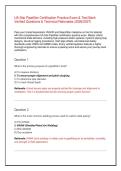
UA Star Pipefitter Certification Practice Exam & Test Bank
Verified Questions & Technical Rationales (2026/2027)
Pass your United Association HVACR and Steamfitter milestone on the first attempt
with this comprehensive UA Star Pipefitter certification practice exam. Master critical
mechanical trade domains, including high-pressure steam systems, hydronic piping loop
designs, structural rigging procedures, math pipe offsets, and advanced safety
standards under OSHA and ASME codes. Every verified question features a highly
thorough engineering rationale to ensure a passing score and secure your journey-level
certification.
Question 1
What is the primary purpose of a pipefitter's level?
A) To measure distance
B) To ensure proper alignment and pitch of piping
C) To determine pipe diameter
D) To check thread depth
Rationale: A level ensures pipes are properly pitched for drainage and alignment in
installation. This is a fundamental tool for ensuring proper system function .
Question 2
What is the most common welding process used for carbon steel piping?
A) TIG (GTAW)
B) SMAW (Shielded Metal Arc Welding)
C) MIG (GMAW)
D) Oxy-acetylene
Rationale: SMAW (stick welding) is widely used in pipefitting for its portability, versatility,
and strength in field applications .
,Question 3
In pipefitting, what does NPS stand for?
A) National Pipe Standard
B) Normal Pipe Schedule
C) Nominal Pipe Size
D) Non-Pressure Steel
Rationale: NPS is a North American standard set of sizes for pipes. It is based on a
dimensionless number (e.g., NPS 4 is 4 inches nominal, but actual outside diameter is 4.5
inches) .
Question 4
The wall thickness of a pipe is commonly referred to by its:
A) NPS number
B) Schedule (SCH) number
C) DN number
D) Weight class
Rationale: Schedule indicates the wall thickness; higher schedule numbers correspond to
thicker walls for a given NPS (e.g., SCH 40, SCH 80, SCH 160) .
Question 5
What does "schedule 40" primarily indicate?
A) Maximum working pressure
B) Wall thickness for a given NPS
C) Material grade
D) Pipe length
,Rationale: Schedule numbers are standardized across pipe sizes. SCH 40 for NPS 4 is
0.237" wall thickness .
Question 6
Which of the following is NOT a standard pipe fitting?
A) 90° elbow (LR or SR)
B) Tee
C) Cross
D) Gearbox
Rationale: A gearbox is a mechanical component, not a pipe fitting. Standard fittings
include elbows, tees, crosses, reducers, and unions .
Question 7
What is the main purpose of pipe insulation?
A) Aesthetic improvement
B) Temperature control and energy efficiency
C) Prevent corrosion
D) Strengthen the pipe
Rationale: Insulation maintains temperature, prevents energy loss, and can help prevent
condensation and freezing .
Question 8
What is the standard angle for a welding bevel on a pipe joint?
, A) 20°
B) 37.5° per side
C) 45°
D) 60°
Rationale: 37.5° per side provides proper penetration for butt welds. This is the standard
bevel angle for pipe welding .
Question 9
What is the primary purpose of a union fitting?
A) Change direction
B) Reduce flow
C) Allow disassembly of piping without cutting
D) Control flow rate
Rationale: Unions allow quick disconnection and reassembly of pipe sections without
cutting or unthreading long pipe runs. They consist of three parts: two end fittings and a
central nut .
Question 10
The term "BTU" stands for:
A) British Thermal Unit
B) The amount of heat required to raise 1 lb of water 1°F
C) Heat per square inch
D) Boiler temperature unit
Rationale: A BTU measures heat energy transfer capacity. Specifically, it is the amount of
heat required to raise one pound of water by one degree Fahrenheit .
Verified Questions & Technical Rationales (2026/2027)
Pass your United Association HVACR and Steamfitter milestone on the first attempt
with this comprehensive UA Star Pipefitter certification practice exam. Master critical
mechanical trade domains, including high-pressure steam systems, hydronic piping loop
designs, structural rigging procedures, math pipe offsets, and advanced safety
standards under OSHA and ASME codes. Every verified question features a highly
thorough engineering rationale to ensure a passing score and secure your journey-level
certification.
Question 1
What is the primary purpose of a pipefitter's level?
A) To measure distance
B) To ensure proper alignment and pitch of piping
C) To determine pipe diameter
D) To check thread depth
Rationale: A level ensures pipes are properly pitched for drainage and alignment in
installation. This is a fundamental tool for ensuring proper system function .
Question 2
What is the most common welding process used for carbon steel piping?
A) TIG (GTAW)
B) SMAW (Shielded Metal Arc Welding)
C) MIG (GMAW)
D) Oxy-acetylene
Rationale: SMAW (stick welding) is widely used in pipefitting for its portability, versatility,
and strength in field applications .
,Question 3
In pipefitting, what does NPS stand for?
A) National Pipe Standard
B) Normal Pipe Schedule
C) Nominal Pipe Size
D) Non-Pressure Steel
Rationale: NPS is a North American standard set of sizes for pipes. It is based on a
dimensionless number (e.g., NPS 4 is 4 inches nominal, but actual outside diameter is 4.5
inches) .
Question 4
The wall thickness of a pipe is commonly referred to by its:
A) NPS number
B) Schedule (SCH) number
C) DN number
D) Weight class
Rationale: Schedule indicates the wall thickness; higher schedule numbers correspond to
thicker walls for a given NPS (e.g., SCH 40, SCH 80, SCH 160) .
Question 5
What does "schedule 40" primarily indicate?
A) Maximum working pressure
B) Wall thickness for a given NPS
C) Material grade
D) Pipe length
,Rationale: Schedule numbers are standardized across pipe sizes. SCH 40 for NPS 4 is
0.237" wall thickness .
Question 6
Which of the following is NOT a standard pipe fitting?
A) 90° elbow (LR or SR)
B) Tee
C) Cross
D) Gearbox
Rationale: A gearbox is a mechanical component, not a pipe fitting. Standard fittings
include elbows, tees, crosses, reducers, and unions .
Question 7
What is the main purpose of pipe insulation?
A) Aesthetic improvement
B) Temperature control and energy efficiency
C) Prevent corrosion
D) Strengthen the pipe
Rationale: Insulation maintains temperature, prevents energy loss, and can help prevent
condensation and freezing .
Question 8
What is the standard angle for a welding bevel on a pipe joint?
, A) 20°
B) 37.5° per side
C) 45°
D) 60°
Rationale: 37.5° per side provides proper penetration for butt welds. This is the standard
bevel angle for pipe welding .
Question 9
What is the primary purpose of a union fitting?
A) Change direction
B) Reduce flow
C) Allow disassembly of piping without cutting
D) Control flow rate
Rationale: Unions allow quick disconnection and reassembly of pipe sections without
cutting or unthreading long pipe runs. They consist of three parts: two end fittings and a
central nut .
Question 10
The term "BTU" stands for:
A) British Thermal Unit
B) The amount of heat required to raise 1 lb of water 1°F
C) Heat per square inch
D) Boiler temperature unit
Rationale: A BTU measures heat energy transfer capacity. Specifically, it is the amount of
heat required to raise one pound of water by one degree Fahrenheit .


