REVIEW WORKSHEET
Relations and Functions
Purpose: This worksheet prepares you for the Relations and Functions summative activity by practising the mathematical
knowledge, representations, reasoning, and modelling skills assessed in Criteria A–D.
Important: The situations, representations, and numbers are different from those in the summative activity. Focus on
understanding why a particular mathematical method is appropriate and how to justify your conclusions. This is an
optional worksheet, so you do not have to complete it if you do not want to. The worksheet will not be checked or graded
by the teacher.
CRITERION A — KNOWING AND UNDERSTANDING
Review focus: selecting and applying appropriate mathematics when working with relations and functions
1. Four relations are represented in different ways.
Relation A: R = {(1, 3), (2, 5), (3, 7), (4, 9)}
Relation B:
x 1 2 3 4
y 5 5 8 10
Relation C: 1 → 4, 2 → 7, 3 → 4, 4 → 9
Relation D:
a. Determine whether each relation is a function.
Relation Function?
Relations and Functions — Review Worksheet
, A Yes / No
B Yes / No
C Yes / No
D Yes / No
b. Choose TWO relations and justify your conclusions using appropriate mathematical reasoning.
c. Two relations above are functions that are not one-to-one. Identify them and explain how you know.
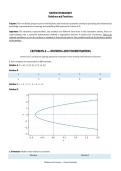
2. Consider the graph below.
a. Determine whether the relation is a function. Justify your answer.
b. Determine whether the function is one-to-one. Justify your answer.
c. Explain why the test used in part (a) is different from the test used in part (b).
CRITERION B — INVESTIGATING PATTERNS
Review focus: identifying a pattern from a graph, forming a general rule and verifying its validity
3. Investigating a pattern from a graph
a. Investigate the pattern shown in the graph. Describe what you notice about how y changes as x increases.
b. Use the pattern to predict y when x = 8. Show how you reached your prediction.
Relations and Functions — Review Worksheet
Relations and Functions
Purpose: This worksheet prepares you for the Relations and Functions summative activity by practising the mathematical
knowledge, representations, reasoning, and modelling skills assessed in Criteria A–D.
Important: The situations, representations, and numbers are different from those in the summative activity. Focus on
understanding why a particular mathematical method is appropriate and how to justify your conclusions. This is an
optional worksheet, so you do not have to complete it if you do not want to. The worksheet will not be checked or graded
by the teacher.
CRITERION A — KNOWING AND UNDERSTANDING
Review focus: selecting and applying appropriate mathematics when working with relations and functions
1. Four relations are represented in different ways.
Relation A: R = {(1, 3), (2, 5), (3, 7), (4, 9)}
Relation B:
x 1 2 3 4
y 5 5 8 10
Relation C: 1 → 4, 2 → 7, 3 → 4, 4 → 9
Relation D:
a. Determine whether each relation is a function.
Relation Function?
Relations and Functions — Review Worksheet
, A Yes / No
B Yes / No
C Yes / No
D Yes / No
b. Choose TWO relations and justify your conclusions using appropriate mathematical reasoning.
c. Two relations above are functions that are not one-to-one. Identify them and explain how you know.
2. Consider the graph below.
a. Determine whether the relation is a function. Justify your answer.
b. Determine whether the function is one-to-one. Justify your answer.
c. Explain why the test used in part (a) is different from the test used in part (b).
CRITERION B — INVESTIGATING PATTERNS
Review focus: identifying a pattern from a graph, forming a general rule and verifying its validity
3. Investigating a pattern from a graph
a. Investigate the pattern shown in the graph. Describe what you notice about how y changes as x increases.
b. Use the pattern to predict y when x = 8. Show how you reached your prediction.
Relations and Functions — Review Worksheet