

Starting with this extract, explore how Dickens presents the effects of greed in A
Christmas Carol.
This was not addressed to Scrooge, or to any one whom he could see, but it produced an
immediate effect. For again Scrooge saw himself. He was older now; a man in the prime of life.
His face had not the harsh and rigid lines of later years; but it had begun to wear the signs of
care and avarice. There was an eager, greedy, restless motion in the eye, which showed the
passion that had taken root, and where the shadow of the growing tree would fall.
He was not alone, but sat by the side of a fair young girl in a mourning-dress: in whose eyes
there were tears, which sparkled in the light that shone out of the Ghost of Christmas Past.
“It matters little,” she said, softly. “To you, very little. Another idol has displaced me; and if it can
cheer and comfort you in time to come, as I would have tried to do, I have no just cause to
grieve.”
“What Idol has displaced you?” he rejoined.
“A golden one.” “This is the even-handed dealing of the world!” he said. “There is nothing on
which it is so hard as poverty; and there is nothing it professes to condemn with such severity
as the pursuit of wealth!”
“You fear the world too much,” she answered, gently. “All your other hopes have merged into
the hope of being beyond the chance of its sordid reproach. I have seen your nobler aspirations
fall off one by one, until the master-passion, Gain, engrosses you. Have I not?”
“What then?” he retorted. “Even if I have grown so much wiser, what then? I am not changed
towards you.”
She shook her head.
“Am I?” “Our contract is an old one. It was made when we were both poor and content to be so,
until, in good season, we could improve our worldly fortune by our patient industry. You are
changed. When it was made, you were another man.”
“I was a boy,” he said impatiently.
“Your own feeling tells you that you were not what you are,” she returned. “I am. That which
promised happiness when we were one in heart, is fraught with misery now that we are two.
How often and how keenly I have thought of this, I will not say. It is enough that I have thought
of it, and I will release you.”
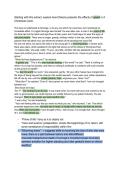
- “Prime of life” irony as it is clearly not
- “Care and avarice” juxtaposition, shows the beginnings of no return, still
some semblance of responsibility within him
- “Mourning dress” → suggests belle is mourning the loss of who she once
knew, there is a split between before and after/different
character/metaphorical death of scrooge’s morality/crosses boundary
between ambition for higher standing and utter greed/is there an ethical
wealthy?
Christmas Carol.
This was not addressed to Scrooge, or to any one whom he could see, but it produced an
immediate effect. For again Scrooge saw himself. He was older now; a man in the prime of life.
His face had not the harsh and rigid lines of later years; but it had begun to wear the signs of
care and avarice. There was an eager, greedy, restless motion in the eye, which showed the
passion that had taken root, and where the shadow of the growing tree would fall.
He was not alone, but sat by the side of a fair young girl in a mourning-dress: in whose eyes
there were tears, which sparkled in the light that shone out of the Ghost of Christmas Past.
“It matters little,” she said, softly. “To you, very little. Another idol has displaced me; and if it can
cheer and comfort you in time to come, as I would have tried to do, I have no just cause to
grieve.”
“What Idol has displaced you?” he rejoined.
“A golden one.” “This is the even-handed dealing of the world!” he said. “There is nothing on
which it is so hard as poverty; and there is nothing it professes to condemn with such severity
as the pursuit of wealth!”
“You fear the world too much,” she answered, gently. “All your other hopes have merged into
the hope of being beyond the chance of its sordid reproach. I have seen your nobler aspirations
fall off one by one, until the master-passion, Gain, engrosses you. Have I not?”
“What then?” he retorted. “Even if I have grown so much wiser, what then? I am not changed
towards you.”
She shook her head.
“Am I?” “Our contract is an old one. It was made when we were both poor and content to be so,
until, in good season, we could improve our worldly fortune by our patient industry. You are
changed. When it was made, you were another man.”
“I was a boy,” he said impatiently.
“Your own feeling tells you that you were not what you are,” she returned. “I am. That which
promised happiness when we were one in heart, is fraught with misery now that we are two.
How often and how keenly I have thought of this, I will not say. It is enough that I have thought
of it, and I will release you.”
- “Prime of life” irony as it is clearly not
- “Care and avarice” juxtaposition, shows the beginnings of no return, still
some semblance of responsibility within him
- “Mourning dress” → suggests belle is mourning the loss of who she once
knew, there is a split between before and after/different
character/metaphorical death of scrooge’s morality/crosses boundary
between ambition for higher standing and utter greed/is there an ethical
wealthy?


