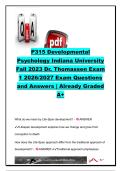
This P315 Developmental Psychology Exam 1 2026/2027 study guide contains 26 questions with answers across 7 pages and is presented as an Already Graded A+ resource based on the Fall 2023 course associated with Dr. Thomassen. The document covers life-span development, developmental trajectories and cascades, integrative and transactional approaches, the diathesis-stress model, Bronfenbrenner’s ecological systems theory, the biopsychosocial model, classical and operant conditioning, Bandura’s social learning and social cognitive theories, attachment theory, ethology, sensitive periods and imprinting. The cover page explicitly identifies the material as P315 Developmental Psychology from Indiana University, making the course and institution clear for students searching for targeted Exam 1 preparation.
The first section introduces life-span development as change and growth from conception through death and contrasts this perspective with the traditional developmental approach. According to the document, the traditional approach emphasizes extensive change from birth through adolescence, relatively little change during adulthood and decline in old age, whereas the life-span perspective recognizes developmental change throughout life. Students also review developmental trajectories, which describe the progression of behavior as people age, and developmental cascades, in which earlier interactions can create chain reactions that influence later developmental systems and outcomes.
The guide then examines several frameworks for understanding the interaction between individuals and their environments. The integrative approach combines elements of multiple theories to account for complex individual circumstances, while the transactional process view emphasizes reciprocal adaptation between a child and caregiving environment. The diathesis-stress model is presented as an interaction between an inherent vulnerability and environmental stressors. These concepts reinforce a recurring theme throughout the document: development results from interconnected personal, biological and environmental influences rather than a single isolated factor.
A particularly important section covers Bronfenbrenner’s Ecological Systems Theory and the biopsychosocial model. Bronfenbrenner’s framework is presented through the individual, microsystem, mesosystem, exosystem, macrosystem and chronosystem, emphasizing the influence of social environments on human development. The biopsychosocial model examines biological, psychological and social influences on health and disease, while the document explains that Bronfenbrenner’s model expands this perspective by incorporating a dynamic-systems approach and further clarifying environmental and social influences.
The learning-theory section compares Ivan Pavlov, B. F. Skinner and Albert Bandura. Pavlov’s classical conditioning is explained as learning through association, in which a neutral stimulus becomes connected with another stimulus and eventually elicits a conditioned response. Skinner’s operant conditioning emphasizes behavioral consequences, reinforcement and punishment, illustrated through the Skinner-box experiment. Bandura’s social learning theory shifts attention toward observation and modeling, explaining how individuals can acquire behaviors by watching others rather than exclusively through direct experience.
The resource extends Bandura’s work into social cognitive theory, emphasizing dynamic interaction among personal factors, behavior and the environment. The study material illustrates this using a self-fulfilling academic example in which expectations about failing influence studying behavior and subsequent performance. This section helps students distinguish learning by direct consequences from observational learning and broader reciprocal interactions among cognition, behavior and environment.
The final section concentrates on attachment theory and ethology. Attachment is described as an emotional bond, with John Bowlby and Mary Ainsworth identified as key figures and early caregiver relationships presented as having lasting developmental importance. Konrad Lorenz is associated with ethology, sensitive periods and imprinting. The guide defines imprinting as rapid, phase-sensitive learning and uses the example of newly hatched animals becoming attached to a human caregiver rather than their biological mother. Sensitive periods are presented as developmental periods when children are especially focused on acquiring particular skills or areas of knowledge.
Relevant students: This resource is specifically relevant to Indiana University P315 students, Developmental Psychology students, Psychology majors, Human Development students, Child Development students, behavioral science students and learners preparing for a P315 Exam 1 covering developmental theories and lifespan perspectives. It is especially useful for students reviewing Bronfenbrenner, Pavlov, Skinner, Bandura, Bowlby, Ainsworth and Lorenz, as well as the major environmental, behavioral and attachment frameworks presented in the course material.
Keywords: P315 Developmental Psychology, P315 Exam 1, P315 questions and answers, P, developmental psychology exam 1, developmental psychology questions and answers, developmental psychology study guide, lifespan development, life span approach, developmental trajectory, developmental cascade, integrative approach, transactional process, diathesis stress model, Bronfenbrenner ecological systems theory, microsystem, mesosystem, exosystem, macrosystem, chronosystem, biopsychosocial model, classical conditioning, Ivan Pavlov, operant conditioning, B F Skinner, Skinner box, social learning theory, Albert Bandura, social cognitive theory, observational learning, attachment theory, John Bowlby, Mary Ainsworth, ethology, Konrad Lorenz, sensitive periods, imprinting, psychology exam preparation, Indiana psychology exam
Content preview
P315 Developmental
Psychology Indiana University
Fall 2023 Dr. Thomassen Exam
1 2026/2027 Exam Questions
and Answers | Already Graded
A+
What do we mean by Life-Span development? - ANSWER
✔✔Lifespan development explores how we change and grow from
conception to death
How does the Life-Span approach differ from the traditional approach of
development? - ANSWER ✔✔Traditional approach emphasizes
, extensive change from birth to adolescence, little to no change in
adulthood, and decline in old age. The Life-Span approach emphasizes
developmental change throughout life
What is Developmental Trajectory? - ANSWER ✔✔Describes the
progression of a given behavior as individuals age
What is Developmental Cascade? - ANSWER ✔✔refers to a process
which a person's previous interactions spread across other systems and
alter their course of development, a chain reaction (e.g., attachment
theory, child has responsive and available parents, child later forms
healthy attachments and can properly manage emotions)
Whats the Integrative Approach? - ANSWER ✔✔Combines aspects
of several theories and schools of thought to best suit the complexity
and the context of the individual's situation
Whats the Transactional Process View? - ANSWER ✔✔Is a process
resulting from interaction between the child and the caregiving
environment, Developmental health is dependent on the child and the
parent adapting to each other as development changes. (e.g., one
person might regard spilling coffee as a minor inconvenience, just mop it
up and carry on, while another might get upset and let it ruin their day)