
• Wrong document? Swap it for free
  • Written by students who passed
  • Immediately available after payment
  • Read online or as PDF
Sell
Where do you study
Your language
Document preview thumbnail
Preview 3 out of 20 pages
Exam (elaborations)

NSG5003 Advanced Pathophysiology Week 1 2026/2027 – 95+ Questions & Answers | Cell Biology, Genetics, Cancer & Genetic Disorders

Document preview thumbnail
Preview 3 out of 20 pages

This NSG5003 Advanced Pathophysiology Week 1 2026/2027 study guide contains 95+ exam-focused questions, definitions, clinical manifestations, and answers covering foundational cellular pathophysiology, genetics, cellular adaptation, cancer biology, and inherited disorders. The opening sections review cellular structures and functions—including the nucleus, mitochondria, ribosomes, endoplasmic reticulum, lysosomes, cytoskeleton, and Golgi apparatus—before examining diffusion, facilitated diffusion, osmosis, active transport, endocytosis, phagocytosis, pinocytosis, and exocytosis. The material then progresses into chromosomes, DNA, chromatin, base pairing, genes, genotype, genome, phenotype, mitosis, meiosis, cellular differentiation, and the major tissue types. A substantial portion focuses on cellular adaptation, injury, and neoplasia. Students review atrophy, hypertrophy, hyperplasia, metaplasia, dysplasia, cellular injury, free radicals, necrosis, gangrene, neoplasms, anaplasia, and the distinguishing characteristics of benign and malignant tumors. Cancer-related material covers carcinoma, sarcoma, leukemia/lymphoma, carcinoma in situ, metastasis, tumor markers, and the initiation, promotion, and progression phases of carcinogenesis. Epigenetic mechanisms are also introduced through DNA methylation and histone acetylation. The genetics section provides extensive preparation on congenital and genetic disorders, patterns of inheritance, autosomal dominant and recessive inheritance, X-linked dominant and recessive inheritance, chromosomal abnormalities, alleles, loci, homozygous and heterozygous genotypes, and single-gene disorders. The later pages connect these principles to clinically important conditions including Marfan syndrome, neurofibromatosis, phenylketonuria, Tay-Sachs disease, Fragile X syndrome, Down syndrome/Trisomy 21, Turner syndrome, familial hypercholesterolemia, Huntington disease, cystic fibrosis, albinism, sickle cell anemia, Klinefelter syndrome, Edwards syndrome, cleft lip, and cleft palate. Clinical manifestations are provided for many of these conditions, making the document useful for connecting underlying genetic mechanisms with recognizable patient presentations. The subject matter corresponds closely to the foundational material traditionally taught in advanced nursing pathophysiology. A widely used academic reference is McCance and Huether's Pathophysiology: The Biologic Basis for Disease in Adults and Children, which Elsevier describes as integrating cellular biology, genetics, and mechanisms of disease with clinical manifestations. The text covers cellular biology, cellular adaptation and injury, genes and genetic diseases, epigenetics, and cancer biology, providing an appropriate academic framework for the concepts reviewed in this NSG5003 material. Elsevier – McCance & Huether's Pathophysiology Relevant students: This document is particularly relevant for NSG5003 students, MSN students, advanced practice nursing students, nurse practitioner students, graduate nursing students, and learners taking Advanced Pathophysiology, Pathophysiology, Genetics, or related health-science courses. It is suitable for Week 1 exams, quizzes, comprehensive review, concept reinforcement, and preparation for questions requiring students to connect cellular and genetic mechanisms with disease manifestations. The uploaded document provides the course code NSG5003 and academic year 2026/2027, but it does not identify a university, so a university name should not be invented. Academic reference: McCance, K. L., & Huether, S. E. McCance & Huether's Pathophysiology: The Biologic Basis for Disease in Adults and Children. Elsevier. This is an appropriate supporting academic reference for the document's coverage of cellular biology, cellular injury, genetics, epigenetics, neoplasia, and mechanisms of human disease. Keywords: NSG5003, NSG5003 Advanced Pathophysiology, NSG5003 Week 1, NSG5003 exam questions and answers, Advanced Pathophysiology Week 1, advanced pathophysiology exam, nursing pathophysiology questions, cell biology, cellular transport, diffusion and osmosis, active transport, cell injury, cellular adaptation, atrophy hypertrophy hyperplasia, metaplasia dysplasia, necrosis, genetics, chromosomes and DNA, genotype and phenotype, mitosis and meiosis, patterns of inheritance, autosomal dominant disorders, autosomal recessive disorders, X linked inheritance, genetic disorders, carcinogenesis, benign and malignant tumors, metastasis, epigenetics, DNA methylation, Marfan syndrome, phenylketonuria, Tay Sachs disease, Fragile X syndrome, Down syndrome, Turner syndrome, Huntington disease, cystic fibrosis, sickle cell anemia, Klinefelter syndrome, Edwards syndrome, nurse practitioner pathophysiology, MSN pathophysiology, NSG

Content preview

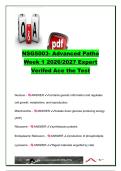
NSG5003- Advanced Patho
Week 1 2026/2027 Expert
Verifed Ace the Test


Nucleus - ANSWER ✔✔contains genetic information and regulates

cell growth, metabolism, and reproduction.


Mitochondria - ANSWER ✔✔breaks down glucose producing energy

(ATP)


Ribosome - ANSWER ✔✔synthesizes proteins


Endoplasmic Reticulum - ANSWER ✔✔production of phospholipids


Lysosome - ANSWER ✔✔Digest materials engulfed by cells

,Cytoskeleton - ANSWER ✔✔Helps transport molecules inside cell

and binds to enzymes of metabolic pathways


Golgi - ANSWER ✔✔sorts, chemically modifies and packages

proteins


Diffusion - ANSWER ✔✔Movement of molecules from an area of

higher concentration to an area of lower concentration.


Passive Process - ANSWER ✔✔substances cross the membrane

without any energy input from the cell


facilitated diffusion - ANSWER ✔✔requires a carrier protein

(Molecule)


Osmosis - ANSWER ✔✔Diffusion of water through a selectively

permeable membrane from an area of lower concentration to an area of

higher concentration


Osmolarity - ANSWER ✔✔describes fluid outside the body


Osmolality - ANSWER ✔✔describes fluids inside the body


Active Transport - ANSWER ✔✔Ex. NA+ K+ pump, requires ATP

(energy)

, Endocytosis - ANSWER ✔✔process of bringing a substance into cell

that is too large. The cell membrane engulfs.


Phagocytosis - ANSWER ✔✔eats solid particles


Pinocytosis - ANSWER ✔✔drinks liquid particles


Exocytosis - ANSWER ✔✔release of material from the cell into cell

membrane with the assistance of a vessicle. Ex. Glands secrete

hormones through exocytosis


Chromosomes - ANSWER ✔✔located in the nucleus of the cell.

There are 46 chromosomes in all normal human cells, with the exception

of mature sex cells, which have 23.


DNA - ANSWER ✔✔contains the genetic information that makes up

the chromosomes.


Chromatin - ANSWER ✔✔Clusters of DNA, RNA, and proteins in the

nucleus of a cell that is wrapped around histone proteins


base pairing - ANSWER ✔✔Adenine+ Thymine, Cytosine+ Guanine


Genes - ANSWER ✔✔DNA segments that serve as the key functional

units in hereditary transmission.


3
COPYRIGHT©JOSHCLAY 2026/2027. YEAR PUBLISHED 2026. COMPANY REGISTRATION NUMBER: 619652435. TERMS OF USE. PRIVACY
STATEMENT. ALL RIGHTS RESERVED


Document information

Uploaded on
September 12, 2026
Number of pages
20
Written in
2026/2027
Type
Exam (elaborations)
Contains
Questions & answers
$21.99

Wrong document? Swap it for free Within 14 days of purchase and before downloading, you can choose a different document. You can simply spend the amount again.
Written by students who passed
Immediately available after payment
Read online or as PDF

Seller avatar
Reputation scores are based on the amount of documents a seller has sold for a fee and the reviews they have received for those documents. There are three levels: Bronze, Silver and Gold. The better the reputation, the more your can rely on the quality of the sellers work.
JOSHCLAY
3.5
(88)
Sold
414
Followers
16
Items
20850
Last sold
15 hours ago


Why students choose Stuvia

Created by fellow students, verified by reviews

Quality you can trust: written by students who passed their tests and reviewed by others who've used these notes.

Didn't get what you expected? Choose another document

No worries! You can instantly pick a different document that better fits what you're looking for.

Pay as you like, start learning right away

No subscription, no commitments. Pay the way you're used to via credit card and download your PDF document instantly.

Student with book image

“Bought, downloaded, and aced it. It really can be that simple.”

Alisha Student

Working on your references?

Create accurate citations in APA, MLA and Harvard with our free citation generator.

Working on your references?

Frequently asked questions
