

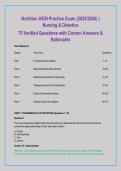
Nutrition HESI Practice Exam (2025/2026) |
Nursing & Dietetics
75 Verified Questions with Correct Answers &
Rationales
Exam Blueprint:
Section Topic Area Questions
Part 1 Fundamentals of Nutrition 1–15
Part 2 Macronutrients & Micronutrients 16–30
Part 3 Nutritional Assessment & Screening 31–40
Part 4 Therapeutic Diets & Clinical Nutrition 41–55
Part 5 Enteral & Parenteral Nutrition 56–65
Part 6 Nutrition Across the Lifespan 66–75
PART 1: FUNDAMENTALS OF NUTRITION (Questions 1–15)
Question 1
The nurse is teaching a patient about the importance of a balanced diet. Which macronutrient should
provide the largest percentage of total daily caloric intake?
A. Protein
B. Carbohydrates
C. Fats
D. Alcohol
Answer: B. Carbohydrates
Rationale: Carbohydrates should provide 45–65% of total daily caloric intake, making them the largest
source of calories. Proteins should provide 10–35%, fats 20–35%, and alcohol does not provide essential
,nutrients. Carbohydrates are the body's preferred energy source and should form the foundation of a
healthy diet.
Question 2
A patient asks the nurse how many calories are in 1 gram of protein. What is the correct response?
A. 3 calories
B. 4 calories
C. 7 calories
D. 9 calories
Answer: B. 4 calories
Rationale: Protein provides 4 calories per gram. Carbohydrates also provide 4 calories per gram. Fats
provide 9 calories per gram, which is the most calorie-dense macronutrient. Alcohol provides 7 calories per
gram but is not considered a nutrient. This knowledge is essential for calculating nutritional requirements
and understanding energy balance.
Question 3
Which nutrient is the body's primary source of energy?
A. Protein
B. Carbohydrates
C. Fats
D. Vitamins
Answer: B. Carbohydrates
Rationale: Carbohydrates are the body's preferred energy source, providing 4 kcal/g. They are broken
down into glucose, which fuels cells, particularly the brain and muscles. Proteins and fats also provide
energy but are secondary to carbohydrates in healthy individuals. Vitamins do not provide energy.
Question 4
How many calories per gram does fat provide?
A. 4 kcal/g
B. 5 kcal/g
C. 7 kcal/g
D. 9 kcal/g
Answer: D. 9 kcal/g
,Rationale: Fats provide 9 kcal/g, making them the most energy-dense macronutrient. Carbohydrates and
proteins provide 4 kcal/g. Alcohol provides 7 kcal/g but is not a nutrient. Fats are essential for hormone
production, cell membrane structure, and absorption of fat-soluble vitamins (A, D, E, K).
Question 5
Complete proteins are those that:
A. Are derived from plant sources only
B. Contain all nine essential amino acids
C. Are low in saturated fat
D. Are absorbed more quickly than incomplete proteins
Answer: B. Contain all nine essential amino acids
Rationale: Complete proteins contain all nine essential amino acids that the body cannot synthesize and
must obtain from food. Sources include animal products (meat, poultry, fish, eggs, dairy) and soy.
Incomplete proteins lack one or more essential amino acids and are typically from plant sources (except
soy).
Question 6
A client following a vegan diet asks about getting enough protein. Which statement by the nurse is most
accurate?
A. "You must eat animal protein to get complete protein."
B. "You can combine plant proteins (e.g., rice and beans) to form complete proteins."
C. "Protein needs are lower on a vegan diet."
D. "You only need protein every other day."
Answer: B. "You can combine plant proteins (e.g., rice and beans) to form complete proteins."
Rationale: Complementary proteins are foods that, when eaten together, supply the amino acid that is
missing or in short supply in the other food. Rice and beans are a classic example of complementary
proteins that together provide all essential amino acids. Vegan diets can meet protein needs through proper
food combining.
Question 7
What is the primary role of dietary fiber in a patient care plan?
A. Provides energy
B. Promotes bowel regularity
C. Builds muscle mass
D. Enhances taste
, Answer: B. Promotes bowel regularity
Rationale: Dietary fiber adds bulk to stool, aiding digestion and preventing constipation. It does not provide
significant energy, build muscle, or enhance taste. Fiber is the total amount of naturally occurring material
in foods, mostly plants, that is not digested by the human digestive system and therefore is not absorbed.
Question 8
What is the recommended daily intake of fiber for adults?
A. 10–15 g
B. 25–30 g
C. 40–50 g
D. 5–10 g
Answer: B. 25–30 g
Rationale: The Dietary Guidelines recommend 25 g for women and 30 g for men to promote digestive
health and reduce chronic disease risk. Other options are either too high or too low.
Question 9
Which vitamin is essential for blood clotting?
A. Vitamin A
B. Vitamin C
C. Vitamin D
D. Vitamin K
Answer: D. Vitamin K
Rationale: Vitamin K is critical for synthesizing clotting factors in the liver. Other vitamins have different
roles (e.g., Vitamin A for vision, C for immunity, D for bone health).
Question 10
What is the recommended daily water intake for an average adult?
A. 1–1.5 L
B. 2–3 L
C. 4–5 L
D. 0.5–1 L
Answer: B. 2–3 L
Nursing & Dietetics
75 Verified Questions with Correct Answers &
Rationales
Exam Blueprint:
Section Topic Area Questions
Part 1 Fundamentals of Nutrition 1–15
Part 2 Macronutrients & Micronutrients 16–30
Part 3 Nutritional Assessment & Screening 31–40
Part 4 Therapeutic Diets & Clinical Nutrition 41–55
Part 5 Enteral & Parenteral Nutrition 56–65
Part 6 Nutrition Across the Lifespan 66–75
PART 1: FUNDAMENTALS OF NUTRITION (Questions 1–15)
Question 1
The nurse is teaching a patient about the importance of a balanced diet. Which macronutrient should
provide the largest percentage of total daily caloric intake?
A. Protein
B. Carbohydrates
C. Fats
D. Alcohol
Answer: B. Carbohydrates
Rationale: Carbohydrates should provide 45–65% of total daily caloric intake, making them the largest
source of calories. Proteins should provide 10–35%, fats 20–35%, and alcohol does not provide essential
,nutrients. Carbohydrates are the body's preferred energy source and should form the foundation of a
healthy diet.
Question 2
A patient asks the nurse how many calories are in 1 gram of protein. What is the correct response?
A. 3 calories
B. 4 calories
C. 7 calories
D. 9 calories
Answer: B. 4 calories
Rationale: Protein provides 4 calories per gram. Carbohydrates also provide 4 calories per gram. Fats
provide 9 calories per gram, which is the most calorie-dense macronutrient. Alcohol provides 7 calories per
gram but is not considered a nutrient. This knowledge is essential for calculating nutritional requirements
and understanding energy balance.
Question 3
Which nutrient is the body's primary source of energy?
A. Protein
B. Carbohydrates
C. Fats
D. Vitamins
Answer: B. Carbohydrates
Rationale: Carbohydrates are the body's preferred energy source, providing 4 kcal/g. They are broken
down into glucose, which fuels cells, particularly the brain and muscles. Proteins and fats also provide
energy but are secondary to carbohydrates in healthy individuals. Vitamins do not provide energy.
Question 4
How many calories per gram does fat provide?
A. 4 kcal/g
B. 5 kcal/g
C. 7 kcal/g
D. 9 kcal/g
Answer: D. 9 kcal/g
,Rationale: Fats provide 9 kcal/g, making them the most energy-dense macronutrient. Carbohydrates and
proteins provide 4 kcal/g. Alcohol provides 7 kcal/g but is not a nutrient. Fats are essential for hormone
production, cell membrane structure, and absorption of fat-soluble vitamins (A, D, E, K).
Question 5
Complete proteins are those that:
A. Are derived from plant sources only
B. Contain all nine essential amino acids
C. Are low in saturated fat
D. Are absorbed more quickly than incomplete proteins
Answer: B. Contain all nine essential amino acids
Rationale: Complete proteins contain all nine essential amino acids that the body cannot synthesize and
must obtain from food. Sources include animal products (meat, poultry, fish, eggs, dairy) and soy.
Incomplete proteins lack one or more essential amino acids and are typically from plant sources (except
soy).
Question 6
A client following a vegan diet asks about getting enough protein. Which statement by the nurse is most
accurate?
A. "You must eat animal protein to get complete protein."
B. "You can combine plant proteins (e.g., rice and beans) to form complete proteins."
C. "Protein needs are lower on a vegan diet."
D. "You only need protein every other day."
Answer: B. "You can combine plant proteins (e.g., rice and beans) to form complete proteins."
Rationale: Complementary proteins are foods that, when eaten together, supply the amino acid that is
missing or in short supply in the other food. Rice and beans are a classic example of complementary
proteins that together provide all essential amino acids. Vegan diets can meet protein needs through proper
food combining.
Question 7
What is the primary role of dietary fiber in a patient care plan?
A. Provides energy
B. Promotes bowel regularity
C. Builds muscle mass
D. Enhances taste
, Answer: B. Promotes bowel regularity
Rationale: Dietary fiber adds bulk to stool, aiding digestion and preventing constipation. It does not provide
significant energy, build muscle, or enhance taste. Fiber is the total amount of naturally occurring material
in foods, mostly plants, that is not digested by the human digestive system and therefore is not absorbed.
Question 8
What is the recommended daily intake of fiber for adults?
A. 10–15 g
B. 25–30 g
C. 40–50 g
D. 5–10 g
Answer: B. 25–30 g
Rationale: The Dietary Guidelines recommend 25 g for women and 30 g for men to promote digestive
health and reduce chronic disease risk. Other options are either too high or too low.
Question 9
Which vitamin is essential for blood clotting?
A. Vitamin A
B. Vitamin C
C. Vitamin D
D. Vitamin K
Answer: D. Vitamin K
Rationale: Vitamin K is critical for synthesizing clotting factors in the liver. Other vitamins have different
roles (e.g., Vitamin A for vision, C for immunity, D for bone health).
Question 10
What is the recommended daily water intake for an average adult?
A. 1–1.5 L
B. 2–3 L
C. 4–5 L
D. 0.5–1 L
Answer: B. 2–3 L


