

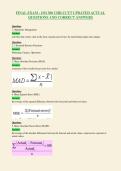
FINAL EXAM - OM 300 CHILCUTT UPDATED ACTUAL
QUESTIONS AND CORRECT ANSWERS
Question:
1. Operations Management
Answer:
activities that creates value in the form of goods and services by transforming inputs into outputs.
Question:
2. 3 Essential Business Functions
Answer:
Marketing, Finance, Operations
Question:
3. Mean Absolute Deviation (MAD)
Answer:
a measure of the overall forecast error for a model
Question:
4. Mean Squared Error (MSE)
Answer:
the average of the squared differences between the forecasted and observed values
Question:
5. Mean Absolute Percent Error (MAPE)
Answer:
the average of the absolute differences between the forecast and actual values, expressed as a percent of
actual values
,Question:
6. Supply Chain
Answer:
a global network of organizations and activities that supply a firm with goods and services.
Question:
7. 10 Strategic OM Decisions
Answer:
1. Design of goods and services
2. Managing quality
3. Process strategy
4. Location strategies
5. Layout strategies
6. Human resources
7. Supply-chain management
8. Inventory management
9. Scheduling
10. Maintenance
Question:
8. Productivity
Answer:
ratio of outputs (goods and services) divided by the inputs (resources, such as labor and capital)
Question:
9. Low productivity in the Service Sector
Answer:
1. Typically labor intensive
2. Frequently focused on unique individual attributes or desires
3. Often an intellectual task performed by professionals
4. Often difficult to mechanize and automate
5. Often difficult to evaluate for quality
Question:
10. Improving productivity in the service sector
Answer:
management focus, innovative practices
Question:
11. Mission
, Answer:
purpose—what it will contribute to society; rovide boundaries and focus for organizations and the concept
around which the firm can rally
Question:
12. Strategy
Answer:
achieving its mission and for helping the organization reach the overall mission
Question:
13. Competitive advantage
Answer:
a set of unique features of a company and its products that are perceived by the target market as significant
and superior to those of the competition
Question:
14. Differentiation
Answer:
making a product different from other similar products by adding value
Question:
15. low-cost strategy
Answer:
focuses on minimizing costs to offer products or services at the lowest possible price while maintaining
acceptable quality. This approach is particularly effective in highly competitive markets where price is a
significant factor for customers.
Question:
16. response
Answer:
a set of values to rapid, flexible, and reliable performance
Question:
17. Cost Leadership
Answer:
achieving maximum value, as perceived by the customer
Question:
18. Product Life Cycle
Answer:
stages a product goes through from its inception to its decline. It is divided into four phases: Introduction,
Growth, Maturity, and Decline.
Question:
19. Introduction
QUESTIONS AND CORRECT ANSWERS
Question:
1. Operations Management
Answer:
activities that creates value in the form of goods and services by transforming inputs into outputs.
Question:
2. 3 Essential Business Functions
Answer:
Marketing, Finance, Operations
Question:
3. Mean Absolute Deviation (MAD)
Answer:
a measure of the overall forecast error for a model
Question:
4. Mean Squared Error (MSE)
Answer:
the average of the squared differences between the forecasted and observed values
Question:
5. Mean Absolute Percent Error (MAPE)
Answer:
the average of the absolute differences between the forecast and actual values, expressed as a percent of
actual values
,Question:
6. Supply Chain
Answer:
a global network of organizations and activities that supply a firm with goods and services.
Question:
7. 10 Strategic OM Decisions
Answer:
1. Design of goods and services
2. Managing quality
3. Process strategy
4. Location strategies
5. Layout strategies
6. Human resources
7. Supply-chain management
8. Inventory management
9. Scheduling
10. Maintenance
Question:
8. Productivity
Answer:
ratio of outputs (goods and services) divided by the inputs (resources, such as labor and capital)
Question:
9. Low productivity in the Service Sector
Answer:
1. Typically labor intensive
2. Frequently focused on unique individual attributes or desires
3. Often an intellectual task performed by professionals
4. Often difficult to mechanize and automate
5. Often difficult to evaluate for quality
Question:
10. Improving productivity in the service sector
Answer:
management focus, innovative practices
Question:
11. Mission
, Answer:
purpose—what it will contribute to society; rovide boundaries and focus for organizations and the concept
around which the firm can rally
Question:
12. Strategy
Answer:
achieving its mission and for helping the organization reach the overall mission
Question:
13. Competitive advantage
Answer:
a set of unique features of a company and its products that are perceived by the target market as significant
and superior to those of the competition
Question:
14. Differentiation
Answer:
making a product different from other similar products by adding value
Question:
15. low-cost strategy
Answer:
focuses on minimizing costs to offer products or services at the lowest possible price while maintaining
acceptable quality. This approach is particularly effective in highly competitive markets where price is a
significant factor for customers.
Question:
16. response
Answer:
a set of values to rapid, flexible, and reliable performance
Question:
17. Cost Leadership
Answer:
achieving maximum value, as perceived by the customer
Question:
18. Product Life Cycle
Answer:
stages a product goes through from its inception to its decline. It is divided into four phases: Introduction,
Growth, Maturity, and Decline.
Question:
19. Introduction


